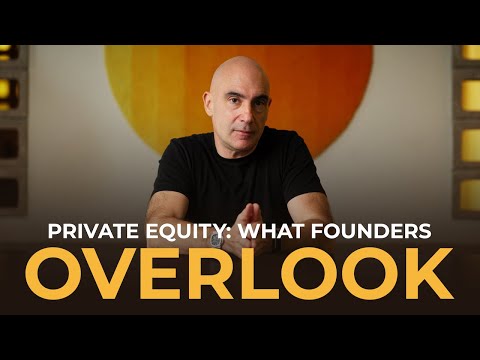
Board Governance & Exit Strategy: What Founders Overlook |…
Part 2 of a Private Equity masterclass series featuring Paul Giannamore, focused on post-close board governance and exit strategy in PE-backed deals. Topics include board composition and decision rights, veto rights and the risks of "industry expert" board seats, preparing for quarterly board meetings, clarifying exit timelines and who controls the exit, the difference between financial exits and cultural fit, and comparing PE claims with what CEOs actually experience. Aimed at founders selling a majority stake while remaining as CEO. (Topics inferred from title, description, and timestamp outline.)
# Channel Presentation Observations
## Video Identity
- **Title:** "Board Governance & Exit Strategy: What Founders Overlook | Private Equity Pt. 2 Masterclass Moment"
- **Presenter (self-identified):** "Again, I'm Paul Jammore. Thank you for joining me today" — named at the close of the transcript.
- **Positioning:** Presented as an excerpt ("Masterclass Moment") from a longer educational series on private equity, "Pt. 2" of a multi-part sequence.
## Intended Audience
- **Business owners / founders considering a private equity sale or partnership.** Direct address: "If you own a business and you're being contacted by strategic acquirers, search funds, private equity firms, and you're trying to size up what you might do, take a step back and give us a call."
- Specifically framed around **mid-size and lower middle-market businesses**: "90 plus% of midsize businesses do not have formal boards"; "if you're a lower middle market business doing 20 million in revenue, the chances of them taking you public are slim to none."
- The recurring hypothetical "Gary" (a founder/CEO negotiating with PE firms) signals the teaching format is directed at **founders in active deal discussions**.
## Claimed Scope & Expertise
- **Extensive deal experience claimed:** The downloadable questions guide is described as "a culmination of 20 plus years and billions of dollars in transaction with private equity."
- **Advisory scope claimed:** The channel/creator offers M&A advisory — "We'll help you forge a plan. Whether that exit is a year from now, five years from now, or 10 years from now, We'll help you think through a plan that is specifically tailored to your financial goals and objectives."
- **Firm identity (self-stated):** "Here at PTOAC, we love to kill it for our clients. And I think that education is the cornerstone which allows our clients to make the best decisions for themselves."
- **Educational mission claimed:** Content aims to teach "the nuances of how strategic acquirers work, how the operations private equity firms work and the psychology and the tactics of an M&A transaction."
## Demonstrated Content Patterns (Observable)
- **Educational Q&A/checklist format:** The bulk of the video is a list of due-diligence questions founders should ask PE firms — board composition, veto rights, board meeting cadence and preparation, exit intentions, hold periods, drag-along/tag-along rights.
- **Anonymized case-teaching style:** Uses a hypothetical founder ("Gary") throughout, plus first-person observations ("I've seen it. A lot of these guys provide zero value whatsoever").
- **Validation-by-reference advice:** Repeatedly recommends cross-checking PE firms' claims with their former portfolio CEOs ("go back to the band of CEOs... How did that go?").
- **Calls to action:** Contact form link in description, direct LinkedIn contact, downloadable "questions you should ask private equity," and share request for the masterclass series.
- **Forward-looking series content:** Announces "the valuation master class," "the buy side M&A master class," and "a lot more... private equity" content coming.
## Claims vs. Demonstrations
- **Creator claims:** 20+ years of experience, billions in PE transactions, education as cornerstone, client-tailored planning (all stated directly in transcript).
- **Demonstrated:** Detailed PE-process fluency (board governance mechanics, fund lifecycle effects on hold periods, 2020–2021 exit-timing compression due to capital market conditions), consistent with the claimed advisory expertise — though the experience figures themselves are unverified self-description.
# Delivery Observation: Board Governance & Exit Strategy Masterclass
## Tone & Register
- **Conversational advisory tone** throughout — sounds like spoken coaching rather than a scripted lecture. Markers include fillers and asides: *"you know," "Um," "I mean," "quite frankly."*
- **Blunt, colloquial emphasis** used for punch: *"Now, private equity firms nowadays will pretty much pull anyone that has a pulse sometimes as an operating partner"* and *"well damn it now I have to report to a board that sucks."*
- Shifts into a **direct promotional pitch** in the final stretch: *"take a step back and give us a call. We'll help you forge a plan."*
## Vocabulary & Framing
- Heavy use of **M&A jargon**, usually paired with plain-language glosses: *"drag-along rights, tagalong rights," "port and current portfolio companies," "frothy," "bake off meetings."*
- Recurring **hypothetical scenario-building around a named persona ("Gary")** — an illustrative stand-in used repeatedly: *"Hey, Gary, we think we're probably going to hold this 5 years"* and *"hey Gary there's a great opportunity for us to exit this now."*
## Recurring Phrases & Patterns
- **"At the end of the day"** appears three times: *"at the end of the day, it is the private equity firm"* (x2 variations) — a stable verbal habit.
- **Question-drilling structure**: converts each topic into rapid-fire sub-questions the viewer should ask — *"Who sits on the board? How many board members are there? Does he have the ability to veto anyone..."* This question-cascade pattern repeats for board prep, exit timing, and the sale process.
- **"Compare and contrast / cross-reference"** advice repeated as a method: *"Then compare and contrast what you learned from the private equity firms as well as their past port and current portfolio companies"* and later *"Again, take what they have to say now and then cross reference it."*
- **"What I always say" / "I think it's important"** — first-person authority framing: *"what I always say is first again ask the private equity firms."*
## Teaching Habits
- **Anecdotal evidence from experience**: *"I've seen it," "I have seen certain circumstances where PE funds will come to the founder."*
- **Historical example** used to illustrate market timing: the 2020–2021 capital markets and compressed PE hold periods.
- **Role-played dialogue** to make scenarios vivid: *"A strategic acquirer might not require that, but potentially a private equity firm would."*
- **Direct-to-camera calls to action** at the close: contact form, LinkedIn, downloadable question list, upcoming master class series, sign-off *"I'm Paul Jammore. Thank you for joining me today."*
## Stability vs. Isolated Moments
- **Stable patterns**: question cascades, "Gary" hypotheticals, "at the end of the day," cross-referencing advice, first-person "I've seen" anecdotes — each occurs multiple times across both topics.
- **Isolated**: the colloquial *"a total who's worked in your industry"* and the single branded slogan *"Here at PTOAC, we love to kill it for our clients"* appear once each and shouldn't be treated as recurring habits.
- **Uncertainty note**: the transcript contains apparent transcription errors ("preclosing" → "postc closing," "archeneemy," "port and current"), so exact wording of some quotes is uncertain; quoted examples above follow the transcript as supplied.
# Observation Document: Board Governance & Exit Strategy — Private Equity Pt. 2
**Speaker:** Paul Jammore (self-identified at end of transcript)
**Video:** "Board Governance & Exit Strategy: What Founders Overlook | Private Equity Pt. 2 Masterclass Moment"
---
## 1. Board Governance Post-Closing
### Core Claim
A hypothetical founder ("Gary") would be **well served to focus on post-closing corporate governance**, including:
- Who sits on the board and how many members there are
- Whether the founder can **veto board appointments**
- Board meeting frequency, decision scope, and preparation responsibilities
### Criticism of PE Operating Partners
Jammore's stated reasoning:
- PE firms "pretty much pull anyone that has a pulse sometimes as an operating partner or put them on the board"
- He claims: **"A lot of these guys provide zero value whatsoever"** — and that some of what they say "could potentially be detrimental to the investment" (note: qualified as *potentially*, not stated as certain)
- Illustrative concern: an industry acquaintance with a poor track record ending up on your board
### Board Meeting Preparation
- As CEO, the founder **will be presenting** at board meetings
- Key questions: who prepares the board book — internal staff or the PE firm?
- Jammore states that **board meetings "will not require a lot of preparation"** in most cases, *however* founders without resources "could end up spending a lot of time" preparing, which "can be quite stressful"
### Contextual Claim
- **"90 plus% of midsize businesses do not have formal boards"** and are unaccustomed to this red tape *(stated without cited source)*
### Counterweight / Qualification
Jammore explicitly warns against viewing the board negatively:
> "The board's there for a reason actually and the board can and does provide a lot of value. It just has to be set up right."
### Recommended Diligence Method
1. Ask the PE firm partners directly about board governance
2. Consult the **"band of CEOs"** — past and current portfolio company executives — about meeting preparation, questions asked, and stress levels
3. **Compare and contrast** what the PE firm says against what portfolio CEOs report
---
## 2. Exit Strategy
### The Partnership Framing
- Unlike a strategic sale where you "take 100% of the cash and walk away," a PE deal leaves **10–50% of the business locked up** with the PE firm
- Therefore an eventual exit is inevitable and must be discussed upfront
### Questions to Ask PE Firms
- **How** do they intend to exit? (IPO unlikely for a ~$20M-revenue lower middle-market business; possible for larger firms)
- **When**? Jammore notes timing depends on the fund lifecycle, cash already committed, and economic conditions — but says to seek a ballpark hold period (e.g., 3–5 years)
- **Alignment risk**: a CEO with 5-year goals may conflict with a PE firm wanting a quick exit
### Sale to Another PE Firm
- If the PE firm exits by selling to another PE firm, the founder may be required to "go along for the ride" (roll over again)
- A strategic acquirer "might not require that, but potentially a private equity firm would"
### Who Decides the Exit?
Jammore's position, stated directly:
> "At the end of the day, it is the private equity firm... they're going to be the majority owner of that business that are ultimately going to be able to pull the trigger."
- Founders would likely have **drag-along and tag-along rights**; investment bankers and legal advisers can explain mechanics
- Even a stated 5-year hold is not binding
### Historical Example (2020–2022)
- Central bank money printing sent financial markets "vertical overnight"
- Result: PE hold periods compressed from the **historical 4–6 years**; in 2021–22 firms were "dumping" businesses because prices were "frothy"
- Conclusion: **economic conditions can override stated hold timelines**
### Founder Influence on Exit Decisions
- Some PE funds consult the founder ("Gary, do you have two more years in you?"); others may list the business without warning ("we hired a new investment bank and the business is on the market")
- Diligence question: which type are you dealing with?
### Questions for Portfolio CEOs
- How far in advance did exit discussions start — 6 months, a year, or only once on the market?
- What participation did the CEO have in the sale process (bake-off meetings vs. kept in the background)?
- Was it purely highest-bidder, or did founder input (e.g., accepting a lower price for better cultural fit) matter?
- Jammore's noted concern: some founders "are not going to want their baby... sold to their archenemy"
---
## 3. Promotional Segment (Speaker's Own Claims)
- Firm: **"PTOAC"** ("we love to kill it for our clients")
- Claims education is the cornerstone of good client decisions
- Offerings promoted: contact link, LinkedIn, downloadable **"questions to ask private equity"** — described as "a culmination of 20 plus years and billions of dollars in transaction" *(self-reported, unverified)*
- Upcoming content: valuation master class, buy-side M&A master class, more PE content
---
## Summary of Unresolved Tensions
- **Board value vs. board burden**: Jammore holds both that boards provide real value *and* that preparation can be stressful and operating partners often add nothing — he resolves this via "it has to be set up right," not by eliminating either claim
- **Stated hold period vs. reality**: PE firms may state a 5-year hold, but Jammore asserts they retain ultimate exit authority and market conditions (2021–22 example) can compress timelines
- **Founder agency**: uncertain and variable — depends entirely on the specific PE firm's culture, hence his emphasis on cross-referencing portfolio CEOs rather than trusting PE statements alone
# Video Attribution Observation
## Video
**Title:** Board Governance & Exit Strategy: What Founders Overlook | Private Equity Pt. 2 Masterclass Moment
**Video ID:** `01a168c7-9e94-7b11-bd7e-3298040edec8`
## Speakers & Roles
- **Paul Jammore** — **Creator / Instructor / Host**
- Self-identified at end of transcript: *"Again, I'm Paul Jammore. Thank you for joining me today."*
- Sole speaker throughout the transcript; delivers instructional/masterclass content, promotional messaging, and closing CTA.
- Affiliated organization named in transcript: **"PTOAC"** (as spoken: *"Here at PTOAC, we love to kill it for our clients."*)
- **"Gary"** — **Hypothetical example founder/CEO**
- Not a speaker; referenced repeatedly as a hypothetical case study of a founder evaluating private equity partnership. All statements about Gary are illustrative, not from Gary himself.
- No guests, narrators, or other identified speakers appear in the transcript.
## Referenced Third Parties & Claims
- **Private equity firms / operating partners** — speaker claims some provide "zero value" and their input "could potentially be detrimental"; attributed to speaker's personal observation (*"I've seen it"*).
- **PE portfolio-company CEOs ("band of CEOs")** — recommended as reference sources; not speaking in this video.
- **Investment banking team / legal advisers** — cited as resources explaining drag-along/tag-along rights; not speaking.
- **Capital markets 2020–2021** — speaker's characterization of central bank liquidity and shortened PE hold periods (historically "four to six years") as context for exit timing; attributed to speaker's account, no cited sources.
## Promotional Segments (Flagged)
The closing portion of the transcript is explicitly promotional:
- Firm promotion: *"Here at PTOAC, we love to kill it for our clients... give us a call."*
- **Contact form link** in video description; **direct contact via LinkedIn** offered.
- **Downloadable resource:** "questions you should ask private equity" (link described in description).
- Upcoming offerings promoted: **valuation master class**, **buy-side M&A master class**, and future private equity content.
## Provenance & Availability Notes
- **Curated metadata:** none supplied beyond title/transcript; no pre-established speaker roster or cited sources beyond those above.
- **Comments availability:** not stated in source material.
- Uncertainty: organization name "PTOAC" is rendered phonetically from the transcript; spelling unverified.
Gary would have been very well served to focus on what corporate governance looks like postc closing. Who sits on the board? How many board
members are there? Does he have the ability to veto anyone from joining the board? Meaning, let's say that you've got the industry dumps that you've known for 20 plus years and he's worked for five of your competitors. You can't keep a job. Now, private equity firms nowadays will pretty much pull anyone that has a pulse sometimes as an operating partner or put them on the board. And I've seen it. A lot of these guys provide zero value whatsoever. In fact, I think some of the stuff that they say could potentially be detrimental to the investment. Do you want a total who's worked in your industry on your board and will you be able to do anything about it? It's an important question to ask because I see
this happening. So board governance, how often the board will meet, what the board decides on. What do you need to do at the board meeting? Well, you're the CEO, so you're going to be presenting.
What do you need to do in order to prepare for that board meeting? What team will help you with that? Is that somebody internally at your company that's going to be preparing a board book or is that somebody you'll have at the private equity firm that's going to help you prepare that? So understanding that is important because for the most part board meetings will not require a lot of preparation from you. However, if you don't have the resources and you're not used to doing this, you could end up spending a lot of time getting prepared for every quarterly board meeting, which quite frankly can be quite stressful. So, understanding that cadence, how the board's set up, what the board will do, when the board will meet, how you'll get prepared for the board meeting, I think is going to be very important because 90 plus% of midsize businesses do not have formal boards and are not used to dealing with this sort of red tape. Now I do think that the board can provide a
lot of benefits and so you shouldn't look at it and say well damn it now I have to report to a board that sucks. Now I mean the board's there for a reason actually and the board can and does provide a lot of value. Um it just
has to be set up right and you have to understand the role of the board and how you get prepared for the board. So these are important questions and what I always say is first again ask the private equity firms you're talking you know Gary's talking to three or four of them now. Ask the partners what they have to say about it and then go back to the band of CEOs. Guys, what was it like going to a board meeting? How did you prepare? What sort of questions did they ask you? Was it stressful? Get that all figured out. Then compare and contrast what you learned from the private equity firms as well as their past port and current portfolio companies. I think they're great folks to talk to.
You know, an important aspect of partnering with private equity, of course, is the exit, right? The front-end consummation of the deal, it's not like selling to a strategic acquire where you take 100% of the cash and you
walk away. No, you're now a partner. And so, you've got another 10, 20, 30, 50% of the business still locked up with these guys. So, at some point, there needs to be an exit. So when you sit down with the private equity firms, the primary questions you want to get out of the way right away are, but how would you intend to exit this business? Now, if you're a lower middle market business doing 20 million in revenue, the chances of them taking you public are slim to none. So that's probably not an option. But if you've got a much bigger firm, that might be an opportunity. Either way, how do they intend to exit? When right now on the onset, do they think they would attempt to exit it? Well, of course, it depends on the fund life cycle and how much cash they've already committed amongst other things like economic conditions, but at least try to get a ballpark idea. Hey, Gary, we think we're probably going to hold this 5 years or 3 years. Try to
understand that to make sure that there's alignment because you as a CEO might have certain goals to accomplish that might take you 5 years to do and if they want to do a quick exit, that might
complicate things for you. So, you have to think about timeline to exit. What are they going to how will they intend to exit, right? Will it be a sale to a strategic potentially another private equity firm? And I bring this up because if they think they might sell to another private equity firm, what's the chances of you having to go along for the ride? They hold you for two years. bigger private equity firm comes in and says, "Hey, um, we want to buy this, but you know what? We need Gary to come along with us." A strategic acquirer might not require that, but potentially a private equity firm would. So, it's important to understand, okay, what happens if that's the case, and I don't want to do that.
The other thing when I think about exits, which comes up as a question to me all the time, is who actually decides? Like, who decides when's the exits going to be? Is it Gary? Is it the
private equity firm? Well, no. At the end of the day, it is the private equity firm. Unfortunately, I mean, they're going to be the majority owner of that business that are ultimately going to be able to pull the trigger. You would likely have dragalong rights, tagalong rights, and of course, your investment banking team and your legal adviser will be able to explain to you how all of that sort of stuff works. But at the end of the day, it's a private equity firm that's going to drive this exit decision. So even though they told you they might hold it for 5 years. I mean if I think back to 2020, we all remember what happened to the capital markets in 2020 and 2021 when central banks around the world were printing all sorts of cash. The financial markets all went vertical overnight. And so we saw a massive compression in how long private equity firms were holding businesses. Historically it was four to six years. So all of a sudden 2021 and 22 came around and these guys were dumping these things because prices were just getting so frothy. And so there are economic conditions that can influence it. But at the end of the day it will be the private equity firm that makes that sort of decision. But I think it's important for you to ask that because you know I
have seen certain circumstances where PE funds will come to the founder and say hey Gary there's a great opportunity for us to exit this now. Um, do you have two more
years in you? Because if you do, we can make this acquisition. We can build value here and then maybe we'll exit in the future. Or if you're not really into that, maybe we'll just take the opportunity right now to exit. So, how much influence will you have on that decision? Are these the types of guys that are going to come and ask you about that or are they the kind of guys that you're going to wake up one day and they're going to say, "Hey, we hired a new investment bank and the business is on the market." Again, take what they have to say now and then cross reference
it. You've got a handful of CEOs who've been through this, who have now exited with this very private equity firm. How did that go? How far in advance did they start talking to you about the ultimate
exit? Was it 6 months? Was it a year? or did you find out when the business was already on the market? What sort of participation did you have in the sale process? Were you going to bake off meetings with acquirers? Did they keep you in the background? Did you have any choice? So, was this purely a financial decision? The company was sold to the highest bidder or maybe you intervened a little bit and somebody was willing to pay a little bit less, but you thought it was a much better cultural fit for the business. Did the PE guys listen to you? Now, you might not care about that, but there are some people out there who are not going to want their baby that they founded and partnered with a private equity firm and then all of a sudden now the private equity firm is turning around selling it
to their archeneemy. Here at PTOAC, we love to kill it for our clients. And I think that education is the cornerstone which allows our clients to make the best decisions for themselves. the more you can understand about the nuances of how strategic acquirers work, how the operations private equity firms work and the psychology and the tactics of an M&A transaction, the better you're going to be when it comes time to pull the trigger. If you own a business and you're being contacted by strategic acquire, search funds, private equity firms, and you're trying to size up what you might do, take a step back and give us a call. We'll help you forge a plan. Whether that exit is a year from now, five years from now, or 10 years from now, we'll help you think through a plan that is specifically tailored to your financial goals and objectives. So, please contact us directly. I've put a link to the contact form in the description of this video, and you can also contact me directly on LinkedIn. Again, you can click on the link below to download the questions you should ask private equity. This is a culmination of 20 plus years and billions of dollars in transaction with private equity. And these are the questions that I recommend clients ask private equity firms before they do a transaction. It's probably something you're not going to want to miss. Further, if you got value from this video, you're not going to want to miss what we have coming up here in the coming weeks. We'll be doing the valuation master class. We'll be kicking off the buy side M&A master class. And we've got a lot more to say private equity. and feel free to share this master class series with somebody who you think might benefit from it. Again, I'm Paul Jammore. Thank you for joining me today and I'll see you on the next one.