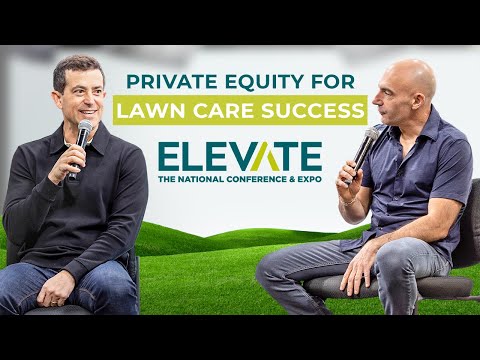
Private Equity Opportunities for Lawn Care Business Owners…
Paul Giannamore speaks with Nick Bartolo about private equity for lawn care and pest control business owners. Topics include how private equity evaluates businesses, why recurring revenue attracts consolidators in service industries, platform versus add-on acquisitions, leverage in deals, value creation, oversight effects on operational efficiency, and how rolling equity benefits sellers. Recorded in connection with NALP 2024.
# Channel Identity Observations — Pomac TV Video
## Channel Name (Self-Identified)
- **"Pomac TV"** — stated by the host: *"hi I'm Paul jamore I wanted to welcome our new subscribers to the channel... thanks for joining us here at pomac TV."*
- Host introduces himself as **Paul Jamore**; his on-stage counterpart is called **Nick**.
## Explicit Self-Description (Creator Claims)
- **Historical focus**: *"historically pomac TV has been focused on business and operational information and interviews for residential and Commercial Services business owners."*
- **Recent expansion into M&A content**: after publishing the *"sside m&a master class last month,"* the host reports his *"LinkedIn inbox has been inundated with a variety of different requests"* — evidence of a claimed audience-driven pivot.
- **Planned scope**: more extensive **sell-side and buy-side M&A master classes** covering *"choice of process," "m&a psychology," "buy-side practice approach and due diligence."*
## Intended Audience (Observable)
- **Lawn care and landscape business owners**, addressed directly: *"it's important for the The Lawn and landscape business owners to understand that if you are a platform versus... an add-on acquisition."*
- **Owners considering sale or PE partnership** — topics (valuation multiples, equity rolls, "second bite of the apple," tax mitigation) target exit-minded founders.
- **Industry newcomers unfamiliar with financial jargon**: the stated goal is to *"demystify some of these terms and topics that folks have heard about but maybe are afraid to ask."*
## Claimed Scope / Content Areas Demonstrated
- **Private equity education for the green industry**: what a PE firm is, fund structure, limited/general partners, 10-year closed-end funds, 3–7 year hold horizons.
- **Lawn care industry fundamentals as investment thesis**: recurring revenue, economic insensitivity, outsourcing trends, market fragmentation.
- **Deal mechanics**: platforms vs. add-ons, debt/leverage financing (60/40 example on a $100M deal), interest-rate effects on valuation.
- **Value creation and seller participation**: consolidation synergies, route density, corporate governance, technology investment, portfolio peer networks, equity rolls and tax mitigation.
- **Event-based content**: filmed live at an industry event — *"Nick live at NP"* — with references to stage interviews with PE-backed companies (Sen Services/Sensy, SavATree) and figures like **Daniel van Stenberg**.
## Viewer Engagement Signals (Explicit)
- **Subscription CTA**: *"you can click below and subscribe to the channel."*
- **Email list**: *"we've provided a link here in the description where you can get on our email distribution list."*
- **Viewer-driven programming claim**: *"this channel is largely driven by you the viewer... what you want to see from us"* — a creator claim about how content is shaped.
- **Serialized format**: the video is framed as an intro with *"a further discussion"* planned, indicating an episodic master-class structure.
## Demonstrated Presentation Style (Observable)
- **Two-host conversational format** with one host in an expert advisory role and the other asking explanatory questions (*"would you mind... could you just walk folks through what a platform is"*).
- **Educational, jargon-defining tone** — each technical term (platform, add-on, rolling equity, buyout) is explicitly defined in plain language.
- **Numeric illustration** used pedagogically (e.g., the $100M / $60M equity / $40M debt example).
# Delivery Observation: Private Equity Opportunities for Lawn Care Business Owners
## Format & Structure
- **Cold-open teaser:** The video opens with a substantive excerpt mid-discussion — *"if you're a homeowner if you're an owner of a commercial property you need to actually transact and receive these services from a lawn care company"* — before the host introduces himself and the channel. This hooks the viewer with content before framing.
- **Channel intro block:** Paul delivers a welcome segment with calls-to-action: *"for those of you who have not subscribed you can click below and subscribe to the channel"* and *"this channel is largely driven by you the viewer."*
- **Two-person conversational format:** The bulk of the video is a dialogue between Paul (host/interviewer) and Nick (expert), with Paul handing off topics: *"could you just walk folks through what a platform is in lawn care and in and add-on"* and *"you want to elaborate a bit on that Paul."*
- **Episode framing:** Both speakers explicitly position this as the first in a series — *"we'll go through those in another in another episode"* and *"let's kick off the next the next episode."*
## Tone
- **Educational and demystifying:** Nick states the intent directly: *"really what we want to do is demystify some of these terms and topics that folks have heard about but maybe are afraid to ask."* He also notes *"sometimes they're afraid to ask unfortunately."*
- **Conversational and affirming:** Frequent brief acknowledgments: *"yeah I mean," "that's a good that's a good point," "that's right," "correct correct."*
- **Plain-language explanations:** Technical concepts are broken down from first principles — *"if you think about what private Equity is okay so private Equity is essentially starts with an investment advisor."*
## Teaching Habits
- **Hypothetical worked examples:** Both speakers repeatedly use a **$100 million acquisition** as a concrete illustration:
> "let's say you have a Lawn and landscape business that is being acquired for $100 million okay the private Equity Fund or firm will take around $60 million from their private Equity Fund... and then they'll go out and they'll borrow the other4 million"
- **Definitional scaffolding:** Key terms are defined on introduction: platform vs. add-on, buyout vs. growth equity, rolling equity — *"what rolling Equity is or an equity role is is that if I go out and I acquire Paul's law in landscape business..."*
- **Relatable analogies:** Nick uses a personal anecdote: *"back in our day right when we were kids our dads were recruiting us hey you have to mow the lawn I'll give you 50 cents."*
- **"Second person" scenarios:** Paul uses *"you and I"* framing to make abstract points concrete: *"if you and I owned a lawn care business we would not be able to borrow in the same way a private Equity Firm can."*
- **Citing real-world context:** Named references appear throughout (KKR, Blackstone, Apex, TrueGreen/TruGreen, Scotts Lawn Service, Brickman, Monarch, Yellowstone, SavATree, Daniel van Stenberg), grounding explanations in actual industry deals.
## Recurring Phrases & Verbal Patterns
- **"Let's say" / "let me give a little example"** — used to introduce hypotheticals (appears multiple times, e.g., [927], [1319], [1351]).
- **"If you think about..."** — a recurring framing device: *"if you think about what private Equity is"*, *"if you think about the fundamentals of the lawn care industry"*, *"if you think back up until November of 2015."*
- **"At the end of the day"** — Paul uses it to summarize: *"at the end of day the private Equity model is one of consolidation."*
- **"That's a feature of that business model"** — Nick's phrasing when highlighting industry attributes.
- **Idioms and industry jargon dropped in with light translation:** *"the proverbial second bite of the apple right these guys like to talk about"*; *"meaning there are a lot of other people like you in the club."*
- **Hedged quantifiers:** Both speakers qualify numbers rather than overstate: *"most people or not most people but a lot of people or less people over time."*
## Uncertainty Notes
- Transcript quality limits confidence in some exact wording (e.g., "the other4 million" appears to be "the other $40 million"; several names are phonetically transcribed). Quotes above reflect the transcript as supplied.
- Tone and pacing observations are inferred from text only; vocal delivery, energy, and visual cues are not observable here.
# Observation Document: Private Equity Opportunities for Lawn Care Business Owners (#NALP2024)
## Speakers
- **Paul Jamore** — co-host, Pomac TV (identified in transcript)
- **Nick** — co-host, live at NALP (identified in transcript)
## Opening Context (Paul Jamore)
- Pomac TV historically focused on business/operational info for residential and commercial services business owners.
- After publication of the **sell-side M&A master class**, his LinkedIn inbox was "inundated" with requests; he and Dylan will film more M&A master classes on sell-side and buy-side topics (choice of process, M&A psychology, buy-side practice approach, due diligence).
- Notes two PE-backed lawn care businesses presented on stage: **Sen Services** (backed by GTCR) and **SavATree** (he says "saet tree"/"save a tree" in transcript).
- Paul mentions knowing Daniel van Stenberg for 15 years — who built a business "in a backyard," grew it to roughly **$40–50 million in revenue**, and "recapped it with a private equity firm."
- Stated goal of the series: "demystify some of these terms and topics that folks have heard about but maybe are afraid to ask." (Nick)
## What Is a Private Equity Firm? (Nick, with Paul's additions)
- PE starts with an **investment advisor**: a group of individuals (often ex-investment bankers or from other PE firms) who raise money from large endowments, state pension plans, wealth management firms, high-net-worth individuals, and family offices.
- PE is "just another investment option" relative to public equity, bonds, commodities, or real estate — specifically, equity in private businesses.
- PE funds pursue a **thesis-driven** process analyzing which vertical/industry to invest in. Paul notes GTCR (backer of Senske/Sen Services) is thesis-driven — top-down industry selection vs. opportunistic buying.
### Fund Structure and Horizon (Paul)
- Most funds are **limited duration**, typically ~10-year closed-end funds.
- The PE firm is the **general partner** contributing capital; limited partners are endowments/institutional investors.
- Typical investment horizon: **3–7 years** — shorter when markets are "frothy," longer when things slow down.
## Why Lawn Care Appeals to Private Equity (Nick)
- **Recurring revenue**: grass and bushes keep growing; accounts need month-after-month service.
- **Low economic sensitivity**: maintenance, fertilizer, weed control can't easily be deferred (unlike landscaping construction projects).
- **Secular outsourcing trend**: fewer homeowners mow or treat their own lawns than in the past.
- Result: an industry that's not economically sensitive but "grows on a secular basis" — PE wants large industries growing well in advance of GDP.
### Paul's Additions — Fragmentation and History
- Fragmentation matters: "literally thousands of these sorts of businesses that can be acquired."
- PE theory: buy a platform in a fragmented market, make **accretive acquisitions** (pay lower prices for small businesses, use leverage, integrate for revenue enhancements, cost savings, added capabilities).
- Interest came first in traditional landscaping (Brickman, Monarch, Yellowstone), then lawn care.
- **History**: Until November 2015, US lawn care was "effectively a duopoly" — TrueGreen and Scotts Lawn Service. TrueGreen acquired SLS from Scotts Miracle-Gro (SMG) in Nov 2015, becoming the largest US lawn care business. Financial sponsors began investing in **regional** lawn care businesses around **2019–2020**.
## Platforms vs. Add-Ons (Nick)
- A **platform** is the initial acquisition, typically large enough to have a management team operating at scale. Definitions depend on fund size:
- Example: SavATree's first PE owner was a middle-market firm focused on $50–250M revenue businesses; the business is now nearly $500M in revenue and was bought by **Apex** (a much larger firm).
- A $10M revenue company is a platform for a **lower middle-market fund**, but for KKR, Blackstone, or Apex "that's not even anything that they would look at — at best that's a small tuck-in."
- **Add-on acquisitions** might be $500K–$5M revenue. Nick: a $6M acquisition is a tuck-in for today's SavATree, but was a very different story in 2010 when the firm did $38M in revenue.
### Valuation Implications (Paul and Nick)
- Paul: platform status likely yields a **significantly higher valuation multiple** — platforms are rare in a fragmented industry, and multiple PE firms competing can drive price up (e.g., 10–15 potential acquirers). Add-ons have fewer buyers.
- Nick agrees (scarcity value, larger buyer pool lifts prices) but adds a qualification:
> "Sometimes a small bolt-on acquisition can yield the same sort of transaction multiple as a platform business... but if I had to choose I would prefer to be a platform acquisition."
- Nick: add-on sellers are "kind of at the mercy of which companies already are in that market" — often bought to increase **route density**.
- Nick: platform status also matters for **role** — rolling equity as a partner means "getting in on the ground floor when the value of the stock is low."
## How Deals Are Financed — Leverage (Nick)
- PE firms don't only use investor capital; they use substantial **debt**.
- **Illustrative example**: $100M acquisition — ~$60M from the fund, ~$40M borrowed (~40% loan-to-value).
- Interest rate environment affects acquisition decisions:
- 2020–2021: ~6.5% on PE debt/direct lending (Fed at 0%) — "very different" from today's ~10–11% or more.
- Leverage lets PE earn a higher return on its equity (return is earned on the $60M, not the full $100M).
## Value Creation (Paul and Nick)
- **Paul — consolidation/cost removal**: the PE model in fragmented industries is consolidation; eliminates costs, centralizes back office. Labor is 30%+ of the P&L in lawn care, much of it direct labor.
- **Paul — financial engineering**: individual owners can't borrow like PE firms; their "money would be more expensive" (more equity required).
- **Nick — seller financing**: for operators buying platform-size (~$10M+) businesses, leverage was extremely difficult; typical structure was 10–20% down with seller financing over time.
- **Nick — operating enhancements**: scale in one area drives **route density** efficiencies; marketing dollars spread over a denser customer base raise margins.
- **Nick — governance and technology**: real CFOs, quarterly board meetings, oversight, dramatically increased technology investment.
- **Nick — portfolio network effect**: portfolio company CEOs can exchange ideas (strategy, operations, software, marketing) with peers across the PE firm's portfolio (5 to 500 investments); access to specialists (e.g., SEO/online marketing for home services) can lower customer acquisition costs.
## Rolling Equity (Nick introduces; Paul elaborates)
- Definition: in a $100M acquisition, the seller decides with the buyer how much cash to take up front vs. how much ownership to **roll into** the PE-backed company.
- Paul's framing: the "proverbial second bite of the apple."
- **Control vs. growth equity**:
- Control/buyout: 70–100% of the business — "the extreme majority of transactions in the green industry."
- Growth/minority equity: less than 50%.
- **Illustrative deal**: $100M enterprise value — $80M cash at closing, $20M rolled into the company's stock. Benefits stated:
- Take money off the table, de-risk, potentially keep working in the business.
- "We can play a little riskier... take more chances."
- Hope: when PE exits in 3–5 years, the rolled $20M is worth at least as much as the upfront $80M. Nick: "you may get anywhere from 2, 3, 4 or 5 times your money on that equity roll depending on a litany of factors."
- **Tax mitigation** (Nick): having rolled capital and a multi-year horizon enables tax mitigation strategies that "reduce that tax bill or potentially eliminate it in some cases."
## Closing
- Both speakers frame this as an introductory/background episode, with detail deferred to future episodes (factors affecting equity roll returns, deeper buy-side/sell-side content).
# Speaker Attribution Record
**Video:** Private Equity Opportunities for Lawn Care Business Owners | #NALP2024 #MergersAndAcquisitions
**Video ID:** 01a168c8-276c-74dc-9ba4-207fe0a9ab51
## Identified Speakers
- **Paul Jamore (self-identified as "Paul jamore")** — **Creator / host**. Welcomes subscribers, references "my LinkedIn inbox," indicates he runs the channel (referred to as "pomac TV" in transcript), and participates as interviewer/discussion partner. He also indicates M&A advisory expertise (references "running a sell-side process" and "the Seaside M&A master class," with his surname likely "Giammarese" — transcript spells "jamore"/"pomac" garbled).
- **Nick (surname not stated)** — **Guest / co-discussion participant**. Introduced by Paul ("all right Nick live at NALP"). Speaks with detailed private equity industry knowledge; acts as primary explainer of PE concepts.
## Referenced Third Parties (mentioned, not speaking)
- **Daniel van Stenberg** — lawn care business founder; reportedly built business to ~$40–50M revenue and recapitalized with a PE firm; known by Nick for 15 years.
- **Sensy Services** (transcript: "Sen Services" / "sensy") — PE-backed lawn care business discussed on stage; backer cited as **GTCR**.
- **SavATree** (transcript: "savry" / "saet tree") — PE-backed business; owner cited as **Apex** (current) after purchase from a prior middle-market PE firm.
- **TrueGreen, Scotts Lawn Service / SLS, Scotts Miracle-Gro (SMG), Brickman, Monarch, Yellowstone, KKR, Blackstone** — referenced as market examples; no statements attributed.
## Promotional Segments (flagged)
- **Channel promotion** by Paul: subscribe call-to-action, email distribution list link in description, request for viewer comments, and announcement of upcoming M&A master class series (sell-side and buy-side).
## Provenance Notes
- Speaker attribution complicated by garbled transcript spellings ("pomac TV," "Paul jamore," business names); corrections above are best-effort inferences from context and remain approximate.
- No curated metadata was supplied; comment availability is referenced only via the host's invitation to "put a comment below."
- Third-party industry figures (revenue sizes, deal history, interest rates) are claims made by the speakers, not independently sourced.
if you're a homeowner if you're an owner of a commercial property you need to actually transact and receive these services from a lawn care company and so
they're recurring in nature in that the grass always grows the bushes grows and so month after month you need to come back and actually service that account which is a feature of that business model that's very attractive to private Equity hi I'm Paul jamore I wanted to welcome our new subscribers to the channel you know historically pomac TV
has been focused on business and operational information and interviews for residential and Commercial Services business owners but after the publication of the sside m&a master class last month my LinkedIn inbox has been inundated with a variety of different requests so Dylan and I will be sitting down filming more extensive m&a master classes both focusing on the sell side as well as the buy side I intend to talk about the choice of process delving deep into m&a psychology uh as well as extensive buide practice approach and due diligence for those of you who have not subscribed you can click below and subscribe to the channel furthermore we've provided a link here in the description where you can get on our email distribution list and if you do that you'll receive an email right in your inbox with our latest Publications feel free to put a comment below on the types of things you want to see I mean this channel is largely driven by you the viewer viewer and what you want to see from us again thanks for joining us here at pomac TV all right Nick live at NP we're going to talk some private Equity today let's do it yeah happy to be here you know we just had two private equity-backed Lawn
Care businesses here on the stage we talked to Sen Services as well as savry and I've known Daniel van Stenberg for 15 years now he built that business literally in a background in a backyard
grew it to around 40 or 50 million in revenue and then ultimately recapped it with a private Equity Firm um so activity from private Equity is prolific across Lawn and Landscape so that's what I want to talk about today and I want to start with what is a private Equity Firm I think it's a good question because it's a term that a lot of folks in the lawn industry actually talk about but I'm not sure all the time that everybody really knows what it is and sometimes they're afraid to ask unfortunately so if you think about what private Equity is okay so private Equity is essentially starts with an investment advisor so a private Equity investment advisor and essentially all that is is a group of individuals who have come together sometimes either from Investment Banking sometimes from another private equity firm and they've gone out and they've raised money okay and typically where they raise money from would be large endowments big state pension plans it could be from wealth management firms High net worth individuals family offices those types of folks who then give their money to a investment advisor to invest in private businesses or an ownership interest in private businesses so if you think about private Equity it's just another investment option for a large institution or a collection individuals that they can invest in relative to let's say public equity which everybody knows would be anything on the stock market it could be versus bonds either government bonds or corporate bonds it could be versus Commodities or real estate so private Equity is really just another investment option and it happens to be in in the ownership interest or the equity in a private business Okay so so that's essentially what a private Equity Fund is and so you have this investment adviser that's raised money and now they need to think about what they're going to do with that money okay so they will go through a thorough investment process to analyze um what actual vertical or what industry they're going to invest in and and they take it from there any thoughts that you have about that Paul yeah I I think it's important to keep in mind that you know most private Equity Funds that are managed maned by uh the financial sponsor the private Equity adviser um tend to be limited duration funds right they tend to be you know an average would be a 10-year Clos in fund where the investment adviser or the private Equity Fund is the general partner and contributes Capital to the fund uh and then they go out and exactly like you said they bring on limited partners who are the endowments and the institutional investors and so on and so forth but they're doing this for a limited term and the the structure of the fund at the very front end of it you've got the capital raising then the deployment going out making Acquisitions growing those organically as well as through add-on Acquisitions and ultimately disposing them um so I think it's important for folks to keep in mind that the investment Horizon for a private Equity Firm into a privately held business tends to be anywhere between 3 and seven years right and that's right obviously when asset prices are higher and the Market's very frothy that tends to be a first shorter period right they can sell and make a greater return when things slow down they tend to hold for longer but that's a u that's typical of what we see from a private Equity perspective and to your point on the thesis driven um process you know earlier on the stage today we talked uh like I said to some private Equity backed p uh Lawn Care businesses gtcr are one of the backers of sensy tends to be thesis driven which is first determining what sort of Industries they want to be in and focusing on kind of a top down approach versus being OPP opportunistic and just determining hey what companies for sale what can I buy irrespec of the industry they're actually looking at that um and I want to talk to you a little bit Nick about the um the fundamentals of Lawn and landscape and why it actually makes sense for a private Equity investment
so if you think about the fundamentals of the lawn care industry and this is something that the private Equity firms do a lot of due diligence on before deciding to enter an industry like Lawn
Care the first thing I would say is that in general a lot of the lawn care related businesses have recurring Revenue so these are services that if you're a homeowner if you're an owner of a commercial property you need to actually transact and receive these services from a lawn care company and so they're recurring in nature in that the grass always grows the bushes grows and so month after month you need to come back and actually service that account which is a feature of that business model that's very attractive to private Equity the other feature that I think that's quite appealing to private Equity is the um is the uh lack of economic sensitivity when it comes to lawn care so clearly in landscaping and big construction projects those can be deferred but when it comes to maintenance and you know think about fertilizer wheat control those are aspects of lawn care that are really not economically sensitive as opposed to let's say a larger construction project another feature of the industry that's appealing to private Equity is the fact that less people are actually mowing their own logs right or doing other fertilizer work within their own lawn whereas back in our day right when we were kids our dads were recruiting us hey you have to mow the lawn I'll give you 50 cents you know something of that nature right where now people homeowners continue to Outsource those types of activities and so most people or not most people but a lot of people or less people over time are actually mowing their own lawn and treating their own lawn so what that creates it creates an industry that's not that economically sensitive but yet grows on a secular basis because some of these qualitative trends and frankly that's something that private Equity firms look at they want a large growing industry that's growing well in advance of the overall economy or GDP would you add anything to to lawn and or private equity and Lawn yeah I would and I would say that I think you're right about the appealing nature of lawn from a recurring perspective for private Equity but we've seen you know we've seen extensive private Equity interest over the years in Traditional landscape if you take like Brickman Monarch you know all of Yellowstone you've got a lot of big Traditional landscape and Landscape Maintenance now granted the landscape maintenance of course is a key attribute to that um but I would say that fragmentation in the market is important and so given that these are very very fragmented when I say fragmented I mean there's literally thousands of these sorts of businesses that can be acquired and so you know the theory is you're a private Equity Firm you've got a roughly 10- year Horizon for a fund you want to make an acquisition you want to buy a business that's in a fragmented market so that you can go out and do a creative Acquisitions and what I mean by that is you can on the small end the the smaller businesses you can pay lower prices and build a much bigger business you can use leverage to make those sorts of Acquisitions and by integrating them you hope to get not only Revenue enhancements but cost savings addon additional capabilities and now you've got yourself a real investment so we saw that signif we saw the financial sponsors involvement First In traditional Landscaping subsequently I mean if you think back up until up until November of 2015 Lawn Care was effectively a do a duopoly in the US you had True Green and Scots Lawn Service you got a lot of regional players but you didn't have private Equity firms particularly involved in November of 15 trur green acquired SLS from SMG Scots Miracle Row company making it of course the further making it the largest lawn care business in the US but it wasn't until around 2019 2020 where a lot of the financial sponsors started to invest in Regional Lawn Care businesses and and before you continue on that path would you mind because I've gotten a lot of questions even here about what's a platform what's an add-on right so in thinking about this Evolution from only a few acquirers to now a financial sponsor driven Market
could you just walk folks through what a platform is in lawn care and in and add-on yeah I mean you know when a private Equity Firm is getting into a market it's got to buy a platform right and it needs to buy typically would want
to buy a business that's large enough to have a a management team to operate at scale so depending upon the industry inde depending on the private Equity Firm like for example you have like a KKR or a Blackstone a very large asset manager Apex which owns um which owns saet tree we talked to saet tree earlier today Apex is the private Equity Firm they bought save a tree from the prior private Equity Firm that own did the first private Equity Firm um was a middle Market firm so they were focused on businesses doing you know 50 to 250 million in Revenue that business now is almost a $500 million in business or $500 million Revenue business needs a much larger private Equity Firm a much larger fund to buy that so depending upon the fund size a a $10 million Revenue company for a lower Middle Market private Equity Firm that's a platform to a Blackstone or KKR or Apex that's not even anything that they would look at at best that's a small tuck in so it depends upon the the size structure of the funds but really when I think about platform businesses in lawn and land uh landscape you you're you're typically looking at firms that are 10 1520 million or above you're typically thinking about smaller funds where that's okay that's a decent sized way to get into the market and then we'll see add-on Acquisitions might be 5 K in Revenue might be a million might be 5 million you know save a tree now a $6 million acquisition is a tuken whereas a $6 million acquisition back in 2010 when the firm was doing 38 million in revenue is a very different story that's a good that's a good point and I think it's important for the The Lawn and landscape business owners to understand that if you are a platform versus if you're smaller and you're an add-on acquisition the valuation multiple that you're likely to receive when you sell is most likely going to be significantly higher if you're a platform and so the point being is that platform companies given the fragmentation in the industry and the number of small Lawn and Landscape businesses platform businesses are much more rare and when you have multiple private Equity firms vying for those assets it creates a lot of competition I mean something that you obviously know a lot about in thinking about negotiations running a sside process when you're able to actually have a potential platform acquisition that might have 10 15 potential acquirers it gives you an opportunity to really drive the price up through that competition whereas an add-on acquisition you might not have as many companies buying for that property is that fair yeah I mean like when you have a when something could potentially be a platform acquisition from multiple different buyers whether strategic as well as private Equity um you're right the scarcity value and the increased buyer pool increases competition which lifts prices um if you're the size of being a tuck in acquisition or an add-on you're kind of at the mercy of which companies already are in that market right right yeah because you're really an opportunity for them to increase route density in your area correct correct now I wouldn't say you know look sometimes an add-on or a tuck in and I use those interchangeably sometimes a small bolt-on acquisition can yield the same sort of transaction multiple as a platform business but it if I had to choose I would prefer to be a platform acquisition not just from a not just from a valuation perspective but also a role perspective and I know we'll talk a little bit about that later in the discussion but if you're a if you're a platform acquisition and you're going to partner with a private Equity Firm and basically roll equity and literally become their partner you're actually getting in on the ground floor when the value of the stock is low we'll talk about that the other item that I think it's important for folks to understand and to bring up as it relates to just this background on private Equity is how
these deals are financed okay so we walked through the example on a private Equity investment adviser raising money and then going out and doing Acquisitions however when they actually
do the acquisition they don't just use the money that they received from their large investors they actually use debt as well and at times the debt levels can be quite substantial let me give a little example on that let's say you have a Lawn and landscape business that is being acquired for $100 million okay the private Equity Fund or firm will take around $60 million from their private Equity Fund so the money that big endowments or Pension funds have given them and then they'll go out and they'll borrow the other4 million so it's a $100 million deal they take 60 million from their fund and they borrow 40 million so there's essentially a 40% loan to value ratio on that acquisition that they're making and you can imagine that the interest rate invironment clearly impacts that acquisition decision you know if interest rates on private Equity debt or direct lending was 65% like it was back in you know 2020 2021 when interest rates were were very distorted when the Federal Reserve was at 0% that's a very different financing environment than today when it's about 10 11% or maybe a little bit more to finance these deals so that can have an impact on valuation but it also I think aluminates the private Equity firm's desire to have a business that isn't that economically sensitive and has recurring Revenue so lastly it also gives them the opportunity to earn a higher return on their equity and what I mean by that is since they're only taking $60 million from their fund and borrowing 40 they're trying to earn a return on the 60 okay and so if you use more leverage you then can earn a higher return on that actual Equity component of the private Equity deal so that's a bit about how leverage or debt comes into play in private Equity I think the
other area that we should touch on is value creation and just to really you know we can get into detail in in later episodes but thinking about value creation specifically in Lawn and
Landscape you want to elaborate a bit on that Paul at the end of the day the private Equity model is one of consolidation at least right now with regard to fragmented Industries like lawn and land landscape so you're going out you're consolidating that allows you to eliminate a variety of different costs right and you're able to spread if we think about you know these sorts of businesses there are a lot of variable cost if I focus on lawn care for examp example the majority of the cost on the p&l 30 plus% of that is labor and a lot of it direct labor right and so when you consolidate you're able to not only remove some back office costs you're able to centralize things so you're able to create some incremental um incremental increase in margins but from a value creation perspective what you know this starts even at very Basics with what you just said let's talk about the ability to go out and if you and I owned a lawn care business we would not be able to borrow in the same way a private Equity Firm can right and so we can't afford to compete on Acquisitions we can't afford to leverage and so our money would be more expensive and what I mean by that is you and I would have to use a lot more equity and so from a value creation perspective just from Pure Financial engineering we see a lot of value creation on the private Equity side what's your thoughts on that I think that's right I mean I think if you and I were doing it or if an operator has a business that would be considered of platform size let's say 10 million or above for a Lawn and landscape business I think their ability to take financial leverage in order to go out and make Acquisitions was extremely difficult and typically what we would see is seller financing in that situation so 10% down 15 20% down and then the actual seller you're paying back the seller over you know some period of time and so on the financial engineering standpoint I think that's very difficult on the um you know operating enhancement side I do think there are some advantages particularly if you're operating in one area to use that greater amount of scale to gain efficiencies so that could be achieved through route density it could be achieved through using your marketing scale or essentially using the same amount of marketing dollars in a particular market and now since that market is more dense you're a ble to spread those dollars out over a greater customer base which leads to higher margins those are two of the two of the factors that that I'm thinking about um and there's a Litany of other you know factors to create efficiencies yeah I mean like when I look at these businesses that were privately held were acquired by private equity and then have
been able to grow under private Equity I see a lot of things I see corporate governance now we've got we've got a real CFO in there we've got real L board meetings we've got quarterly board meetings we have a lot of oversight you
see a dramatically increased use of Technology investment technology and you know one of the benefits that you always think about from a value creation perspective is if you're if you are a portfolio company of a private Equity Firm you are typically in a portfolio which means that you have a lot of peers other CEOs that are running other businesses within their portfolio so if you look at any private Equity Firm depending upon the size you know they might have five Investments they might have 500 meaning there are a lot of other people like you in the club and so the exchange of ideas not only from a strategy perspective management financing operations software uh marketing you may have name you know a search engine optimization expert online marketing expert who specializes in customer acquisition for Home Services in general that can also create a lot of efficiencies on lowering customer acquisition costs for your Lawn and landscape business another area just in this background intro that I think would be interesting for folks is equity rooll or rolling Equity so a lot of folks again have
heard that term about rolling Equity I guess the PRI our private Equity friends like to call it partnering right but essentially what rolling Equity is or an
equity role is is that if I go out and I acquire Paul's law in landscape business I'm going to give you let's say I'm acquiring it for $100 million okay and and you're going to make the decision or we're going to collaborate on the decision about how much cash you're going to get up front and how much Equity or ownership stake that you currently have that you're going to roll into the private Equity backed uh PES or sorry private Equity back Lawn Company so could you kind of take it from there Paul and elaborate on that what happens next yeah I mean effectively you know it's the proverbial second bite of the apple right these guys like to talk about course so you're we take the $100 million business you know what would be typical you know when you look at private Equity Investments you typically have a controlling a control buyout right we call it a buyout yeah and that's usually you know 70 80 90 or 100% of a business and then of course you have a growth Equity investment or a minority investment and that's typically less than 50% of the business now those sorts of things happen for a variety of different reasons the extreme majority of the trans actions in the green industry are control or buyouts and that's when if I use your example the $100 million player you got $1 million Enterprise Value the private Equity Firm comes in and buys it from us they might write us a check for $80 million at the closing and we're taking $20 million and we're rolling it into the stock of the company and whether that's uh whe whether we're an add-on acquisition or a platform acquisition we're effectively investing in the portfolio company of the private Equity Firm and the great hope is that we take the money off the table we drisk our lives we potentially continue to work for the business but now you know we can buy the things we want to buy we're not worried about all of our capital and all of our net wealth tied up into that business we can play a little riskier right we can take more chances and then we work alongside the private Equity Firm to grow that and so when the PE shop wants to exit three four five years in the future we're hoping that the 20% or the 20 million that you and I rolled is worth at least as much as we got on The Upfront which is 80 million which is what we hope for yeah you may get anywhere from 2 three four or five times your money on that Equity role depending on a Litany of factors and we'll go through those in another in another episode but I would also add that that Equity role also allows for effective tax mitigation strategies because many strategies that we're rolling out from an investment perspective require that an owner actually has capital okay and in that situation where your business is acquired you get a big check but you know at some point maybe it's two years down the road maybe it's seven seven years down the road if you have the capital and the ability to plan with that amount of time in the future there is a lot of tax mitigation strategies that we can Implement in order to reduce that tax bill or potentially eliminate it in some cases so that's another feature of the equity role that is quite a during that let's call it the second by to the Apple that's right well look Nick I I think that was a healthy intro here to private equity in the law and Landscape space and I think uh you and I can maybe get into some details on a further discussion yeah and really what we want to do is demystify some of these terms and topics that folks have heard about but maybe are afraid to ask so let's kick off the next the next episode sounds good thanks Nick you