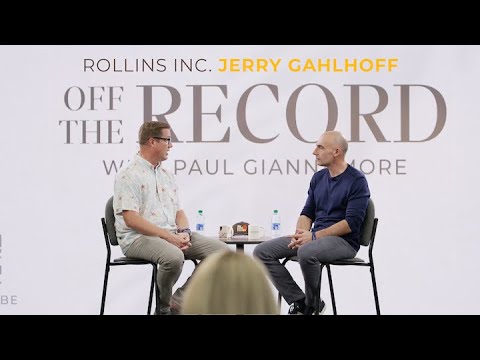
Rollins CEO, Jerry Gahlhoff, Live from PestWorld 2023
Live interview from PestWorld 2023 in Honolulu (filmed October 17, 2023) with Rollins CEO Jerry Gahlhoff, part of Paul Giannamore's "Off the Record" series covering the pest control industry and related business topics such as M&A and business valuation suggested by the video's hashtags.
# Video Identity Observations — "Rollins CEO, Jerry Gahlhoff, Live from PestWorld 2023"
## Video Format & Presentation
- **Interview format**: A one-on-one conversational interview between an off-camera host ("Paul," inferred from "you're trying to get me there Paul") and Rollins CEO Jerry Gahlhoff, conducted live at the PestWorld 2023 trade show. Evidence: title; setting references like "coming out to pest world."
- **Channel name audible in transcript**: The host opens with "welcome to fomic TV" (likely "Pest Control TV" or similar, transcription uncertain). Evidence: transcript opening line.
- **Casual, insider tone**: The interviewer and guest reference shared industry knowledge — "everyone knows who you are," "I recall" (re: the failed VC rollup), and the host asks technically informed questions about M&A criteria, branch sizing, and franchises. Evidence: multiple host questions throughout.
## Intended Audience
- **Pest control industry professionals and executives**: Questions presuppose industry familiarity — blackout periods, tuck-in vs. standalone brand acquisitions, "smart traps," franchise buybacks, brand performance. Evidence: "I know we're in the blackout period for Rollins," "how big is independent Brands Now versus orcan."
- **Business/investor-interested viewers**: Repeated probing for undisclosed financial detail ("we don't disclose that Paul") suggests an audience interested in company financials. Evidence: brand-size and disclosure exchanges.
## Claimed / Demonstrated Scope of Content
- **Executive interviews at industry events**: The channel demonstrably secures C-suite guests at trade shows. Evidence: sitting Rollins CEO interviewed live at PestWorld.
- **Industry strategy and M&A discussion**: Topics include acquisition criteria, international expansion, franchising, and brand strategy. Evidence: extended Q&A on UK, Australia, Egypt/UAE franchises.
- **Personal-career profiles**: The host explicitly frames part of the interview as personal background: "what I want to do is focus more on you." Evidence: Gahlhoff's biography segment (childhood in Orkin branches, entomology degrees, career path).
## Self-Description Evidence
- **No explicit channel self-description** appears in the transcript beyond the host's greeting ("fomic TV"). No mission statement, tagline, or audience address was observed.
## Creator Claims vs. Demonstrated Patterns
- **Claims by the guest (not the channel)**: Gahlhoff's statements about Rollins (e.g., "we're now the third largest pest control company in Australia," "Orkin brand that's been around for 125 years") are guest claims about his company, not channel claims.
- **Demonstrated channel pattern**: An established relationship with industry leadership sufficient to obtain a long, candid interview with a public-company CEO during an earnings blackout period — evidenced by Gahlhoff's acknowledgment: "I appreciate you taking it easy on me since I'm in that blackout period."
# Delivery Observation: Jerry Gahlhoff, Rollins CEO — PestWorld 2023 Interview
## Overall Format
This is a **two-person conversational interview**, not a lecture or presentation. The host asks short questions; the guest gives extended, story-driven answers. Delivery is casual and unscripted, with a live-event backdrop.
---
## Tone and Register
- **Warm, upbeat, and informal.** Opens with self-deprecating humor: when asked about being a dropout, he replies, *"I'm a quitter."* When the host teases about his calendar rules — *"written by your wife?"* — he plays along: *"no no they were written by me."*
- **Enthusiastic about the industry and people.** Recurring positive framing: *"it's been a heck of a lot of fun,"* *"there's not much to be disappointed about it's all good,"* *"my passion is being in the field I get my energy from being around our people."*
- **Humorous asides** even on serious topics. On technician comfort: *"I thought of giant sombreros that they could wear to keep them in the shade."* On his communication style: *"maybe I'm a bit of a dinosaur in that regard."*
---
## Recurring Phrases and Verbal Habits
- **"Family of Brands"** — used repeatedly when describing the portfolio: *"moving forward as one company that operates in this family of Brands mentality."*
- **"Learn and share" / "best practices"** — appears multiple times: *"learn and share best practices in our business,"* *"a culture of best practice sharing."*
- **"Culture" as anchor word** — invoked across acquisition criteria, branch management, and his CEO agenda: *"in order culture is always number one,"* *"culture is something you feel and that you experience."*
- **"Face time / face to face"** — a repeated theme: *"I'm still one of those face-to-face kind of people,"* *"I want my team there I want I want FaceTime."*
- **"Disciplined"** — applied to growth strategy, international expansion, and calendar management: *"we're just going to continue to remain focused and disciplined,"* *"I've gotten more disciplined over time about my calendar."*
- **Filler and restart patterns** — frequent *"um," "uh," "you know,"* and duplicated words (*"they they," "that that," "it's it's"*), suggesting unscripted, thinking-aloud delivery. Stutter-repeats cluster notably: *"that's that's the that's a key first step,"* *"a a a a big one for me personally."*
---
## Teaching / Explanatory Habits
- **Concrete numbers and named examples.** Explains branch economics with specifics: *"a $7 million branch that may grow a small low single digit percentages but as soon as we split that branch and make two 3.5 million branches those things begin to grow at Double Digit rates."* Lists brands with founding years: *"Western Pest Services 1927 Wahlam 1893."*
- **Anecdote-driven reasoning.** Answers policy questions with personal history — childhood at Orkin branches, the snake-and-rat aquarium, the job offer he took home to his wife.
- **Self-aware hedging on soft topics.** On measuring culture: *"I just know it when I feel it... I don't particularly think that's some Whimsical way that you can actually measure it."* (Note: this is a directly stated claim of intuitive judgment, not an inferred trait.)
- **Structured answers on business topics** — e.g., acquisition criteria delivered as an ordered list: *"in order culture is always number one,"* then people, then metrics.
---
## Boundaries and Deflection
- **Politely firm refusals on financials**, citing the blackout period and disclosure policy: *"you're trying to get me there we don't disclose that Paul,"* *"we don't disclose the numbers."*
- Frames limits with lightness rather than resistance: *"I appreciate you taking it easy on me since I'm in that blackout period."*
---
## Stable Patterns vs. Isolated Moments
**Stable (repeated across the interview):**
- People/culture-first framing of nearly every topic
- Concrete anecdotes and named companies/people
- "Disciplined growth" language
- Humor woven into answers
**Isolated / thin evidence:**
- The **"giant sombreros"** joke and **"dinosaur"** self-description are one-off moments; not enough repetition to call them a comedic pattern.
- The **"one-page sheet of rules"** for his calendar is mentioned once; no detail on content.
- Interviewer's closing reference to his **birthday** has no elaboration from the guest.
---
## Uncertainty Notes
- Timestamps are approximate per transcript markers; no visual delivery cues (gesture, pacing, laughter) are available from the transcript alone, so observations are limited to spoken content.
- The host's name appears as "Paul" once and the channel as "fomic TV" in the opener — transcription fidelity for proper nouns is uncertain (*"Orin/orcan/orcin"* appear as variants of "Orkin" throughout).
# Position Extractor Record: Jerry Gahlhoff, Rollins CEO — PestWorld 2023 Interview
## Interview Context
- **Speaker:** Jerry Gahlhoff, CEO and President of Rollins (interviewed ~10 months into tenure)
- **Setting:** Live interview at PestWorld 2023; interviewer addresses him as host of "Pestworld TV"-style segment (referred to as "fomic TV" in transcript)
- **Constraint noted:** Gahlhoff states Rollins is in an earnings **blackout period**, so financial topics were avoided
---
## Career Background (as stated by Gahlhoff)
- Grew up in pest control; his **father worked for Orkin**, and the family relocated frequently in the 1970s–80s. Orkin branch communities "became my family and that was my social network."
- Started college as a business major, switched to **entomology** intending to enter pest control.
- Worked as a **technician and in sales** during college.
- First post-school job (~late 1990s): **Wilson Pest Control** in Winston-Salem, NC, a family-owned firm later acquired by a venture capital firm attempting an industry rollup — Gahlhoff: "that didn't go terribly well... lasted about 2½ years... ended badly."
- Subsequently sold to **CNX Corporation**; he moved through roles, citing mentors, and had a ~7-year run with **HomeTeam** until Rollins acquired the brand in **2008**.
- Moved to Atlanta in **2016** to run the specialty brands group, later President/COO, then CEO.
- Self-described **PhD dropout**: finished a master's at University of Florida (termite research), began PhD, then left for the Wilson job. Attributes the decision to his wife (a schoolteacher and "the bread winner") telling him to "grow up and get a job."
## Rollins C-Suite and Governance
- **Gary Rollins**: remains **Executive Chairman**, "very active," ~58 years in the business; Gahlhoff and John Wilson meet with him often.
- **John Wilson**: **Vice Chairman**, described by Gahlhoff as a key mentor, confidant, and "one of my first phone calls."
- Other named leaders: a recently onboarded **CFO**, **Pat Schanowski** (President of Orkin's five divisions), **Steve Levit** (non-Orkin US brands and international), **Be Chandler** (General Counsel), **Thomas Tesh** (Chief of Staff, also runs IT).
## Vision and Strategy
### Continuity plus accelerated growth
- Gahlhoff: not looking to change Rollins' tradition and culture; intends to "honor that," while pursuing **faster organic growth** than historical rates.
- Advocates a **"family of brands"** mentality: eliminating silos, sharing best practices across brands.
### Multi-brand structure
- **Declined to disclose** relative brand sizes: "You're trying to get me there... we don't disclose that."
- Claims "a lot of people underestimate how big" the non-Orkin US business is.
- **Opposed to consolidating brands into Orkin**: "I don't see that on the horizon." Values cultural differences between brands; cites founding years of Clark (1950), Northwest (1950), OPC (~1972), Western (1927), Waltham (1893), and Orkin's 125 years.
### Branch size philosophy
- Rollins operates both large branches and deliberately split small ones, varying by brand.
- Claimed a finding: branches above **$7–8 million** become "unruly"; splitting a $7M branch into two $3.5M branches causes them to grow at **double-digit rates** — also creating leadership opportunities.
### Technology and innovation
- Framing: **"technology is an enabler."** Prioritizes making technician/sales jobs less physically taxing (bending less, checking stations, keeping workers cooler in heat).
- Explicit limit: "I'm less interested in technology that means we don't get FaceTime with the customer."
- On commercial-side smart traps/labor reduction: worries about **commoditization**; argues the human relationship is needed for difficult conversations (sanitation, timing). Self-describes as "a bit of a dinosaur" preferring face-to-face over texting.
## M&A Criteria
- For **standalone brands**, stated order of priorities:
1. **Culture and brand equity** — internal (teammate passion, core values) and market quality
2. **Quality/bench of people** — has walked away from deals lacking talent depth behind a departing charismatic owner
3. **Growth metrics** — healthy growth typically yields improving cash flow and profit
- Standard: standalone brands should **grow faster organically than the company average** (hypothetical example: 8%).
- On measuring culture: acknowledges engagement surveys but says "I just know it when I feel it" — culture is felt, not measured by any "whimsical" method.
## Northwest Exterminating Case Study
- At acquisition: 20+ branches in Atlanta metro; since expanded across Alabama, Tennessee (incl. Nashville), North Carolina, South Carolina, and throughout Florida (no numbers disclosed).
- Called Rollins' **"second bite at the apple"** platform in the Southeast and "the perfect case study" for the model.
- On national expansion: "I don't know" — disciplined Southeast growth first; possible future Virginia, Louisiana, Mississippi. Notes leader **Stanford Phillips** has expansion plans.
## International Strategy
- **Country-by-country, platform-first discipline**: ~a dozen UK acquisitions but no expansion beyond the UK until unified on one CRM/accounting platform.
- **Australia**: claims Rollins is now the **third-largest pest control company** there, present ~12–13 years.
- Uses an internal **index** (corruption index, business-friendly rules, labor environment) to decide where to operate.
- **Franchising** used where direct operation is uncomfortable — examples: Egypt ("a great franchisee"), UAE.
- Franchise growth: continuing; sees franchising as a path for **employees to become owners**. Orkin retains many franchises in secondary/tertiary markets; Critter Control franchise network expanding (several sold per year; brand acquired ~2012–13, with buybacks when owners are ready to sell).
## Wildlife Work
- Some brands (Northwest) do wildlife work, but "the vast majority of that business is referred" to the wildlife/Critter Control brands.
## Personal Initiatives as CEO
1. **Parent-company modernization**: Rollins was effectively "a parent company of Orkin for 50–60 years"; last 15 years of multi-brand acquisition challenged that model. Frames evolving the culture — overcoming "my way was the best way" pride — as a **"three-to-five-year project"**.
2. **Talent pipeline**: feels "the weight on my shoulders" to leave the company in as good shape as he "was gifted it" and prepare a successor team.
## Work Style
- Manages calendar via a self-written "one-page sheet of rules"; the host joked whether his wife wrote them — Gahlhoff: no, though she "would probably have me gone all the time."
- Rhythms: quarterly field-time budgeting, road shows (e.g., Dallas week with Texas Orkin and HomeTeam groups), quarterly reviews bringing field leadership to Atlanta, balanced against board meetings and earnings calls.
- Prefers in-person work: "I don't do well in remote environments" — wants his team co-located in Atlanta, though division presidents may live in their divisions (e.g., Sean Murray).
- **Atlanta's role**: still important as roots and gathering hub, though brand corporate offices are distributed (HomeTeam–Dallas, Western–New Jersey, Northwest–Atlanta, separate from HQ).
## Interviewer Positions (host, unnamed in transcript)
- Characterized Rollins' business as "in a lot of ways... on autopilot" relative to peer leadership transitions (referencing Terminix's Brett Ponton) — Gahlhoff did not directly contest this.
- Asked pointed questions on brand-size disclosure and national expansion; Gahlhoff declined both.
## Unresolved / Qualified Points
- National potential for Northwest: explicitly uncertain ("I don't know").
- Brand-size breakdown: not disclosed.
- Culture measurement: no method offered beyond intuition — a stated gap versus systematic metrics.
- Critter Control acquisition date given imprecisely ("12 or 13, something like that"), with host suggesting ~2012.
# Speaker & Provenance Observation Record
## Video Identification
- **Title:** Rollins CEO, Jerry Gahlhoff, Live from PestWorld 2023
- **Video ID:** `01a168c8-a611-7333-b8aa-53a12e7d4fbb`
- **Setting:** Live interview conducted at PestWorld 2023 (explicitly stated in title and referenced in transcript closing).
## Speakers & Roles
### Primary Guest
- **Jerry Gahlhoff** — **Guest / Interviewee**
- Identified as **CEO and President of Rollins**, ~10 months into the role at time of interview.
- Career history stated by him: grew up around pest control (father worked for Orkin), studied entomology (master's at University of Florida, began PhD), worked as technician and salesperson in college, first job at Wilson Pest Control (Winston-Salem, NC), later at HomeTeam brand, moved to Atlanta in 2016 to run Rollins' specialty brands group, then President/COO, then CEO.
### Interviewer / Host
- **Unnamed host** — **Creator / Interviewer**
- Self-identifies with the channel "fomic TV" (as heard: "welcome to fomic TV" — transcription of channel name is uncertain; possibly "Pest TV" or similar — flag as **uncertain**).
- Addresses the guest as "Paul"? No — the guest says "we don't disclose that Paul," indicating the **interviewer is likely named Paul** (uncertain, inferred from direct address in transcript).
- Drives the interview, asks all questions.
### Referenced Third Parties (Non-Speaking, Named Roles)
Per Gahlhoff's statements about Rollins' leadership:
- **Gary Rollins** — Executive Chairman, ~58 years in the business, still active.
- **John Wilson** — Vice Chairman; mentor/confidant to Gahlhoff.
- **Pat Schanowski** (transcribed "Pat schanowski") — President of Orkin, runs five divisions.
- **Steve Levit** — Runs non-Orkin US brands and international operations.
- **Be Chandler** (transcribed "be Chandler") — General Counsel.
- **Thomas Tesh** — Chief of Staff; also runs IT.
- A **new CFO** onboarded within the past year (name not given).
- **Stanford Phillips** — Runs Northwest Exterminating.
- **Sean Murray** — Orkin division president, lives in his division.
- **Brett Ponton** (transcribed "Brett poton") — referenced by interviewer as head of Terminix.
- **Gahlhoff's wife** — referenced; was a schoolteacher supporting him during graduate school.
## Disclosed Restrictions on Content
- **Blackout period:** Gahlhoff explicitly states Rollins is in an **earnings blackout period**, limiting discussion of financial topics. Multiple questions are declined or deflected on this basis:
- Brand-by-brand size breakdown ("we don't disclose that Paul").
- Northwest Exterminating financials ("we don't disclose the numbers").
## Referenced Sources & Claims
- **Rollins acquired Orkin in 1964** (per Gahlhoff).
- **Rollins acquired Gahlhoff's brand (HomeTeam) in 2008**.
- **Critter Control brand acquired ~2012–2013** (stated approximately).
- **Northwest Exterminating acquired** — described as "second bite at the Apple platform business" in the Southeast US.
- Rollins' **UK acquisitions**: "close to a dozen"; **Australia**: third-largest pest control company, present ~12–13 years.
- Brand founding years cited: Clark Pest Control (1950), Northwest Exterminating (1950), OPC Services (~1972), Western Pest Services (1927), Waltham (1893), Orkin (~125 years old).
- International expansion framework: an internal **country index** (corruption index, business-friendliness, labor environment); franchises preferred in certain markets (Egypt, UAE cited).
## Promotional Segments
- **None identified.** No explicit promotional or sponsored segments are present in the transcript.
## Comment Availability
- **Not indicated** in the supplied source material.
## Uncertainty Notes
- Interviewer's name and channel name are inferred from an imperfect transcript ("fomic TV"; "Paul") — flagged as uncertain.
- Some proper nouns may be misspelled due to transcript quality (e.g., "Schanowski," "Be Chandler").
Jerry welcome to fomic TV hello hul so 10 months into your new gig as CEO how's it been thus far it's been a
heck of a lot of fun um we have a lot of really positive energy um I've got a great team and we're doing a lot of good stuff so there's uh not much to be disappointed about it's all good you know I uh I know we're in the blackout period for Rollins which is the period around earnings where we can't talk about any interesting questions that I have so I think today what I want to do is focus more on you everyone knows who you are but they don't know a lot of details so how did you get into this space yeah so I guess first I appreciate you taking it easy on on me since I'm in that blackout period so uh keep certainly keep it light um what a lot of people don't know about me is that I grew up around pest control so when I was a child my dad worked for orcin and uh I moved around a lot as a child um and what really attracted me to this industry overall was the people side of it um as I relocated as a kid usually in the 1970s and early 1980s quite a bit um the orcan people in the branches that I moved from place to place to became my family and that was my social network as a as a 10-year-old 11year old we'd have Wednesday night softball games and Saturday or Friday night rodeos in Louisiana and those kinds of things and so as I um got into college uh I started out as kind of a business major and then eventually switched over into entomology and with the idea that I would end up in Pest Control I didn't think that I would do that at first but eventually I did um
and I worked as a technician uh as well as uh in sales when I was uh going through college uh when I left school um in the late '90s I got my first job with
what was a family-owned company in Winston Salem North Carolina called Wilson pest control that had been around since the 1940s that eventually became a uh got owned by a venture capital firm uh that attempted to do a rollup of the pest control industry uh and that didn't go terribly well I recall yeah that that lasted about two 2 and a half years uh ended badly and we ended up getting sold I got sold to what at the time was cnx Corporation okay and then uh I continued to move around and uh got a lot of opportunities along the way and I had great bosses and great mentors along the way um at a pretty young age I was exposed to to some some really um really powerful leadership type folks in the business uh had a lot of those mentors guide me and support me along the way and um my we had a pretty strong run when I was at the home team brand um for about uh 7 years until we were acquired by Rollins were you based in Dallas at the time at that time I was uh I had I had gone from North Carolina to Dallas then Dallas to Tampa then back to Dallas again in 2011 um so I I've continued that pattern of moving around um but uh uh it's it's
been quite a journey really and Rollins acquired Us in 2008 I acquired the the brand I was with in 2008 uh and then I moved to Atlanta in 2016 running our
specialty Brands group um and uh then in uh a few years later became the president and COO of Rollins and then now as you mention mentioned at the outset for the last uh almost 10 months been the CEO and president of Rollins now I understand you're a Dropout I'm a quitter you're a quitter yeah so uh I had finished my uh master's program at the University of Florida uh research on termites and um had had a project lined out and began working on my PhD program I thought that's what I was going to do and then I got recruited for that job at Wilson pest control and um some these folks made me offer and I took that home that offer that piece of paper home to my wife and I said look at the these crazy people are going to do this for me cuz they want me to work for them and she said oh you're going to do that uh time for you to quit school and get a job uh wasn't wasn't part of my plans cuz I really enjoyed school was she supporting you at the time she was she was a school teacher okay uh she was the bread winner and I was the one living it up on the weekends and having a really good time and this kind of stuff and she said well it's time for you to grow up and get a job I think is was the message I really had so you were getting your PhD in entomology that was my plan yeah so you're really into that the science yeah I did I was I was really I am I am really into the the science I the more I got into it the even when I was a kid uh I remember going into my dad's orcan branches and he would have an aquarium in there on Saturdays when I went to work with him you know we'd put a a mouse or a rat in
there along with a snake and every Saturday I'm checking to see which one lived or whatever Critters that we had in the office so I was always messing around with that um I I liked growing
things I liked having a garden as a kid I would have roly poliy under bricks as a kid so yeah I mean not a lot of people say they were uh born into pest control and bred to do that kind of stuff but I certainly had that interest probably when I was 6 seven years old so when Rollins acquired home team back in 2008 what was your first position you stayed at home team for some years I guess right right so uh in 2008 I was running what was called the East Division of home team which was everything on the East Coast operations and I did that for three more years under um under Rollins and then um there were some or or changes that occurred and I moved back to Dallas and became the president of home team MH so the organization now at Rollins now that you're CEO what is it we've got Gary Rollins there we've got John Wilson there I see him running around somewhere on vacation uh what What's the sea suite at Rollins look like today yeah so uh Gary Rollins remains as our uh executive chairman and he uh still is very active um he's been in this business for about 58 years and he loves it he's very passionate about it he asks questions uh and uh meet with him often both John and I do uh John Wilson uh has stayed on and he is our our vice chairman um he's a very important Mentor for me he's a a very a confidant and an adviser he's someone I call and time of need or don't really know exactly what to do he he's one of my first phone calls in life um so he's he's still integral part of it I have uh a CFO that's been around for about a year I had recently on boarded a
new CFO um and then um I have my chief of staff and we're organized in the field operations is I've got a president pres of Orin uh Pat schanowski who runs all
the five divisions of Orin each division has a division president and then Steve levit who runs all of our other brands that aren't orchid in the US and all of our International operations which is uh a very rapidly growing as you know we've added to our portfolio of Brands over the years uh and we take a lot of pride in that as well but then at the same time we've got the history of the orcin brand that's been around for 125 years and the knowledge and expert that comes with that uh so that's it's very exciting and I also have a my general counsel be Chandler um she um she's on my team and Thomas Tesh is my uh Chief of Staff so um and he also runs uh Our IT department so I've got a fantastic team that um really has set up really well for the future so it's not going to be easy to follow in John Wilson's footsteps no what's your without getting too forward looking like broadly what's your vision now where you're going to take Rollins into the future how are you going to make your mark on the company yeah so um you know you you think about the history of Rollins Rollins acquired Oran in 1964 uh and has really been at it you know for you know a long time and there's a so there's a lot of Deep Roots um there's a lot of institutional knowledge about how to how to be in Pest Control how to serve customers so uh and there's a awful lot of tradition and culture that comes as part of Rollins and that's really not something I'm looking to change and in fact I I intend to continue to honor that um and be true to that at the same time I think we have some opportunity to continue to grow our business faster than maybe we have historically grown can we uh accelerate our organic growth rates but at the same time I think we have a great story to tell when it comes to Our Brands and our brand strategy and uh we we love uh the culture the the people and what in what all of our individual Brands bring to the table is something new and unique that uh when we leverage that and we learn and share from one another learn and share best practices in our business um there's there's a lot
to be gained from that when we create the environment in which those discussions can be had and we eliminate silos and we're and we're really moving forward as as one company that operates
in this family of Brands mentality how big is independent independent Brands Now versus orcan for example yeah you're trying to get me there we don't disclose that Paul um we you know we don't um really disclose a lot of the details we treat we we talk about our residential business our Commercial Business as well as uh our termite and ancillary service business and those and those kind of line service lines but we really don't disclose how big Our Brands are but but our a lot of people underestimate how big that the uh the everything that's kind of non workan in the US a lot of people underestimate how big that really is yeah I mean look it's you got it's a pretty big business and of course that's what you ran one of the things you ran prior to becoming CEO will Rollins continue to run in the long term a variety of different brands you don't see it at some point all being organ no I I don't see that um on on the horizon you know we we strongly value culture we strongly value the differences yeah we all do pest control but if you walked into a home team Branch or a Northwest Exterminating Branch or an orcan Branch they're all different uh and it's not different that one's better or worse or bad or good they're just different and customers do business with them for a reason employees our teammates stay with them for a certain reason and there's a lot of brand Equity that comes when you look at our family of Brands you take Clark Pest Control that's been around since 1950 also Northwest Exterminating 1950 OPC Services uh I think they were found in around 1972 um Western P Services 1927 walam 1893 these are brands that have a name and reputation we we we're proud of that we're proud of that Legacy that those brands have just like we're proud of the oran brand and how long they've been around as well interesting the um was going to ask you Jerry going forward now in into 2024 your SE Suite is pretty
much set here for the future now you guys have done all that it seems like Gary's still pretty active in that business so you've got a lot of the stability that you've had historically you know when you think
about innovation in the industry everyone's talking about it right they talk about you know technology with traps and so on and so forth and your mind in the future how are some ways that we can be more Innovative in the industry yeah so that's an interesting subject and it's one I think a lot about um unfortunately I don't know that we're always doing as much uh to act on it as I I would like um my thought about technology is that technology is really an an enabler um is something that um I'm looking at it when I when I think 5 years from now it's going to be really hard or much harder for us it's already hard to recruit new new people in our industry uh and let's face it the job of a technician or a salesperson that's getting in addicts and in crawl spaces and and Outdoors all the time those are hard physically taxing jobs um I'm I'm interested in how we use technology to make our technicians and our salespeople's jobs easier how it's easier on their body maybe because they have to bend over less um or to check stations things along those lines um how do we keep them cooler uh as the the world's getting hotter is like how do we how do we keep them uh more air conditioned I thought of giant sombreros that they could wear to keep them in the shade more when they're outside things there's certainly technology advancements that could help along those lines so when I think of Technology it's along those lines is how do we make the
job better for our people so that people want to come in in our industry and stay because it's a fun exciting kind of a job and it's not just a a super taxing
uh physical job so that's how I think of it because I I still value the relationship with customers I'm I'm less interested in technology that means we don't get FaceTime with the customer I want that FaceTime with the customer but if I can use technology to supplement that service or make that service experience better or improve that relationship between that technician and that customer that's what we're most interested in Rollins how important is that on the commercial side the relationship with the customer between the customer and the technician because clearly there's a movement to try to reduce direct labor right replacing it with smart traps and so on and so forth on the commercial side how important is that relationship between the tech yeah I think some of that's uh Often divined by the commercial customer the the nature of that commercial customer um I'm I worry about you know using technology and overtime commoditizing things when that relationship with that client is important I think we have to continue to work to prove that value to that customer that that relationship and that you need to see that person there you need to have a working relationship to point things out have you know difficult conversations about time about sanitation issues or whatever is going on that's a relationship thing that's a human that's the human element of our business and that's from the outset that's why I got into this business I love that human element um and so to me technology supplements that um and anything we can to improve those relationships I think I think humans want relationships I know um I know we've gone to texting and people don't want to talk talk to you on the phone
I'm still one of those face t- face kind of people I want to look at you and talk to you um I don't want to go back and forth with you on text messages for for days so um maybe I'm a bit of a dinosaur
in that regard but but I still think I think humans have that need and I and I think it's important to our business and I think it's in important to our industry that we don't get commoditized that way you know on your current current you know speaking of the human need for connection how does rins in general organize service centers now because there's always this move between you know these large super centers or super service centers right and then they break them up and they're smaller do you have a philosophy as to to how that works out in the field yeah um we have both uh depending on the brand uh and the organization in the brand we could have a brand with a $10 million branch and you can have another brand say of Northwest that prefers smaller smaller operations uh and are very disciplined about uh splitting them out and and creating more branches quite quickly um what we found is that the when the branch gets more than 78 million it becomes a little unruly it's really hard to uh supervise and continue to grow um so we find this sweet spot that if you can what we find is that we have a $7 million branch that may grow a small low single digit percentages but as soon as we split that branch and make two 3.5 million branches those things are begin to uh to grow at Double Digit rates just like that and next thing you know that $3.5 million branch is right back to $7 million and we're we're talking about about that again and that's the fun part of our business is growing creating opportunity for our people creating opportunity for leaders coming up through the organization to have their own operation and developing that tal Talent pipeline to fill that so we just find that those smaller branches
tend to drive that growth that and create that opportunity for us to create create new leadership opportunities for our people you know for a long time now Rollins has always talked about when
they when you guys do Acquisitions it's more important to buy a business that's growing at an organic growth rate greater that that of Oran that's a metric that you guys have used historically for a long long time because I've heard your team talk about it you know what are I don't want to get too deep into m&a today but what are some important things that you guys look for in an acquisition Target yeah so um I when I talk I guess contextually I'll you know we can talk about tuck in acquisition or do you want to talk about like Standalone brand let's talk about Standalone brand so think about um from a standalone brand standpoint that brand Equity um and when I talk about brand Equity it's not just the quality of the brand in the marketplace it's also the quality of the brand to the teammates that work there how how um how passionate are the teammates that work for that brand about that company and their image and their brand and who they are if they have strong core values um that they really truly live up to that's important to us so it all starts with culture CU we know if there's a healthy culture there that's right and it creates the envi right environment to grow that that that's that's the that's a key first step and then secondly we're looking at quality of people um do they have the talent there that continue can continue to grow with us so there's been deals we've walked away from when I if I can't import the talent into it and let's say there's a charismatic owner that's walking away that maybe doesn't have the bench strength behind um his or herself to turn the Baton over to usually that that may not be a good fit for us cuz we don't know the culture we
don't know the people so in hting someone in there is not always in our comfort zone so some of those we just walk away from so that culture and that leadership Talent that's where it all starts and then we're looking at the
metrics like do they grow are they growing the business healthy yep um and are you know and this business is so wonderful if you're growing a healthy pest control company it's not hard to increase your cash flow and improve your profit year-over year so those those are the main things and I would say in order culture is always number one uh along with that brand that brand Equity uh owning those again go back to our look at our portfolio of Brands they're all just wonderful companies with a great history and a great culture but when you say culture like how do you measure that how what are the some of the indicia of whether or not this is the right culture um you know so um you know certainly you can do Employee Engagement surveys and things like that I I just know it when I feel it mhm um same as I can walk into a branch within one of our own operations and get a sense of the micr culture in that location or in that operation you just feel it sometimes when you just walk in the door yeah right so uh when you meet people when you understand the organization you truly do your due diligence to get to know them personally uh culture is something you feel and that you experience it um and um I don't I particularly don't think there's some uh Whimsical way that you can actually measure it is there any particular Rhyme or Reason as to how you guys determine what's an independent brand when you're looking at an acquisition Target versus a Rollins or I'm sorry an orcan acquisition yeah so um our you typically what we want our uh Standalone Brands to do is grow faster than our company average organically so let's say hypothetically we're growing organic revenues at 8% a year Well if we're going to acquire somebody we we want them to be a creative to that we want them to help that number maybe accelerate that growth um goes back to the kind of the the goals that I I think we can um accelerate our organic growth
rates in part by doing that by having that philosophy and then we'll watch Our Brands be good parents to Our Brands to foster a culture of best practice sharing um a culture of learning and and
sharing with one another so that they can take uh the best of all Brands incorporate into their business and use that as fuel use that as accelerant to help them grow their their business faster maybe than what they did under previous ownership so um that that's that's probably the the the the the biggest uh thing that we look at is can they continue to grow uh and do they have a sustainable business model that's that and typically we find that if you have good people and a good culture uh and a good solid brand that I mean that's usually a winning combination and you see that in our and how you know we as a company have performed and excelled and how we're valued in the marketplace it seems like on the independent brand side a company like Northwest is actually a more of a powerful brand in the Southeast and even work in like I think even on your on your in your home state Georgia you guys have a lot more a lot more traction with Northwest in terms of scale yeah when when we acquired Northwest Exterminating they were pretty large in Atlanta m a lot of branches in Atlanta I think o over 20 branches just in the Atlanta metro area uh they had just gone into Tennesse in recent years um and a little bit in South Carolina now Northwest Exterminating is in Alabama throughout um Eastern kind of central Tennessee Nashville uh they're throughout North Carolina they're in South Carolina and they're throughout Florida all the way
from I mean they they have um um uh we don't disclose the numbers but they've grown tremendously in that footprint and they're kind of our second bite at the Apple platform business uh
in the southeast United States they' they've just performed it's a that's the perfect case study for our business model and how we think about acquisition the nor Northwest certainly fits that could that ever be a national company I don't know um we can certainly uh build continue to build out in the southeast United States there's still still a few Market there that uh they they could be stronger players in and we'll continue to be disciplined about that growth strategy and make sure we don't uh stray too far away um but I'm sure Stanford Phillips who runs that business uh has has plans to expand it I think they could certainly probably go into Virginia maybe um certainly into Louisiana or Mississippi if they chose to do so but they they'll just do it in a very disciplined way that makes sense to them you know I know you had a lot of r prior to becoming CEO what's your what's your normal work weeks look like now are you spending much time on the road anymore yeah uh I've gotten uh more disciplined over time about my uh calendar and what I do um kind of have a onepage sheet of rules that I follow as it relates to my calendar written by your wife no no they were written by me uh she she I if you asked her she'd probably have me gone all all the time okay um but um so typical like La last week take last week uh last week I traveled to Dallas and we did uh with my team uh what we call a road show and we had all of our Texas operations from orcan in
for a day uh with some training classes and some sharing of information sharing of best practices we also had a group from the home team brand in the ne the day before and we did did that and we
were out in branches visiting visiting teammates in the Dallas in the Dallas metro area seeing people uh we did that Monday Tuesday Wednesday got home Wednesday night back in the office catch you know it's like catchup time so I try to carve out a certain percentage of my I I look at it every quarter like how much time do I want to spend in the field how and so I I I make sure I dedicate certain weeks of the quarter toage that but at the same time I've got a The Balancing Act of um you know I've got this you know upcoming next week I've got board of directors meetings I got earnings call investor relations type stuff so just balancing all that in my in my schedule my passion is being in the field I get my energy from being around our people y uh and um and and seeing all the wonderful things that go on every day um that that's what motivates me and I just then I come back to the office and I do the work on you know really to support them and on behalf of them and their hard work each and every day how important is Atlanta to Rollins from an A management perspective now that you you guys are a massive firm all over not only North America but globally now I mean how is important how important is it to have the executives here in Atlanta um you know a lot of Our Brands operate their kind of corporate offices and say home team operates in Dallas
certainly uh Stanford at Northwest has his office in Atlanta it's not attached to ours and Western is in New Jersey so we have Executive offices kind of spread
around the country and that's perfectly fine um you know I I personally like I said at the outside I love I need face to face I like to to see people and I I like to be around people so for me I don't do well in remote environments and on video calls and things like that so for me selfishly I want my team there I want I want FaceTime and I want us to be together so um that part's uh pretty important and then what we do is every quarter we bring in all of our field operations people and we have a quarterly review where we get together we have dinner we have meetings we talk about the business we learn from one another and we go back go back and do work so it's um you know that part of it being in Atlanta is it's still important and it's it's um and it's Our Roots yeah you know that that's that's where we've been for an awful long time and your orcan division presidents all living at Atlanta no most do not all um we have uh say Sean Murray who operates specific division he actually lives in the division it would be hard for him we want our people in the field with their teammates y so it' be hard for him to commute and all the way to say Arizona or California uh every week to go do that so we we allow certain people to live remote to the extent you can talk about it how focused are you now on International markets outside of North America yeah intern um is certainly interesting to us but we you know we're pretty uh disciplined about how we're going to approach that so take a look at the UK we've done I know close to a dozen Acquisitions in the UK but we're not going to expand outside of the UK until we've truly built a platform until we truly have a unified brand and our operations are running well not that they're not they are running well but it's it's like how do we get them um uh operating on one CRM on one one accounting platform when we have all that done and we have the
infrastructure right we'll evaluate going to other countries uh we're we're now the third largest uh pest control company in Australia uh which has been a lot of fun we've been there for about um
12 or 13 years now uh so we we love to go into a country like in Australia build it out um and make sure we have a good operation a good sound coverage of say the country and when we do that we'll explore going elsewhere so we'll we we're you're just not going to see us hopscotching all over Europe just doing a deal because it's there we're just we're just going to continue to remain focused and disciplined so you make the determination on a country by country basis whether or not you want to operate in that country as opposed to whether the opportunity exists yeah you know we have developed kind of a an index that we use that where you're looking at things like uh the corruption index and uh the how easy is it do they have uh business business friendly rules and laws what's the labor environment like in that country things along those lines we we have a kind of a chart that that we've created with an index on that so we kind have a good sense of where we're willing to be and where where we are pretty sure we don't want to go and those places that we don't want to go those are places that are really good for franchises and so uh being able to operate a franchise say in uh Egypt where we're not as comfortable we have a great franchisee in Egypt right or going into the uh UAE or something along those lines those are great great markets for us to just um stick to the franchising modeling is that a business you're trying to grow still the international franchise business yeah we will um we we'll continue to grow in that um I I do think uh that there's
opportunity to do a better job supporting those businesses and and leveraging some of our size and knowledge and expertise and do it to do a better job supporting and helping them when we're so far away compared to say a
domestic franchise it's much more difficult to support them so that's a that's an area of opportunity what's your franchise Network in the US look like now roughly you guys have bought back a lot of those over the years yeah we have um but then uh or or the orcan brand still has a lot of franchises people underestimate the the size of the franchises there's a lot lot of franchises still that remain at orcon there's a lot of kind of middle middle markets maybe secondary uh maybe tertiary markets where there's a lot of franchises that's still an important part of the business uh and they do a they do a great job representing the orcan brand we also have Critter Control franchises we bought the Critter Control brand years ago and uh we're continuing to expand that franchise Network so um we we also look at franchising as a way for sometimes our employees want to be owners so they come in they learn the business and they say you know what I want to go on my own I want to learn to do this myself well there's no reason we can't offer them a franchise opportunity in a market where they can go apply their skills and build their own business so that's another opportunity and part of our story that we can tell to recruit people into our organization are your businesses doing Wildlife Control outside of Credit Control now or is a lot of that get referred to Credit Control some do so Northwest does some some um Wildlife Management more of the difficult some of the a lot more of the difficult stuff ends up that becomes the TR Tech Critter Control Brands but um a lot of that business I would say the vast majority of that business is referred to the uh Wildlife business most of the time and are you guys still selling Critter Control franchises yeah yeah absolutely yeah we uh typically we sell several a year yeah that was a
business you guys bought what in 20 12ish I'm thinking between 10 and probably yeah it would have been out 12 or 13 something like that yeah yeah with a great name great Network great network
of franchises that already existed and over time we bought some of those back and turn them into company owned franchises when they when the owner is ready to sell y um but at the same time we just continue to open new markets uh around the country and as well as in Canada you know what you taken over at the hel of Rollins was very different than for example when Brett poton took over the helm over at Terminex right I mean the business in a lot of ways is on autopilot due to your predecessor setting it up the right way I mean what are some sort of personal initiatives that you might have for the coming years things that you might want to make your mark on the business personal initiatives um you know I think um as our our our company has evolved if you look at Rollins Inc it was largely Rollins Inc is a parent company of Orin for the last 50 60 years right and then it's really over the last 15 years where we've taken this brand philosophy and having our second bite at the Apple brands in the marketplace and that's challenged us from a parent company standpoint and how we uh how we act as a parent to a bunch of new brands so um there's some uh modernization
of our business that we have to do from a from a parent company standpoint uh we have uh such strong history and Roots especially tied to the to the orc inside
there's so much knowledge that can be shared and there's so much um so much opportunity for all of our Brands to learn and share from one another with one another and creating the environment in which for for everyone to do that there's a there's a specialty behind doing that there's a there's an art to that because sometimes we're kind proud of what we built we're proud of our companies and we're proud of Our Brands and we always think we did it the best way my way was the best way and why should I listen to someone else so it you know you have to do a little bit of culture shift to open people's minds and get them exposed to hey maybe there is a better way or maybe we can learn from one another so for me it's it's evolving the culture to evolve with the business uh that how we've changed as a parent company to be a better parent um be a better Coach to our family of Brands and that's probably a a three to fiveyear project for me over over the coming years that's really exciting so that's a that's a that'll be a a a a big one for me personally and at the same time um I've got to work a lot on building my team I've got to work on ensuring uh we have had this long track record of success you talk about Gary Rollins and John Wilson and right I trust me I feel the the weight on my shoulders to make sure I leave the company in as good of a shape as I was gifted it right so I I bear that burden and I I need to make sure that I execute to that so that at when the time comes for me to move on there's someone I've got a a a very healthy team that's that's ready to step in and take over at the same time so that's always in the back of my mind I'm always thinking about that making sure we're doing right from a people development standpoint fantastic Jerry I guess I wanted to wish you a happy birthday for coming out coming out to pest world on your birthday I know it was a couple of days ago happy birthday I know thank you for joining us today appr aloha
aloha you