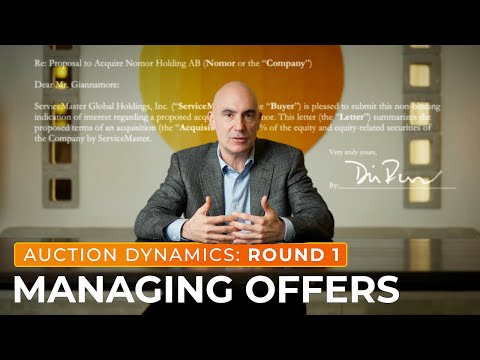
Avoiding the LOI Trap: Why First Bids Should Be Light |…
Excerpt from a sell-side M&A masterclass in which Paul Giannamore discusses running the sale process for Nomor AB (~$200M deal), including managing over 50 buyers with a low-friction auction, why full letters of intent should not be requested up front, how to handle low initial offers, why a "preemptive" $1.7B bid was rejected, and when to trim the buyer pool to drive price up.
# Observation Document: Video Identity Evidence
## Video Identity
- **Title:** "Avoiding the LOI Trap: Why First Bids Should Be Light | Sell-Side M&A Masterclass Moment"
- **Format indicator:** The "Masterclass Moment" framing in the title suggests the video is excerpted or presented as an educational segment within a broader instructional series on M&A.
## Observable Presentation Evidence
### Intended Audience
- **Practitioners and learners of sell-side M&A advisory.** The speaker addresses the listener as a peer/advisor in training:
> "your goal as an advisor is to try to whittle down the playing field as much as you can."
- **Current or prospective investment banking professionals.** The speaker references industry norms as instruction:
> "you'll see this is prolific throughout investment banking. Great investment bankers are going to ask for indicative offers."
### Claimed Scope
- **Instruction in sell-side M&A process design.** The video walks through a defined stage of an auction process: soliciting indications of interest (IOIs), interpreting low first-round bids, handling preemptive offers, and narrowing the buyer field.
- **Practitioner-vantage instruction.** The speaker repeatedly uses first-person process language ("I ferret out as much information as I possibly can on the sell-side"; "how do I introduce competition"), demonstrating a method from the advisor's seat.
### Demonstrated Self-Description / Credentials
- **Active sell-side practitioner.** Stated directly:
> "We're the sell-side, we're setting the process. Here's the rules."
> "I deal with this on a day-to-day basis."
- **Case-study-based teaching.** The speaker grounds the lesson in a named personal engagement ("the case of No More"), citing specific figures (target of 2.1 billion SEK; IOIs clustering at 1.3–1.4 billion SEK; a preemptive bid of 1.7 billion SEK) and recounting direct client and buyer conversations.
### Tone and Presentation Style
- **Direct, candid, colloquial.** The speaker uses informal, blunt language, e.g., "sellers get pissed. This is offensive."
- **Narrative + principle structure.** Each process principle (use indicative bids, keep round-one burden low, expect low first offers, narrow the field) is paired with a concrete anecdote from the No More case.
## Summary of Observable Identity Signals
| Signal | Evidence Type |
|---|---|
| M&A educational channel positioning | Title ("Masterclass Moment") |
| Sell-side advisor authority | Explicit self-description ("I deal with this on a day-to-day basis") |
| Practical, experience-based teaching | Named case with specific deal figures |
| Audience: aspiring/current deal professionals | Direct address ("your goal as an advisor") |
# Delivery Observation: Sell-Side M&A Masterclass Moment
## Tone
- **Conversational and candid**: The speaker uses informal language despite technical subject matter, e.g., > "sellers get pissed. This is offensive, I can't believe it's so low."
- **Confident and directive**: Positions himself as setting the rules: > "We're the sell-side, we're setting the process. Here's the rules."
## Vocabulary & Terminology
- Heavy, consistent use of **M&A jargon**: "indicative bids," "IOIs," "LOI," "preempt process," "funnel."
- Explicitly bridges jargon to plain English: > "instead of using formal bids, I like to use indicative bids" and > "indicative offers or indications of interest."
## Recurring Phrases
- **"At the end of the day"** appears multiple times: > "But at the end of the day, IOIs and front-end offers tend to be low" and > "Because at the end of the day, as you move this along..."
- **"Quite frankly"** recurs: > "and quite frankly, that's okay" and > "And quite frankly, they're testing the water."
- **"Time, money, and effort"** as a fixed triad: > "spend time, money, and effort attempting to bid" and again > "spend a lot of time, money, and effort learning about the business."
- **"Whittle down"** repeated for narrowing the buyer pool: > "try to whittle down the playing field" and > "You try to whittle those down."
## Teaching Habits
- **Anaphora / parallel listing**: Uses repeated "Here's..." structure: > "Here's what I'll do with it. Here's how I'll finance it. Here's what I'll do with management."
- **First-person process narration**: Frames advice through his own workflow: > "So, I ferret out as much information as I possibly can."
- **Concrete case example**: Grounds the principle in a live deal ("No More" / SEK figures: > "cluster around 1.3 to 1.4 billion SEK").
- **Empathy for audience reactions**: Anticipates client frustration: > "it's frustrating I think for clients."
- **Funnel metaphor**: Visual language for process design: > "introduce as many buyers as we can to the front end of the funnel" and "the pool of participants should be getting narrower and narrower."
## Communication Patterns
- **Rhetorical questions** to explain buyer behavior: > "I mean, why are they going to go all in on a first bid?"
- **Role-played dialogue** to dramatize negotiation moments: > "The client immediately responded, this is ridiculous for a preemptive offer."
- **Vivid informal imagery**: > "had an analyst at 2:00 in the morning write up an IOI."
## Uncertainty Notes
- Evidence comes from a single short excerpt; frequencies (e.g., "at the end of the day") are noted where repeated, but broader stylistic stability cannot be confirmed from this clip alone.
# Position Record: "Avoiding the LOI Trap: Why First Bids Should Be Light"
## Speaker
- A single, unnamed sell-side M&A advisor/investment banker delivering a masterclass segment. No curated speaker metadata is provided; identity is inferred only from first-person sell-side framing in the transcript.
## Core Positions & Reasoning
### 1. Use indicative bids, not formal LOIs, at the front end of a sale process
- **Position:** Prefer **indicative bids / indications of interest (IOIs)** over formal bids or full LOIs in round one.
- **Reasoning:** Formal bids demand more buyer effort; many buyers "will just fall out of the process" rather than spend time, money, and effort on a business they don't know well, especially if they doubt they'll prevail.
- **Claimed prevalence:** "You'll see this is prolific throughout investment banking. Great investment bankers are going to ask for indicative offers."
### 2. Cast a wide net to introduce competition
- **Reasoning stated:** The seller's side sets the process rules; keep rules minimal ("2 weeks from now, provide us an indicative bid") to maximize funnel breadth.
- **Goal:** Get **10, 15, 20 IOIs** to read where the market is on valuation.
### 3. What a first-round bid should contain
- Bullets per the speaker: "I will pay X," what the buyer will do with the business, how it will be financed, plans for management, and regulatory constraints.
### 4. Expect and accept low first bids
- **Reasoning:** IOIs are low because buyers know little about the business and "they're testing the water" — "why are they going to go all in on a first bid?"
- **Acknowledged tension:** Clients/sellers often get angry at initial offers ("This is offensive"), but the speaker says this is expected and "quite frankly, that's okay" — **unless** a buyer wants to preempt the process.
### 5. Case study: "No More" (SEK figures)
- **Hoped outcome:** ≥ **2.1 billion SEK**.
- **Actual IOIs:** clustered at **1.3–1.4 billion SEK** — "substantially lower than where I wanted to end up."
- **Preemptive bid:** One acquirer offered **1.7 billion SEK** to shut down the process.
- **Client response:** Called it "ridiculous" for a preempt; demanded "something north of 2 billion SEK."
- **Advisor's message to that buyer:** "You didn't win... we intend to do substantially better throughout this process."
### 6. Narrow the field after IOIs
- **Position:** Whittle down the buyer pool aggressively; expect "garbage" bids (e.g., an analyst writing an IOI at 2 AM "just to see what would happen").
- **Stated dynamic:** As the process progresses, **price should rise** while the **participant pool narrows**.
## Qualifications & Unresolved Tensions
- The speaker's expectation (2.1B SEK) was not met initially; the record preserves the gap between hope and market signal without stating a final outcome.
- Preemptive bids are framed as the exception to low first offers, but the No More preempt (1.7B) was itself rejected as too low — an unresolved negotiation at the point the excerpt ends.
# Video Attribution & Provenance Record
## Video Identification
- **Title:** Avoiding the LOI Trap: Why First Bids Should Be Light | Sell-Side M&A Masterclass Moment
- **Video ID:** `01a168c8-1d4a-7167-89f1-24ada2cbb7c9`
## Speakers & Roles
### Primary Speaker (Unidentified by Name)
- **Role:** Creator / instructor — speaks as a **sell-side M&A advisor ("investment banker")** in first person, describing their own client work.
- **Evidence in transcript:**
- > "I ferret out as much information as I possibly can on the sell-side... how my client's business might create value"
- > "We're the sell-side, we're setting the process."
- > "your goal as an advisor is to try to whittle down the playing field"
- **Identity:** Not stated in the transcript; no curated metadata supplied.
### Referenced Third Parties (Non-Speaking)
- **"Client" (seller):** Referenced in the "No More" case — rejected a 1.7 billion SEK preemptive bid, demanding >2 billion SEK.
- **Unnamed preemptive buyer/acquirer:** Submitted the 1.7 billion SEK preemptive bid.
- **"No More":** A referenced deal/case (SEK valuations); relationship to the title "No More" not further explained in transcript.
## Referenced Sources & Claims
- **Case study — "No More" deal:** IOIs clustered at 1.3–1.4 billion SEK; advisor hoped for ≥2.1 billion SEK; preemptive bid of 1.7 billion SEK rejected.
- **Industry practice claim (no citation):** > "You'll see this is prolific throughout investment banking. Great investment bankers are going to ask for indicative offers."
- No external documents, publications, or data sources cited.
## Promotional Segments
- **None identified** in the transcript. The title references a "Masterclass," but no explicit promotional call-to-action appears in the transcript text.
## Availability & Uncertainty
- **Curated metadata:** None supplied.
- **Speaker name:** Unknown — recorded only by role.
- **"No More" case:** Deal specifics (parties, dates) not identified.
- **Comment availability:** Not stated in supplied material.
So, I ferret out as much information as I possibly can on the sell-side to understand how my client's business might create value for each individual
buyer. It's a lot of work, but it's worth it. After that, I say to myself, well, how do I introduce competition? And typically, I tend to take the approach of casting a relatively wide net on the front end. And I, instead of using formal bids, I like to use indicative bids. And you'll see this is prolific throughout investment banking. Great investment bankers are going to ask for indicative offers or indications of interest at the front end of the process. And the purpose of that is we want to introduce as many buyers as we can to the front end of the funnel. And we want them to put an offer on the business in round one. Simply something that says, I will pay X for the business. Here's what I'll do with it. Here's how I'll finance it. Here's what I'll do with management. And here's what the regulatory constraints I might have. And we want buyers to provide a bid,
do all on the same day, um doing the smallest amount of work as possible because if we wanted more formal, like a full-on LOI or a more
formal bid, it's going to require buyers to do more work. And a lot of buyers will just fall out of the process cuz they don't want to spend time, money, and effort attempting to bid on something that they don't know much about. And they don't want to incur the cost of figuring it out if they don't think that they're going to likely prevail in the process. So, you want to make it very easy. And as far as process rules at the very beginning, that's the extent the process rules. We're the sell-side, we're setting the process. Here's the rules. 2 weeks from now, provide us an indicative bid. We've cast wide net, we've got a wide funnel, come on in, bring them all in. So, in this process, what we hope to do is we hope to get 10, 15, 20 maybe
indications of interest, and it'll allow us to kind of understand where the market is at in general terms with regard to valuations. Now, in the case of No More, I was hoping to
get 2.1 billion SEK or more, but when our indications of interest came in, they tended to cluster around 1.3 to 1.4 billion SEK. So, substantially lower than where I wanted to end up, and quite frankly, that's okay. And you know, it's frustrating I think for clients. I deal with this on a day-to-day basis when those initial
offers come in, sellers get pissed. This is offensive, I can't believe it's so low. But at the end of the day, IOIs and front-end offers tend to be low because
buyers don't know a whole heck of a lot about the business yet. And quite frankly, they're testing the water. I mean, why are they going to go all in on a first bid? Um unless of course they want to preempt process. So, in the case of No More, we did have a buyer that said, I want a preempt process. I want to shut down the process before other buyers have the opportunity to spend a lot of time, money, and effort learning about the business only to increase their bid. So, one of the acquirers stepped up and said, here is our preemptive bid, no one can pay more than us, 1.7 billion SEK. The client immediately responded, this is ridiculous for a preemptive offer. If you want to shut down process, I expect to see something north of 2 billion SEK, not 1.7 billion. So, at the front end of this process, right after the IOIs, I had a conversation with this that particular buyer and said, you didn't win. I clearly this is a low bid for a preemptive bid, and we intend to do substantially better throughout this process. Now, after indications of interest, your goal as an advisor is to try to whittle down the playing field as much as you can. You know, there's going to be a lot of
garbage in there, companies that you really feel like are are just had an analyst at 2:00 in the morning write up an IOI and just tendered it just to see what was going to happen. You try to whittle those down because as
you move through the process, you want to boot potential participants that's from your process. Because at the end of the day, as you move this along, the price should be going up, and the buyer field or the pool of participants should be getting narrower and narrower.