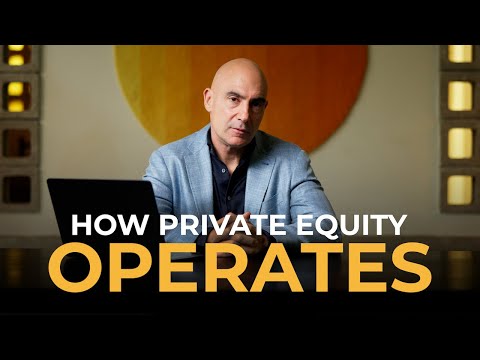
Debt, Valuation & Control: How PE Really Operates | PE Q&A…
A Q&A excerpt from a Private Equity masterclass in which advisor Paul Giannamore answers owner questions about partnering with a PE firm. Topics covered include how PE firms use debt more aggressively than independent owners, the drivers of valuation (cash flow, risk, and growth rather than revenue), what control owners retain or lose in majority versus minority deals, when PE can accelerate growth, how to create deal urgency without appearing desperate, and how to recognize when a PE firm is stringing a seller along.
# Channel Presentation Observations
## Explicit Self-Description (Creator Claims)
- **Stated profession and role**: The presenter introduces himself as an **investment banker** who "negotiate[s] for a living."
> "I'm Paul Jaimala, I'm an investment banker and I negotiate for a living."
- **Claimed deal exposure**: He claims that **more than half of transactions he advises on involve private equity firms**.
> "In any given year, more than half the transactions we advise on tend to be with private equity firms."
- **Advisory relationship framing**: He positions the channel's content as answers to **frequently asked client questions**.
> "I've put together a list of the most common questions I get from my clients with regard to private equity."
## Intended Audience
- **Middle-market business owners**, particularly those considering selling to or partnering with private equity. Evidence: repeated second-person address to owners ("in your own middle market business," "A lot of you guys out there own businesses"), and framing of questions from a **seller's perspective** ("How much control will I have after taking on a private equity investment?").
- **Owners contemplating a majority sale** who intend to remain as CEOs:
> "that question is largely asked by individuals who intend to sell the majority of their business... Remain on as CEOs."
## Claimed Scope
- **Private equity education for sellers**, covering:
- Use of debt (leverage multiples vs. owner-accessible debt)
- Post-investment control and consent rights
- Valuation drivers ("valuation is inversely related to risk"; "cash flow always drives value, not revenue multiples")
- Whether PE can accelerate growth
- Deal dynamics and buyer behavior (closing anecdote about a single-buyer situation)
## Observable Presentation Patterns (Demonstrated, Not Claimed)
- **Q&A format** structured around named questions, each introduced explicitly ("How do private equity firms use debt...").
- **Anecdote-driven teaching**: a client story ("I got a call from a guy about 4 months ago") illustrates the risk of negotiating with a single buyer.
- **Advisor positioning with call to action**: the video ends with a **client-solicitation prompt**.
> "feel free to reach out to me directly on the contact form in the description below, or join me on LinkedIn."
- **Balanced/nuanced tone on PE**: repeatedly notes variability across firms ("every private equity firm is a little bit different," "there's a spectrum"), avoiding blanket claims.
- **Educational framing mixed with marketing**: the content demonstrates both instruction (valuation mechanics, consent rights) and implicit demonstration of advisory competence (the anecdote concluding "he ultimately engaged us").
## Metadata Notes
- **No curated metadata was supplied**; identity observations rest solely on title and transcript.
- The **title** itself signals a channel positioning around PE mechanics ("How PE Really Operates") in a **"Q&A Masterclass"** format, consistent with the transcript's demonstrated structure.
# Delivery Observation: "Debt, Valuation & Control: How PE Really Operates"
## Speaker & Format
- The speaker self-identifies at the open: > "I'm Paul Jaimala, I'm an investment banker and I negotiate for a living." (Closing: "My name is Paul Jonna Ware" — note the transcript renders the name two different ways.)
- **Q&A lecture format**: an announced question list, then one-by-one answering. Framed at the start: > "I've put together a list of the most common questions I get from my clients with regard to private equity."
## Tone
- **Conversational and advisory**, not academic. Marked by frequent casual fillers: "you know," "I mean," "um," "right?" — e.g., > "I mean, debt allows a private equity firm or allows anyone to juice returns, right?"
- **Direct address to viewer/business-owner audience**: "you," "your own middle market business," "A lot of you guys out there own businesses."
- Occasional **humor/irreverence**: > "the private equity overlords" and > "get off the pot."
## Recurring Phrases & Verbal Habits
- **"right?" as a checking tag** — repeated: "juice returns, right?", "the private equity firm will have control, right?", "recurring revenue, right?"
- **"I mean"** as a pivot phrase, appears many times ("I mean, do you lack capital?", "I mean, this is deal making").
- **Hedging via "pretty much / pretty / sort of"**: "pretty judicial," "pretty much allow you to run the business," "what sort of an investment was it."
- **"So," as a topic-transition marker**, opening many answers: "So, for example…", "So, I do think…", "So, they are probably focused on growing your business more than you are today."
## Teaching Habits
- **Concrete numeric illustration** for leverage: > "you might be able to take on one or two times of EBITDA in debt, whereas private equity firms sometimes can get three, four, five, six, seven, eight times EBITDA in debt."
- **Emphasis by contrast/parallelism**: > "cash flow always drives value, not revenue multiples."
- **"It depends" framing, then enumeration**: answers often start with variation-acknowledgment — > "every private equity firm is a little bit different" (repeated later as "every private equity firm is different and there's a spectrum").
- **Rhetorical questions to structure an answer**: > "Is it a control investment?" … > "Do you lack capital?"
- **Anecdote as teaching device**: the final question is answered entirely through a client story ("I got a call from a guy about 4 months ago…"), including reconstructed dialogue.
- **Distilled aphorisms/summarizing rules**: > "valuation is inversely related to risk"; > "They buy it for price X, and they sell it for price X * 3 or X * 4 or X * 5."
## Structure & Signposting
- Explicit question headings delivered verbatim ("How do private equity firms use debt…", "How much control will I have…").
- Closing bookend with **call to action**: > "reach out to me directly on the contact form in the description below, or join me on LinkedIn."
## Stability vs. Isolated Moments
- **Stable patterns**: filler density ("you know," "I mean," "um"), "right?" tag questions, "So," transitions, "every firm is different" hedging, contrastive summarizing — all recur across multiple answers.
- **Isolated moments**: the "private equity overlords" joke and the client anecdote appear once each; the name inconsistency between opening and closing is a single transcription-level observation, not a delivery pattern.
# Observation Record: PE Q&A Masterclass Moment
**Speaker:** Paul Jaimala / "Paul Jonna Ware" (transcript gives both spellings), self-described investment banker who "negotiates for a living"; states more than half of his firm's annual transactions involve private equity firms.
---
## Q1: How do PE firms use debt in ways most business owners don't?
- **Core claim:** Debt "juices returns" — the more debt, the higher returns to invested equity — but excessive debt makes deals risky.
- **Firm-by-firm variation:** Every PE firm has a different philosophy on debt.
- **Middle-market observation:** He finds most PE firms "pretty judicial" (presumably "judicious") with debt in the middle market.
- **Access differential:** A middle-market owner might borrow **1–2× EBITDA**, while PE firms can sometimes obtain **3–8× EBITDA**.
- **Qualification:** PE firms use this debt access willingly, but "not to such an extent that I think it puts your transaction at risk."
## Q2: How much control will I retain after a PE investment?
- **Control deals:** By definition, if the PE firm owns a majority, it has control.
- **Minority deals:** The owner retains control but signs a document with **consent rights**, contractually transferring rights — e.g., needing PE permission for acquisitions or capex above a threshold.
- **Negotiation dynamic:** Those contractual terms depend on leverage at closing and how the parties' rights align with their goals.
- **Context of the question:** Usually asked by owners selling 60–90% and staying on as CEO.
- **Spectrum answer:** "Every private equity firm is different" — some let you run the business as before; others require dramatic change; "there's no one answer."
- **Advice:** Going to market lets congruent PE firms "self-select" based on your preferences.
## Q3: Key valuation factors
- **Cash flow is primary:** "At its core, private equity is a cash flow buyer"; cash flow — not revenue multiples — drives value.
- **Critique of revenue multiples:** Industries with recurring revenue (software, SaaS, PaaS, lawn care) "tend to focus a little bit more on revenue multiples than they should."
- **Risk relationship:** Valuation is **inversely related to risk**; de-risking increases value.
- **Growth factor:** Greater and faster-growing cash flow increases value.
- Acknowledges valuation methods are broadly consistent across companies with industry-specific nuances.
## Q4: Can PE help me grow faster?
- **Answer: "It's possible"** — depends on the resources and capabilities you lack:
- **Capital** for existing ideas/business
- **Capabilities** such as data analytics or a CFO
- **Incentive argument:** PE firms make money by buying at X and selling at X×3, 4, or 5, so "they are probably focused on growing your business more than you are today."
## Q5: Creating urgency without looking desperate (case study)
- A seller, ~4 months prior, described months of talks with a PE firm: dinners, an NDA, exchanged numbers, big-offer signals — but no offer materialized.
- **Paul's position:** "I would never want to be in a position of just dealing with one buyer."
- **Outcome:** The seller engaged Paul's firm for a formal process; when contacted, the PE firm declined to participate.
- **Paul's mixed interpretation** (preserved as stated):
- "Sometimes I think this might be sellers projecting desire."
- But in this case he believes they "kind of strung him along" — "talked some big numbers… didn't ultimately produce the offer."
- **Caveat:** "This is deal making. You got to expect this. You can't take it too seriously."
---
## Unresolved tensions / qualifications
- Debt use described as both aggressive (up to 8× EBITDA) and not endangering transactions — held together only by his judgment that middle-market firms remain "judicial."
- The case study contains an explicit internal tension: projected desire vs. being strung along, with Paul endorsing the latter only tentatively ("I do think").
- Transcript itself is inconsistent on the speaker's surname (Jaimala vs. Jonna Ware); recorded as expressed, unresolved.
# Video Attribution & Provenance Record
## Video
- **Title:** Debt, Valuation & Control: How PE Really Operates | PE Q&A Masterclass Moment
- **Video ID:** `01a168c7-ca00-734f-9ab2-cd31f9d0ab28`
## Speakers & Roles
| Speaker | Role | Evidence |
|---|---|---|
| Paul Jaimala / "Paul Jonna Ware" (name given twice, spelled differently in transcript) | **Creator / Host / Investment banker (self-identified)** | Opens: *"I'm Paul Jaimala, I'm an investment banker and I negotiate for a living."* |
- **No guests, narrators, or other identified speakers** appear in the transcript.
- Single-speaker Q&A format: the creator both poses and answers the listed client questions.
## Structure & Content Attribution
- **Format:** Self-conducted Q&A on private equity topics, framed as the creator's clients' most common questions.
- Topics covered: PE use of debt; post-investment control; valuation factors; PE-assisted growth; a client anecdote about urgency and a single PE buyer.
## Referenced Sources & Third-Party Claims
- **No cited external sources, studies, or data** — all claims are the creator's own professional opinion/experience.
- **Anecdotal client story** (unverifiable, anonymized):
- Caller ~4 months prior seeking advice on creating urgency with a PE buyer.
- Claims about the unnamed PE firm's behavior ("strung him along," "talked some big numbers") are the creator's characterization, not attributed statements.
- Outcome: firm declined to participate in a formal process, per the creator's account.
## Promotional Segments
- **Outro promotion:** Creator invites viewers to reach out via a **contact form in the video description** and to connect on **LinkedIn**; repeats his name as a sign-off. This is a self-promotional segment and should be flagged as such.
## Availability & Uncertainty
- **Comment availability:** Not stated in source material.
- **Curated metadata:** None supplied.
- **Name discrepancy:** The speaker's name appears as "Paul Jaimala" (intro) and "Paul Jonna Ware" (outro); transcript spelling is uncertain and unresolved.
- No timestamps were present in the transcript; none are recorded.
I'm Paul Jaimala, I'm an investment banker and I negotiate for a living. In any given year, more than half the transactions we advise on tend to be with private equity firms. So, today I thought I would take the opportunity to
have a discussion with you and I've put together a list of the most common questions I get from my clients with regard to private equity. So, let's go ahead and dive right in. How do private equity firms use debt in ways that most business owners don't? So, you know, every private equity firm is a little bit different with regard to their philosophy on the use of debt. I mean, debt allows a private equity firm or allows anyone to juice returns, right? The more debt you put on something, the more returns you get to invested equity. The issue becomes when something is so debt-laden it becomes quite risky. I find that most private equity firms are still pretty judicial, at least in the middle market, with their use of debt. But, you know, private equity firms have the ability to take on far more debt than you do. So, for example, in your own middle market business, you might be able to take on one or two times of EBITDA in debt, whereas private equity firms sometimes can get three,
four, five, six, seven, eight times EBITDA in debt. So, I do think private equity firms have access to debt capital that you don't and are often willing to
utilize it, but not to such an extent that I think it puts your transaction at risk. How much control will I have after taking on a private equity investment? Now, this kind of strikes at the heart of what sort of an investment was it. Is it a control investment? Um, just by definition, the private equity firm will have control, right? If they own a majority of the business, they will have control. From a minority perspective, if they're investing in buying a minority stake in the business, now you will have control, but you'll sign a document that has consent rights on it and you'll hand over or you'll contractually hand over of rights that would otherwise be yours as a majority shareholder to the private equity firm. Like for example, you might see that you can't make an acquisition without the permission of the private equity overlords. You can't uh spend X amount in capital expenditures without permission. There's a variety of different things that you would contract to. And those contracts are largely based upon the leverage you have at the
table when you're closing the transaction. And how um the rights and responsibilities between private equity and you impact the ultimate goals of both parties going
forward. But I would say that that question is largely asked by individuals who intend to sell the majority of their business. So, 60, 70, 80, 90%. Remain on as CEOs. Uh and what they're asking is how much control they have and every private equity firm is different and there's a spectrum. Some will pretty much allow you to run the business exactly the same way you are today. And others will require a dramatic change and there's everything in between. And so that's one of the things you need to do. There's no one answer to this. As you start getting out into the market and thinking about what it is that you want, you'll be able to set yourself up so that the private equity firms that are congruent with your line of thinking will self-select. What are some of the key factors in determining the valuation of my company? Now, of course there's a lot of consistencies in valuation methodology from company to company, but there are some nuances in various different industries. I would say at its core, private equity is a cash flow buyer. A lot of you guys out there own businesses and there's a lot of rules of
thumb related to revenue multiples, irrespective of what industry you're in. But industries that tend to have recurring revenue, right? Software SaaS, PaaS, lawn, whatever,
tends to focus a little bit more on revenue multiples than they should. But at the end of the day, cash flow always drives value, not revenue multiples. And, um private equity firms are cash flow buyers. Um you know, key factors in valuation is really, you know, valuation is inversely related to risk. And so, if you can think about all the factors that increase risk in your business, if you can de-risk the business, you'll make it more valuable. Um obviously, cash flow drives valuation. So, the greater the cash flow is, and the greater or the faster that stream of cash flow is growing, the more valuable the business will be. Can private equity help me grow my business faster? It's possible, right? I mean, it depends upon what sort of resources and capabilities you need. I mean, do you lack capital? Like, do you have all these great ideas and a great business, you just need more money to capitalize on it? Yeah, they can certainly help you with that. Do you not really understand um some of the dynamics of your customers, and you need some data analytics, and you need some chief financial officer, or you
need all all sorts of capabilities? Sure, they can help you with that, too. I mean, there's a lot of way I mean, look, private equity firms are in the business of buying businesses and selling them.
That's literally how they make money, right? They buy it for price X, and they sell it for price X \* 3 or X \* 4 or X \* 5. So, they are probably focused on growing your business more than you are today. So, yes, they can certainly help with that. So, the last question here, I got a a call from a guy about 4 months ago who said to me, "Paul, what's the best way I can create a sense of urgency without looking desperate?" I said, "Well, so, what are you asking me here?" He said, "Well, look, I've been dealing with a private equity firm for a few months. Um I really like these guys, and I think they're willing to put a pretty big offer on the table. They've said as much. Um we've had some dinners, we've signed an NDA, we traded some numbers back and forth, and they They telling me that the offer full although it it just doesn't show up. And so, I wanted to give them a call and say, "Hey, or get off the pot." And you know, you know, me as an advisor, I look at that and say, "I would I would I would never want to be in a position of just dealing with one buyer." It didn't make sense to me, and I explained it as such. And um Yeah, subsequent to that conversation,
he ultimately engaged us, and we're going to be taking that business out to a formal process. And he handed off the contact information to me, that private equity firm. We gave him a call, and and the private
equity firm wasn't as nearly interested in the business as he had thought they were. And you know, sometimes I think this might be sellers projecting desire. Um but in this particular case, I do think that they kind of strung him along. I think that they talked some big numbers, talked a big game, um didn't ultimately produce the offer, which of course happens sometimes. I mean, this is deal making. You got to expect this. You can't take it too seriously. Um but when we had that conversation with the private equity firm, they just said they're not interested in moving forward with us in a formal process. So, that shows me their level of interest. Thank you for joining me today as I discuss my clients' most common questions regarding private equity. If you've got any questions, feel free to reach out to me directly on the contact form in the description below, or join me on LinkedIn. My name is Paul Jonna Ware. Thank you for joining me today, and I'll see you on the next one.