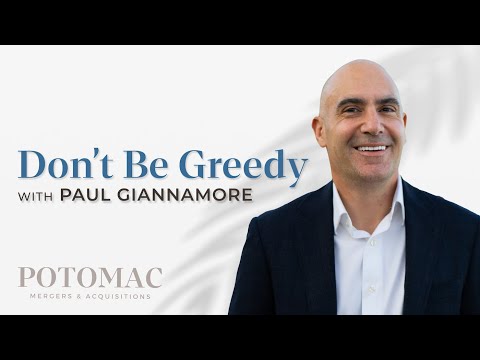
Don't Be Greedy! With Global M&A Advisor Paul Giannamore
Interview with Paul Giannamore, global M&A advisor, on the counterintuitive nature of mergers and acquisitions, apparently discussing greed and timing in selling a business (part of a larger "The Counterintuitive Nature of M&A" series covering business valuation and the sale of service businesses such as pest control).
# Channel Presentation Evidence: "Don't Be Greedy! With Global M&A Advisor Paul Giannamore"
## Explicit Self-Description Evidence
- **Professional identity in title**: The title itself labels the speaker as a **"Global M&A Advisor"** ("Don't Be Greedy! With Global M&A Advisor Paul Giannamore"), an explicit claim about the channel's host and expertise area.
- **Advisor role stated in transcript**: The speaker describes his own role in a transaction: > "it's my job as a buyer as advisor to say, 'Hey, listen, we're going to be nasty and greedy on purchase price, but at some point you've really got to give it up.'"
- **Industry positioning**: He repeatedly refers to working within **residential services**: > "in residential services, the acquirers tend to be blue collar guys" and > "it's hard to get talent into the industries in which we work in."
## Intended Audience
- **Business owners considering selling their companies**: The advice is addressed directly to sellers: > "before you ever go into an M&A process, do not for a single second think that you're negotiating with a big nameless corporation."
- **Entrepreneurs, specifically self-made ones**: The speaker personifies the audience: > "here you are, somebody who started spraying lawns out of high school, and... you're a classic entrepreneur, but you've built this business."
- **Likely pest control / lawn care adjacent ownership**: The "spraying lawns out of high school" framing suggests the target viewers run field-service businesses, consistent with the residential services references.
## Claimed Scope of Content
- **Lessons from deal experience**: The video is framed as transferring accumulated expertise: > "another really important lesson that I've learned over the years" and > "important lessons I've learned over the years... a very important lesson that many of you never learn until it's too late."
- **M&A transaction guidance for sellers**: Content covers seller behavior in negotiations, hiring investment bankers, incentive structures, and deal-closing dynamics across market cycles (references to the early 2000s and 2008).
## Observable Presentation Patterns (Demonstrated, Not Claimed)
- **Anecdote-driven teaching style**: Uses concrete hypotheticals, e.g., a seller in a **$50 million transaction** quibbling over a **"$600 a month fuel allowance"** or an **AC bill** on a leased building.
- **Direct, colloquial, occasionally blunt tone**: Includes informal language such as > "their wives are bitching at them" and > "wants to clobber everyone in the head and just drag every single penny out."
- **Empathy-flipping perspective**: Encourages sellers to see buyers as individuals: > "You're negotiating with people that have a job, they've got kids at home... they've got all of the same problems that you have."
- **Market-cycle awareness**: Discusses weakening M&A environments and investment committees "tightening down the hatches," indicating content tied to current deal-market conditions.
## Key Takeaway Statement
The video's distilled message, delivered by the speaker: > "be likable, be humble, and don't be greedy."
# Delivery Observations: "Don't Be Greedy! With Global M&A Advisor Paul Giannamore"
## Tone
- **Conversational and advisory**: The speaker adopts a mentor-like, direct tone, framing the talk as shared experience: > "another really important lesson that I've learned over the years"
- **Blunt, unvarnished language**: Occasional profanity and coarse phrasing appear without hedging: > "their wives are bitching at them"
- **Slightly self-deprecating about the industry**: > "sometimes it's hard to get talent into the industries in which we work in"
## Vocabulary & Framing
- **Financial/M&A terminology** used throughout: "selling shareholder," "investment banker," "incentive structures," "investment committees," "M&A process," "purchase price"
- **Repeated dichotomy of seller vs. advisor roles**: he repeatedly distinguishes who should be greedy: > "You want to hire an investment banker that literally wants to clobber everyone in the head and just drag every single penny out" vs. the seller who should "resist all urges of being greedy"
- **Class/education contrast vocabulary**: "blue collar guys," "Harvard MBAs," "Yale," "somebody who started spraying lawns out of high school"
## Recurring Phrases & Repetition Habits
- **"Greedy" as the anchor word**, repeated throughout, including an explicit definitional pivot: > "let me be precise with my words and define greedy"
- **Verbal repetition for emphasis** (stutter-style emphasis) occurs frequently:
- > "right right advisor"
- > "I I I know"
- > "you can you can resist all urges"
- > "and immediately and immediately prior to the closing"
- > "be likable, be hum- be humble, and don't be greedy"
- **Filler phrase "you know"** appears persistently across the talk: > "You know, another really important lesson…", > "And, you know, if you do your job right…", > "And I you know, I'm going back to this…"
- **"I've seen it"** used twice as an authority marker: > "they walk away, and I've seen it" and > "you're going to moan about things, and I've seen it"
## Teaching Habits
- **Opens with a folksy, common-wisdom hook**: > "we've all heard this saying, probably our mom told us this, maybe your Sunday school teacher told it to you"
- **Concrete hypothetical scenario** to illustrate the definition of greed: the "$50 million transaction" seller demanding a "$600 a month fuel allowance" or an AC bill
- **Direct address to audience**: > "I I I remind all of you, before you ever go into an M&A process…"
- **Inner-voice dramatization**: he voices hypothetical characters to make points, e.g., investment committees: > "Hey, uh M&A guys, operators, president, we're tightening down the hatches" and executives: > "Look, we made a commitment to this guy. We're closing this deal."
- **Historical anchoring**: cites "the early 2000s" and "2008" as evidence of deals that failed from seller greed
- **Rule-of-three summarizing close**: > "be likable, be hum- be humble, and don't be greedy" — explicitly labeled as a lesson: > "a very important lesson that many of you never learn until it is too late" *(note: transcript reads "that many of you never learn until it's too late")*
## Communication Patterns
- **Circular structure**: ends by restating the opening lesson, closing the loop on "lessons I've learned over the years"
- **Emphasis through direct second-person address**: > "I'm talking about you as a seller"
- **Self-correction mid-sentence** appears multiple times: > "as a buyer as advisor" (apparent slip, likely meant "as your advisor"), > "be hum- be humble"
## Uncertainty Notes
- Single-talking-point monologue; patterns like "you know" and stutter-emphasis are strongly evidenced, but whether they are stable across the speaker's other videos cannot be determined from this source alone.
- The transcript lacks punctuation-verified speaker attribution beyond the title's naming of Paul Giannamore; delivery observations assume the title correctly identifies the speaker.
# Position Record: "Don't Be Greedy! With Global M&A Advisor Paul Giannamore"
## Speaker
- All positions expressed by **Paul Giannamore**, identified via video title as a **global M&A advisor**.
## Central Thesis
> "Be likable, be humble, and don't be greedy."
Sellers who let their advisor be aggressive on price — while remaining personally likable and humble — are far more likely to close deals, especially in weak markets.
## Key Positions & Reasoning
### 1. Let the advisor be greedy, not the seller
- Hire an investment banker who "wants to clobber everyone in the head and drag every single penny out."
- With the right advisor and **incentive structures**, the seller can and should resist personal greed.
- Giannamore frames this as his own role: "It's my job as a buyer as advisor to say, 'we're going to be nasty and greedy on purchase price, but at some point you've really got to give it up.'"
### 2. Seller greed kills deals
- Citing the **early 2000s and 2008**: "there were some transactions that never closed that should have closed because sellers got a little bit too greedy, or sellers found themselves in positions where buyers didn't like them."
### 3. Buyers are people, not faceless corporations
- In **residential services**, acquirers "tend to be blue collar guys" — even large public firms — because top talent is hard to attract to these industries.
- Acquirers "really do business with people that they like."
- Sellers should not think they're negotiating with a "big nameless corporation" but with individuals with jobs, families, and the same everyday problems.
### 4. A likable seller gets executives to fight for the deal
- In a weak market where investment committees say "kill the deals on the table," executives will go to the board and insist, "Look, we made a commitment to this guy. We're closing this deal" — **if they like the seller**.
- If they don't like the seller or the seller is greedy, "they walk away, and I've seen it."
## Definition of "Greedy" (Giannamore's own precision)
- Example: a seller in a **$50 million transaction** who insists just before closing on a **$600/month fuel allowance** or sticking the buyer with the **AC bill** on a building the buyer is leasing only as a favor.
- These trivial end-game demands jeopardize enormous transactions.
## Supporting Observations on Buyer Psychology
- Corporate dealmakers often come from elite schools ("Yale," MBA paths) and, per Giannamore, "look at you as somebody who does not deserve to get what you're getting" — a class dynamic facing the lawn-care-style entrepreneur who built a business from nothing.
- Acknowledged tension: business owners "always want to win" and see negotiations as with entities, not people — which Giannamore explicitly works to correct.
## Stated Basis
- All claims grounded in **Giannamore's personal experience over years of M&A work** ("I've seen it"); no external data or sources cited.
# Speaker Attribution Record
## Video
- **Title:** Don't Be Greedy! With Global M&A Advisor Paul Giannamore
- **Video ID:** `01a168c8-a310-7908-8886-9d...` (as supplied: `01a168c8-a310-7908-8886-9f72019ca8ec`)
## Speakers
| Speaker | Role | Evidence |
|---|---|---|
| Paul Giannamore | **Creator / primary speaker** | Title identifies him as "Global M&A Advisor"; first-person remarks such as "a lesson that I've learned over the years," "I've seen it," and "it's my job as a buyer as advisor" indicate he speaks from an advisor's perspective throughout. |
- No guest, narrator, or additional speakers appear in the transcript.
- No dialogue or turn-taking is present; the entire transcript is a single continuous monologue.
## Role Notes
- The speaker identifies himself as an **investment banker / M&A advisor** ("it's my job as a buyer as advisor"), consistent with the creator role in the title.
## Referenced Sources & Third-Party Claims
- **No cited external sources, data, publications, or named third parties** appear in the transcript.
- Historical/timeframe references (e.g., "the early 2000s," "2008") are the speaker's own recollections, not attributed sources.
- Anecdotes (failed deals, greedy sellers, corporate buyers' attitudes) are the speaker's **personal observations**, explicitly framed as "I've seen" — no named counterparties or deals.
## Promotional Segments
- **None detected.** No calls to action, sponsor mentions, or service promotion appear in the transcript.
## Availability & Provenance Limits
- **No curated metadata supplied** beyond title and transcript.
- **Comment availability:** Not stated.
- Speaker identity is inferred from the title; the transcript itself does not contain a self-introduction by name.
## Uncertainty
- Role attribution rests solely on the video title; the transcript does not independently confirm the speaker's name.
You know, another really important lesson that I've learned over the years, and we've all heard this saying, probably our mom told us this, maybe your Sunday school teacher told it to you, but don't be greedy.
And, you know, if you do your job right as a selling shareholder, you've gone out and you've hired the right right advisor, the right investment banker, and that investment banker is greedy, right? You want to hire an investment banker that literally wants to clobber everyone in the head and just drag every single penny out. But, if you've hired the right guy, or right team, you've set up the right incentive structures, you should let your advisor be the one who's greedy, because as we start to get in the environment that we're in right now, it becomes increasingly important, you know, if I think back to the early 2000s, and I think back to 2008, there were some transactions that never closed that should have closed because sellers got a little bit too greedy, or sellers found themselves in positions where buyers didn't like them. And I you know, I'm going back to this because in residential services, the acquirers tend to be blue collar guys. I mean, even some of the big publicly traded firms, I mean, they're not bringing in, you know, Harvard MBAs to run these businesses and execute these transactions. For the most part, I I know I know they wish they had the ability to do that, but unfortunately, sometimes it's hard to get talent into the industries in which we work in. I mean, I I I like So,
in a lot of ways, these acquirers really do business with people that they like. And if you can run an M&A deal, you as a
seller, I'm not talking about your advisor, I'm talking about you as a seller, if you can constantly be humble, if you can constantly be likable, if you could try to build a relationship with the people on the other side of the table that you're working with, and then you can you can resist all urges of being greedy at the very end, as the market finds itself in a very weak position, as other investment committees are saying, "Hey, uh M&A guys, operators, president, we're tightening down the hatches, we're not doing deals. Kill the deals on the table." You're going to find yourself in a position where those executives are going to fight for you. And they're going to go to the board, they're going to go to the executive committee, and the investment committee, and they're going to say, "Look, we made a commitment to this guy. We're closing this deal." If they don't like you, or if you're getting greedy, they walk away, and I've seen it. And so, let me be precise with my words and define greedy. I've seen instances where owners are are doing a $50 million transaction, right? The seller's getting $50 million, and immediately and immediately prior to the closing, he takes a firm stand on "Hey, I'm I'm I'm doing a consulting gig for you buyer for a year. I want you to pay my $600 a month fuel allowance. Or I want you to be responsible for the air conditioning unit on my building, which I'm only leasing to you
because you're actually willing to lease it. And quite frankly, you you be leasing it at all. You should just shut that office down, but you're trying to do me a favor, but I'm going to stick you with
an AC bill, or I'm going to stick you with a meaningless fuel stipend. You know, and it's my job as a buyer as advisor to say, "Hey, listen, we're going to be nasty and greedy on purchase price, but at some point you've really got to give it up, and and you can't focus on your um monthly fuel allowance." And it's very hard, and I know business owners always want to win, and I know that business owners view these negotiations as not negotiating with people, but with the big corporate entity, but I I I remind all of you, before you ever go into an M&A process, do not for a single second think that you're negotiating with a big nameless corporation, cuz you are not. You're negotiating with people that have a job, they've got kids at home, their wives are bitching at them, they're they've got all of the same problems that you have. And then on top of that, they're dealing with somebody that they actually are looking down on, because, you know, a lot of these guys go to the great schools, they did what their parents said, they said, "Listen, I'm going to go out there and get a good job, and go to Yale, and go and get an MBA, and go and do this, and go and do that." And here you are, somebody who started spraying lawns out of high school, and you've done a phenomenal job, you're a classic entrepreneur, but you've built this business, but they look at you as somebody who does not deserve to get what you're getting, because of where valuations are. And then on top of that, you're going to moan about things, and I've seen it. So, I wanted to talk today about important lessons I've learned over the years, and as I sat here today, just kind of thinking through it, a very important lesson that many of you never learn until it's too late is to be likable, be hum- be humble, and don't be greedy.