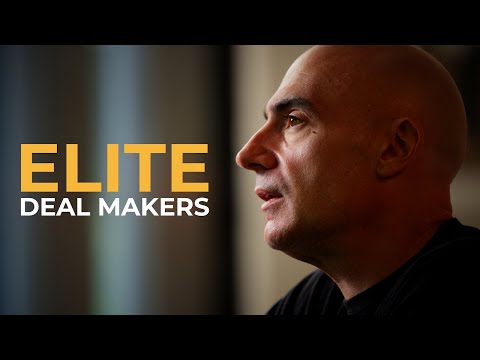
Elite Deal Makers: Emotional Detachment & Tactical Silence…
A clip from a sell-side M&A masterclass Q&A in which Paul Giannamore describes the traits of elite deal makers: rapid pattern recognition, emotional detachment versus banker "neediness," helping sellers manage their emotions, listening more than talking, using tactical silence, staying non-reactive under data overload, and calmly handling multiple concurrent buyer conversations.
# Channel Identity Observations — "Elite Deal Makers: Emotional Detachment & Tactical Silence"
## Observable Presentation Evidence
### Content Domain & Claimed Expertise
- The video demonstrates the channel publishes **M&A (mergers and acquisitions) masterclass content**, per the title framing "M&A Masterclass Moment."
- The speaker presents himself as an **experienced dealmaker**, evidenced by first-person references: *"when you're doing deals all the time, you're recognizing... a lot of pattern recognition"* and *"this was something that was very difficult for me actually and I've had to learn this over the years."*
- He references an **operational business context**: *"my VP of admin execution always makes fun of me"* and ridicule "in my own office," indicating he works within a firm or deal team.
### Intended Audience
- Primarily **prospective sellers of businesses and M&A practitioners**, evidenced by direct address: *"everyone out there that's going to engage an investment banker needs to make sure that their deal while important to the investment banker is not extremely important."*
- Also **aspiring or current dealmakers/advisors**, given the framing "attributes of elite dealmakers" and practical negotiation coaching (e.g., tolerating silence to "gauge neediness on the other side of the table").
### Claimed Scope
- **Educational/insight content on elite M&A negotiation**, positioned as a "Masterclass Moment" — a short excerpt of expert commentary rather than a full course.
- Topics demonstrated within this segment:
- Emotional detachment in negotiation
- Tactical silence and listening over talking
- Managing clients' emotions
- Handling multi-buyer deal complexity ("negotiating with eight buyers trying to sell one business")
### Creator Claims vs. Demonstrated Patterns
- **Creator claims:** Elite dealmakers listen more than they talk, detach emotionally, and use silence tactically — stated as general expertise assertions, not just personal anecdote.
- **Demonstrated patterns:** The speaker shares personal anecdotes as evidence (sitting silent 45 minutes, 10-minute phone silences), presenting himself as a practitioner of what he teaches.
### Presentation Style
- **Conversational Q&A format** — opens with a question: *"What's the one skill that separates elite dealmakers from average ones?"*
- Uses **accessible metaphors** ("size up the context of the battlefield," "what the board looks like in terms of the buyers out there") to explain deal dynamics.
- Includes **self-deprecating anecdotes** (colleagues mocking his silence) to humanize the expertise claims.
## Notes & Limitations
- No curated metadata was provided; observations rely solely on title and transcript.
- The transcript does not state the channel name, host identity, or upload cadence — nothing can be concluded about broader channel structure from this single excerpt.
# Delivery Observation: "Elite Deal Makers: Emotional Detachment & Tactical Silence"
## Tone & Register
- **Conversational, advisory tone** throughout, structured as direct guidance to an audience ("I think it's important everyone out there that's going to engage an investment banker needs to make sure...").
- **Reflective and self-correcting**: the speaker revises his own framing early on — "I don't know if that there is one skill. I think it's kind of, you know, holistic."
- **Candid self-disclosure about professional habits**, delivered without defensiveness: "I actually get ridiculed sometime in my own office."
## Vocabulary & Framing
- **Repeated military/spatial metaphors**: "the context of the battlefield," "size up," "the other side of the table," "buyers out there."
- **Business jargon**: "pattern recognition," "close the deal," "M&A deal," "negotiations," "data points."
- **Value-labeled nouns for dealmakers**: consistent contrast between "elite dealmakers" and "great deal makers" versus average ones.
## Recurring Phrases
- **"I think"** as a hedge-opener — appears repeatedly ("I think elite dealmakers have the ability...", "I think you have to be able to really emotionally detach...", "I think that's a skill that very, very elite dealmakers pick up over time").
- **"You know"** as a pervasive filler phrase throughout the transcript.
- **"You've got to be able to..." / "you have to"** as the dominant prescription structure: "You've got to be comfortable with being in very awkward situations," "you've got just an ungodly amount of data points coming at you."
## Teaching Habits
- **Enumeration of attributes**: shifts from "one skill" to a list — emotional detachment, listening over talking, comfort with silence, non-reactivity, deliberation.
- **Clarification through negation**: "I don't mean suppress emotions per se. I don't mean don't feel. I just mean..."
- **Anecdotal evidence from his own practice**: quotes his VP — "Sometimes it's really awkward to be on the phone with you... I can literally sit there for 10 minutes and not say anything at all."
- **Concrete hypothetical illustration**: "Let's just say you're negotiating with eight buyers trying to sell one business."
## Communication Patterns
- **Emphasis through restatement**: "It's not to get a deal done. to get a great deal" — repeats the key phrase immediately for weight.
- **Rhetorical questions/tag endings**: "not extremely important to the investment banker... right?" and "...that's not a good position to be in."
- **Intensity modifiers**: "very, very elite," "ungodly amount," "substantially far more listening."
- **Interpersonal directness**: brief address to the audience ("everyone out there that's going to engage an investment banker").
## Stability vs. Isolated Moments
- **Stable patterns**: "I think" hedging, "you've got to" prescriptions, "you know" fillers, and negation-based clarification recur across the entire clip.
- **Isolated**: the battlefield metaphor and the office anecdote each appear once; insufficient repetition to call them signature habits, though the anecdote is the clip's most concrete delivery moment.
# Observation Record: Elite Deal Makers — Emotional Detachment & Tactical Silence
**Video:** *Elite Deal Makers: Emotional Detachment & Tactical Silence | M&A Masterclass Moment*
**Speaker:** Unidentified (single speaker throughout; no curated metadata supplied)
## Central Framing
The speaker opens with a question — **"What's the one skill that separates elite dealmakers from average ones?"** — and immediately resists it:
> "I don't know if that there is one skill. I think it's kind of, you know, holistic."
He reframes the question from a single skill to a set of **attributes of elite dealmakers**, which structure the rest of his remarks.
## Claimed Attributes of Elite Dealmakers
### 1. Rapid Contextual Sizing via Pattern Recognition
- Elite dealmakers can **"size up the context of the battlefield pretty quickly."**
- Reasoning: frequent deal work produces pattern recognition — "you see a lot of the same things over and over" — enabling quick assessment of "what the context of the board looks like in terms of the buyers out there."
### 2. Emotional Detachment (Not Suppression)
- The speaker explicitly qualifies his claim:
> "I don't mean suppress emotions per se. I don't mean don't feel. I just mean that you have to find yourself in a position where you are not needy."
- **Stated goal:** "My job is to get my client a great deal. It's not to get a deal done."
- **Advice to sellers engaging investment bankers:** ensure the deal, while important, is not *extremely* important to the banker, because the banker will then "have the same emotional needs that you the seller will have and that's not a good position to be in."
### 3. Helping Clients Manage Their Own Emotions
- Great dealmakers help clients manage emotions — a skill the speaker says **was difficult for him personally** and that he "had to learn... over the years."
### 4. Listening Far More Than Talking
- Great dealmakers do "substantially far more listening than talking"; the point is **extracting as much information as possible** from each situation.
- **Personal anecdotal evidence:** his VP of admin execution "makes fun" of him for sitting silent for 10 minutes on negotiation calls; the speaker says he can go 45 minutes without speaking and "appreciate[s] long periods of silence. I don't have the need to fill the air."
- He presents this comfort with **awkward silence** as a skill elite dealmakers "pick up over time," and claims it helps **gauge neediness on the other side of the table**.
### 5. Not Reacting Emotionally; Deliberate Thinking
- Builds on emotional detachment: one must be "okay kind of sitting with yourself and really thinking about things."
- **Illustrative scenario:** selling one business while negotiating with eight buyers means tracking eight conversations with different goals, intentions, and different abilities to close — requiring willingness to "sit down and really think through things on behalf of your clients."
## Qualifications and Notes
- The speaker repeatedly hedges ("I think," "I guess," "you know") — claims are presented as professional opinion and experience, not settled fact.
- Personal anecdotes (his own silence, his VP's teasing) are self-reported and offered as illustrative, not as evidence of outcomes.
- No disagreement or counter-positions appear; the record is a single-speaker monologue.
# Speaker Attribution & Provenance Record
## Video
- **Title:** Elite Deal Makers: Emotional Detachment & Tactical Silence | M&A Masterclass Moment
- **Video ID:** `01a168c7-f49e-7e21-8daf-02c0a1284dfa`
- **Transcript type:** Interview / Q&A excerpt ("Masterclass Moment")
## Speakers
### Primary Speaker — Unnamed
- **Role:** Guest / interviewee (M&A practitioner)
- **Evidence in transcript:**
- Answers an interviewer's opening question ("What's the one skill that separates elite dealmakers...?")
- Describes personal professional experience: first-person references to his own negotiation practice, his office, and colleagues
- **Speaker identity:** **Not explicitly named in the transcript or metadata** — cannot be determined from available source material
### Interviewer
- **Role:** Questioner
- **Evidence:** Opening question posed to the guest; not further identified
- **Speaker identity:** **Unnamed** in source material
### Third Parties Referenced (not speakers)
- **"VP of admin execution"** — colleague of the guest; quoted/anecdotal reference about the guest's long silences on negotiation calls
- The guest's other office colleagues ("ridiculed sometime in my own office")
## Provenance & Source Notes
- All claims are the guest's **first-person professional opinion and anecdote** — no external cited sources, studies, or data references appear in the transcript.
- The example scenario ("negotiating with eight buyers trying to sell one business") is **hypothetical/illustrative**, not a cited case.
- **No promotional segments** detected in the transcript.
- **No curated metadata** supplied (no speaker names, channel info, citations, or comment availability).
## Uncertainty Flags
- Guest and interviewer names: **unknown** — identity not established by source material.
- Role classification (guest vs. creator) is inferred from Q&A structure; the transcript does not explicitly label roles.
What's the one skill that separates elite dealmakers from average ones? And you know, I don't know if that there is one skill. I think it's kind of, you
know, holistic. I guess fundamentally instead of talking about one skill, I could talk about kind of attributes of elite dealmakers. Um, I
think elite dealmakers have the ability to size up the context of the battlefield pretty quickly. Remember, like when you're doing deals all the
time, you're recognizing, you know, it's a lot of pattern recognition. You see a lot of the same things over and over. Um, so you you have to be able to recognize what the context of the board looks like in terms of the buyers out there. I think you have to be able to really emotionally detach yourself from the
negotiations. And I don't mean suppress emotions per se. I don't mean don't feel. I just mean that you have to find yourself in a position where you are not
needy. Right? like um I think it's important everyone out there that's going to engage an investment banker needs to make sure that their deal while important to the investment banker is not extremely important to the investment banker because they're going to have the same emotional needs that you the seller will have and that's not a good position to be in. So you've got to be able to emotionally detach
yourself as a dealmaker and say you know my job is to get my client a great deal. It's not to get a deal done. to get a great deal and I need to be able to step
back emotionally from the transaction. I think great deal makers uh have the ability to help their clients manage their own emotions. Um I think that you know and this was something that was very difficult for me actually and I've had to learn this over the years. Great deal makers do substantially far more listening than
talking, right? Um, it really is about extracting as much information as you possibly can from each situation that you're dealing with and not doing a ton
of talking. I mean, I I get it gets to the point right now, I actually get ridiculed sometime in my own office that I'll sit there for 45 minutes and not say anything. And I'm the guy who, you know, my VP of admin execution always makes fun of me from the standpoint. He's like, "Sometimes it's really awkward to be on the phone with you when we're on some of these negotiations because I can literally sit there for 10
minutes and not say anything at all while the other side figures out what they're going to say." Like, I I appreciate long periods of silence. I don't have the need to fill the air. Um,
and I think that's a skill that very, very elite dealmakers pick up over time. And, um, you've got to be comfortable with being in very awkward situations and and awkward silences because at the end of the day, that's really what helps you kind of gauge neediness on the other side of the
table. Um, I think elite dealmakers um, learn to not react emotionally. You know, I talked about emotional
detachment, but it's also like you have to be okay kind of sitting with yourself and really thinking about things. You know, in any M&A deal, you've got just an ungodly amount of data points coming at you, right? Let's just say you're negotiating with eight buyers trying to sell one business. So, you're following eight different conversations, eight different buyers who have different goals and objectives, who want to do different things, who have different abilities actually to close the deal. So, you've got to be able and willing to sit down and really think through things on behalf of your clients.