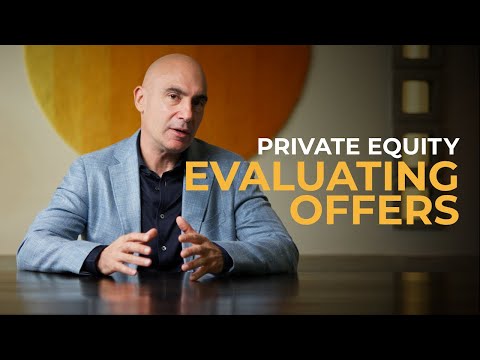
Evaluating Private Equity Offers: Control the Process &…
A Q&A clip from a Private Equity Masterclass featuring Paul Giannamore on evaluating multiple private equity offers. Topics include proactively controlling the negotiation process, interviewing PE firms to assess their capabilities and track record, differences between control and minority deal structures, the importance of due diligence on potential PE partners, and identifying and preventing potential retrades before narrowing down to the best-fit partners.
# Observation Document: "Evaluating Private Equity Offers: Control the Process & Maximize Value | M&A Masterclass Moment"
## Explicit Self-Description Evidence
### Creator identification
- The speaker identifies himself directly at the end of the video: <blockquote>"I'm Paul Gammore. Thanks for joining me today. I'll see you on the next one."</blockquote>
- He refers to himself as a professional advisor serving clients: <blockquote>"I love when clients actually take that approach. I love when clients sit there as opposed to being just very reactionary passive."</blockquote>
### References to a broader content series
- The video is presented as part of a larger educational offering, a "masterclass" series (also in the video title: "M&A Masterclass Moment"): <blockquote>"in both of the cellside master classes, I talked specifically about running a formal sellside process."</blockquote>
- He references prior extensive coverage: <blockquote>"I talked about it extensively in the sellside master classes."</blockquote>
### Direct audience solicitation
- The video ends with an explicit call-to-action for business owners contacted by private equity: <blockquote>"So, if private equity has reached out to you, feel free to reach out to me. You can contact me on the contact form below in the description, as well as you can always reach me on LinkedIn."</blockquote>
## Observable Presentation
### Intended audience
- **Business owners / founders considering selling to private equity.** The advice is framed around the seller's perspective throughout, e.g., <blockquote>"one of the things you should be concerned with if you're a seller about to sign with a private equity firm"</blockquote> and <blockquote>"if you just answer the telemarketer who's like, 'Hey, pool covers private equity,' then you're going to end up leaving a ton of money on the table."</blockquote>
- Specifically **lower/middle-market owner-operators**, evidenced by discussion of platform vs. tuck-in acquisitions and firm sizes ($100M to $1B businesses; PE firms with "$500 million under assets under management or two billion").
### Claimed scope of the channel/creator
- **Sell-side M&A advisory and education.** The speaker demonstrates advisory experience via a claimed recent deal: <blockquote>"Just last week, I closed a transaction with Digitalist Capital where they combined three fire protection companies... One of them was our client and the client was super happy."</blockquote>
- He presents himself as an experienced intermediary coaching sellers through processes, letters of intent, retrades, and deal structuring — not as a general business commentator.
### Demonstrated tone and teaching style
- **Casual, blunt, directive** delivery with colorful language: <blockquote>"they're using the douchebag playbook"</blockquote>, <blockquote>"this is a job interview baby"</blockquote>, <blockquote>"I'm not saying you need to be a dick about it."</blockquote>
- **Hypothetical role-play teaching device**, addressing an imagined seller ("Michael"): <blockquote>"let's say that you and I don't know who Michael is, but we're going to use him today. Michael, I appreciate your assistance."</blockquote>
- Encourages seller assertiveness: <blockquote>"you're the one creating the vision... You shouldn't be passive."</blockquote>
### Recurring themes demonstrated in this video
- Sellers should run formal, competitive processes and control negotiations with PE buyers.
- Distinction between PE buyers (diligence-heavy, retrade risk) and strategic acquirers: <blockquote>"private equity firms will spend hundreds of thousands, if not millions of dollars on due diligence, which is a multi-month process."</blockquote>
- Concern about retrades from industry-inexperienced PE firms: <blockquote>"I'm always a little bit more nervous when private equity is very heavy for me in a process, especially private equity that does not have experience in the particular industry."</blockquote>
- Control processes suit majority-stake sales; minority/growth-equity deals should avoid formal processes: <blockquote>"a control process sucks actually" for a "20% equity partner."</blockquote>
## Summary of Identity Signals
| Signal | Type | Evidence |
|---|---|---|
| Named creator "Paul Gammore" | Explicit | Closing self-introduction |
| M&A masterclass series | Explicit | "sellside master classes" references; title |
| Sell-side advisory practice | Explicit + demonstrated | "our client"; contact-form solicitation |
| Audience: PE-courted business owners | Demonstrated | Repeated second-person seller advice; closing CTA |
| Educational, candid tone | Demonstrated | Colloquial asides, role-play, direct warnings |
# Delivery Observation: "Evaluating Private Equity Offers"
## Tone & Register
- **Conversational, blunt, and unfiltered**: The speaker uses profanity and coarse dismissive language without hedging, e.g., "the **douchebag playbook**," "I'm not saying you need to be a **dick** about it," and "goes out and buys a company and **shits all over it**."
- **Direct second-person address**: Consistently speaks to "you" as the imagined seller, and frequently role-plays dialogue: > "No, this is what I want to do. Are you the right party to help me do that? Yes or no?"
- **Blunt value judgments stated declaratively**: > "a control process **sucks** actually. And I would largely advise people not to use formal processes..."
## Recurring Phrases & Verbal Habits
- **"At the end of the day"** — appears at least twice: > "Because at the end of the day, money is fungeable" and > "But at the end of the day, you're the one creating the vision."
- **"Here's what I mean"** as a setup-and-explain pattern: > "And here's what I mean by that."
- **Sentence-initial "So"** used constantly as a connective: "So, I'm not going to go into all the details today..."; "So once you run this thing through an iterative process..."; "So, if private equity has reached out to you..."
- **"Again"** as a recurring discourse marker to re-anchor topics: "Again, you want to take control of the process"; "So again, I think the broad process..."
- **Vague approximations paired with concrete numbers**: "a hund00 million business," "500 million or a billion dollar business," "$100 million... Congratulations. It's now a $90 million deal."
## Teaching Habits
- **Hypothetical role-play with a recurring stand-in character ("Michael")**:
> "Hey, Michael, I love your business."
> "So, Michael, you now have chosen the private equity firm... Michael, I appreciate your assistance."
He even acknowledges the device: > "let's say that you and I don't know who Michael is, but we're going to use him today."
- **Extended hypothetical scenario-building** to explain concepts, e.g., the **retrade** explanation delivered as a two-party dialogue: > "I'm giving you $100 million for your business... I'm going to ding you on the purchase price. Congratulations. It's now a $90 million deal."
- **Explicit references to prior content** ("masterclass cross-referencing"): > "in both of the cellside master classes, I talked specifically about running a formal sellside process. So, I'm not going to go into all the details today."
- **Definitional asides**: defining terms mid-flow — "And what's a retrade? A retrade is..." and "what I mean by a strategic acquire is..."
- **Sarcastic/parodic mimicry** of private equity personas: > "telling you all about their Ivy League schools that they went to and how they interned at Goldman Sachs and all this that you don't care about" and > "Hey, pool covers private equity."
- **Calls to action at close**: > "reach out to me. You can contact me on the contact form below in the description, as well as you can always reach me on LinkedIn. I'm Paul Gammore."
## Communication Patterns
- **Contrast framing** as the primary explanatory structure:
- PE process vs. broad process: > "a private equity process is slightly different than a broad process."
- Control vs. minority deals: squeezing "every penny" vs. "you don't have to extract every nickel off the table."
- Strategics vs. PE on diligence/retrade risk: > "you end up running into these sorts of things with private equity far more than you do with strategics."
- **Repeated empowerment/control theme**: the seller, not the buyer, should drive the process — "instead of them interviewing you, now you're interviewing them"; "this is a job interview baby. I want to know what you can do for me"; "you need to be the one creating the vision."
- **Anecdotal evidence from practice**: > "Just last week, I closed a transaction with Digitalist Capital where they combined three fire protection companies."
- **Casual asides and self-corrections**: > "they tend to be more sophisticated on the — I shouldn't even use the word sophisticated. They tend to be more cautious."
## Stability vs. Isolated Moments
- **Stable patterns** (repeatedly evidenced): "So"/"Again" connectives, second-person coaching, hypothetical dialogues, contrast framing, blunt register, cross-references to prior masterclasses.
- **Isolated moments** (single instances, insufficient repetition): the named client anecdote (Digitalist Capital), the profanity, the "Michael" acknowledgment aside, and the closing contact-form/LinkedIn plug. These appear once each; they characterize tone but cannot be confirmed as recurring habits from this transcript alone.
# Observation Document: Evaluating Private Equity Offers — Control the Process & Maximize Value
**Speaker:** Paul Gammore (self-identified at end of transcript)
**Format:** M&A Masterclass moment; sellside masterclass commentary with hypothetical seller "Michael"
## Core Thesis: Take Control of the Process
- The seller, not the private equity firm, should drive the process: **"The more you know what you want to do, the more you're going to be in control and the better off you're going to be."**
- By narrowing from ~200 PE firms to ~20, **"instead of them interviewing you, now you're interviewing them."**
- Gammore frames the meeting as a **"job interview"**: capital is fungible ("anyone can come up with capital"), so the seller should probe what capabilities each PE firm brings.
- Recommended diligence questions to PE firms: what they did at portfolio companies, returns on investments, who sat on boards, what changes they made.
### Tone Guidance
- Be assertive but not unpleasant: **"I'm not saying you need to be a dick about it"** — be playful, friendly, fun, but mission-driven.
- Rationale: thousands of PE firms mean wasted time if passive; answering "telemarketer" outreach (e.g., "pool covers private equity") means **leaving money on the table**.
## Control vs. Minority Situations
- **Formal control processes work well** for majority-stake sales — seller should "squeeze out every penny" and ensure proper structure.
- **Formal processes "suck" for minority/growth equity deals** (e.g., 20% equity partner). These are partnerships based on "capital as well as capabilities"; extracting every nickel isn't necessary.
- Indications of interest: ideally ~20, laid out simultaneously to compare price and terms.
## Different PE Firm Profiles and Endgames
- Illustrative options after whittling to a few firms:
- **Platform play:** PE commits to your industry, you become CEO and brand name — flattering but possibly "a ton of work" (speaker explicitly uncertain: "I don't know").
- **Combination play:** PE merges you with a larger/better-branded peer; you roll equity but are not CEO — potentially economically better.
- **Cited example:** "Just last week" Gammore closed a deal with **Digitalist Capital** combining three fire protection companies; the client (one of the three) "was super happy with the way it went down."
- Varying firm sizes matter: lower middle market firms building $100M businesses vs. upper middle market ($500M–$1B); AUM of $500M vs. $2B affects "runway."
- Sellers should set the vision so the wrong parties **self-select out**; don't fear offending PE firms — "they're a dime a dozen."
## Letters of Intent and Retrade Risk
### Strategics vs. PE Buyers
- **Strategic acquirers** (public or large private industry players), especially serial acquirers, are reputation-conscious, cautious pre-LOI, know the industry, and can suss out problems before signing.
- **PE firms** (unless deeply experienced in the industry) sign LOIs quickly, then conduct extensive, months-long diligence with outside experts, big accounting firms (quality of earnings), and consultants — spending "hundreds of thousands, if not millions."
### Retrade Warning
- A **retrade** is illustrated: $100M deal → after-LOI diligence reveals industry learnings → price cut to $90M, with the seller angry and the PE firm deferring to outside experts.
- Retrades happen "far more" with PE than strategics.
- Gammore's stated position: **"I'm always a little bit more nervous when private equity is very heavy"** in a process, especially industry-inexperienced PE, due to dramatically higher retrade incidence.
## Closing
- Call to action: contact Gammore via the contact form or LinkedIn if PE has reached out to you.
# Speaker Attribution Record
## Video
**Title:** Evaluating Private Equity Offers: Control the Process & Maximize Value | M&A Masterclass Moment
**Video ID:** `01a168c7-dab0-7a84-b757-3e14ab7c0fcc`
## Identified Speakers
### Primary (and sole) Speaker
- **Paul Gammore** — identifies himself by name at the close: *“I'm Paul Gammore. Thanks for joining me today.”*
- **Role:** Creator / instructor. He references his own **“sellside master classes”** as prior teaching content, indicating a series-creator relationship to the material.
### Hypothetical / Illustrative Figures (not actual speakers)
- **“Michael”** — a hypothetical client used as a teaching example, explicitly framed as such: *“I don't know who Michael is, but we're going to use him today. Michael, I appreciate your assistance.”*
- Named illustrative acquaintances (**Jim, Bob, Helen**) appear only within the hypothetical scenario; they do not speak.
## Provenance & Referenced Facts
### Referenced Third Parties / Transactions
- **Digitalist Capital** — cited as counterparty in a transaction the speaker says he closed “just last week,” combining three fire protection companies, one of which was his client.
### Sources Referenced
- The speaker's own **sellside master classes** (prior content by the same creator).
- **Private equity firm websites / portfolio company pages** — recommended as due-diligence research sources.
- Mentioned but unnamed diligence actors: **outside industry experts**, **large accounting firms** (transaction services, quality of earnings reports), **consultants**.
### Promotional Segments
- **Closing call-to-action (explicit promotion):** *“So, if private equity has reached out to you, feel free to reach out to me. You can contact me on the contact form below in the description, as well as you can always reach me on LinkedIn. I'm Paul Gammore.”* — This is a promotional/contact solicitation segment and should be flagged as such.
## Availability & Uncertainty
- **Curated metadata:** None supplied with this source.
- **Comment availability:** Not stated in the source; unknown.
- **Timestamps:** Not available in transcript.
- No guest, narrator, or additional speakers present beyond the creator.
Now, in both of the cellside master classes, I talked specifically about running a formal sellside process. So, I'm not going to go into all the details today, but here's one of the things that I will say specifically when you're
dealing with private equity. Now that you've come up with your own game plan, you've kind of determined what your business is worth today, what your business might be worth in 5 years. If you can apply all these different levers to the business, now you're able to start sitting down with private equity firms in a process. And for me, a private equity process is slightly different than a broad process when you're dealing with both private equity firms and strategic acquirers.
The more you know what you want to do, the more you're going to be in control and the better off you're going to be. And here's what I mean by that. When you whittle that playing field down from 200
private equity firms to 20, now you can bring these guys in and instead of them interviewing you, now you're interviewing them. Now you're sitting these guys down and they're using the douchebag playbook and telling you about, you know, bites of the apple and turns of this and blah blah blah blah blah, telling you all about their Ivy League schools that they went to and how they interned at Goldman Sachs and all
this that you don't care about. Now, you're going to be able to say, "Okay, private equity firm, I I want to know specifically what you've done on all these various different portfolio
companies that you've already researched because they're on their website. So, you've read about every portfolio company. You know, the individuals that actually did the deals with the private equity firm. You're going to talk to them about what sort of capabilities did they bring to the table, what were their returns on those investments, who was on the board from the private equity firm at those companies, what sort of changes in the business. You're going to be able to get into a tremendous amount of detail and have them walk you through specifically what they were able to do to create value. Because at the end of the day, money is fungeable, right? Meaning anyone can come up with capital. You don't need a sophisticated private equity firm to do that. But what private equity firms do in addition to that is they bring a lot of various capabilities
to your firm and hey listen this is a job interview baby. I want to know what you can do for me. And I love when clients actually take that approach. I love when clients sit there as opposed to being just very reactionary passive
and like I think I want to sell my business and I'm not quite sure what can you do for me and that. No, this is what I want to do. Are you the right party to help me do that? Yes or no? And if you're not, let's not waste any more time. Now, I'm not saying you need to be a dick about it, and as I say in my Southside master classes, I think you need to be playful and you need to be friendly and you need to be fun, but you're on a mission and you have to
remember that because you will waste a lot of time. There are thousands of private equity firms. You'll waste a tremendous amount of time on the one hand. And on the other hand, if you just answer the telemarketer who's like, "Hey, pool covers private equity," then
you're going to end up leaving a ton of money on the table. You don't want to do that either. Again, you want to take control of the process. And when you're doing a private equity deal, again, the right way is you go through this process, you're going to get indications of interest. Like the private equity firms are going to say, "Hey, Michael, I love your business. You know, here's what we would do with it. You know, we'll pay between X and Y. Here's how we'd structure the deal. You're going to roll, you know, 15% of the purchase price. We're going to keep you on. We're keep your right-hand man on. Um, here are the things that we intend to do with the business." We enjoyed our conversation. We talked about all these
different levers we can pull. here's what we'd do. Here's how we'd structure it. We'd love your opinion on our proposal. And so you'll get a handful of these, you know, ideally you'll get 20 of them, right? And so you've got a lot
and you can lay them all out on the table simultaneously and you're going to say, "Oh, this one's a piece of and this one's crap, but this one I like these. I like the purchase price. I like what they have to say. Now we're equipment with gas. Now we can start a process." When you're contemplating a control situation, when you're contemplating a private equity firm buying a majority stake in a business, a control process works quite well. When you're doing a minority interest in a business, when you're going to do a growth equity investment, a control process sucks actually. And I would largely advise people not to use formal processes when you're taking on a 20% equity partner. I mean, you're not giving up a ton of equity. So, I mean, you don't have to extract every nickel off the table here. Um, and what you're doing is you're forming a partnership with a minority investor. It's really a partnership based on some capital as well as some capabilities. Whereas, when it's a control situation, I mean, the majority of your your business is being transacted for, right? So, you want to make sure that you get every penny you can squeeze it all out. Uh, you want to make sure that the deal is structured appropriately, and we'll talk about that. So once you run this thing through an iterative process and again I'm not going to belabor that because I talked about it extensively in the sellside master classes. Now you find yourself with a whittleled playing field of 1, two, three private equity firms and you might be faced with a variety of different options. One private equity firm might say hey we love your industry Michael like we're all in on this and you're going to be our platform and this is going to be our brand name and we're going to do all these acquisitions and we're going to make you the CEO and you're feeling great. I'm getting all this money. I'm going to be CEO. This is fantastic. That might be an interesting opportunity for you, but you might have a ton of work to do. I don't know.
Then, Michael, you might have another situation. You might have a private equity firm that says, "Hey, listen. We're looking at two businesses in your industry, Michael. Um, one's a little bit bigger. It's got a better brand
name. So, we're going to combine those two. We're kind of working on the other one now. We want to do it simultaneously. Um, so we will use your business, but you can kind of stick around. We definitely need you to roll equity, but you're not going to be the CEO." But when you look at it in the economic terms are right, that might be a better situation for you. Just last week, I closed a transaction with Digitalist Capital where they combined three fire protection companies like on the first deal and uh they used one of the brands, combined three of them. One of them was our client and the client was super happy with the way it went down. So, you'll find different flavors as you deal with private equity firms. What I'm trying to impress upon you is every one of them is different. Every one of them may be contemplating different deals. Every one of them will have different ways in which they operate. Some are lower middle market private equity firms, right? They're only going to build a hund00 million business. Some are kind of middle market or upper middle market. They're going to buy a build a 500 million or a billion dollar business. And so what sort of deep pockets does the private equity firm have? Are you dealing with somebody that has 500 million under assets under management or two billion? Right? And so there's those sorts of considerations and um I think it allows you to really understand what sort of runway you're going to have. So again, I think the broad process of taking a lot of private equity firms, meeting the lower middle market, the upper middle market, where you're going to be a platform, where you're going to be a tuck in, where doing those sorts of things gives you some optionality. But at the end of the day, you're the one creating the vision. I I I want you to really think about this like you need to be the one creating the vision for this business. You shouldn't be passive. Now, your vision can change, right? Your vision
can change, but I think setting the vision for yourself is suddenly like structuring boundaries where the other party is going to very quickly self- select. Like, do I want to do business with Michael? Like, he's got this
grandiose plan and he wants a financial sponsor that looks like this. That's not us. Well, that's great. That's great. You you just got valuable information. That's not the right party. Don't waste time on them because I can promise you there's scores of other private equity firms that'll fill right in where they've left. Don't fear offending any of these guys. Don't feel like you're cutting them out of the process because they're a dime a dozen. Okay. So, now you've gone through this and let's say that you and I don't know who Michael is, but we're going to use him today. Michael, I appreciate your assistance. So, Michael, you now have chosen the private equity firm that is going to put your face on the mug, so to speak, right? You're going to be the big daddy, the CEO. They're using your brand. You're the platform. And you've done a great job because you've in in your Southside materials as you were going through this process, you sat down with me and you said, "Paul, there are seven or eight companies I want to acquire." And I've met with all of these guys. I know Jim and I know Bob and I know Helen and I know their kids and I know what they're do, what they do. I know how they fit into our business. I kind of had a sense of what I would have to do in order to be able to buy them. So, I've got my acquisition pipeline. You've got your financial plan. You've got your systems plan set up from a tech perspective. You're like, I need to revamp this tech system. It's going to shave a few basis points off our cost. You've got this plan all put together. The private equity firms loved it. They're giving you a great price. Now, the deal's actually about to start. Right now, we're at ground zero effectively. Now, we're going to sign a letter of intent. And the letter of intent, I think, is important um with private equity firms
and sometimes more important because you know in any industry when you're dealing with a strategic acquire and what I mean by a strategic acquire is an acquire that might be a publicly traded company
or a large privately held business within your industry. They're very well known in the industry that you operate in. And if they're serial acquirers, meaning they go out and buy a lot of businesses, have done so for a long time. They are particularly concerned about the reputation. They don't want to be the company that goes out and buys a company and shits all over it and then gets a bad reputation, then no one else wants to do a deal with them. So, they tend to be pretty careful. They tend to be more sophisticated on the I shouldn't even use the word sophisticated. They tend to be more cautious on the front end when they sign letters of intent and they want to make sure they anticipate what they might find in diligence. They're also familiar with your industry, so they can ask you a lot of questions that sometimes private equity firms can't because they actually know what you do intimately, and so they can sus out problems usually on the front end of signing a letter of intent. Private equity firms don't, however, unless they have a tremendous amount of experience in your industry. What a private equity firm will often do is bring on outside experts. They'll sign a letter of intent, and then their diligence process is often extensive. They're going to bring in outside industry experts. They're going to bring in large accounting firms to do transaction services, quality of earnings reports. They will bring in a lot of consultants. And you know, private equity firms will spend hundreds of thousands, if not millions of dollars on due diligence, which is a multi-month process. And I think one of the things you should be concerned with if you're a seller about to sign with a private equity firm is if this is a new industry for them, they are probably going to learn a lot
not only about your business, but about the industry after they sign the letter of intent. And you might be at risk for a retrade. And what's a retrade? A
retrade is I'm giving you $100 million for your business. sign this letter of intent. You say, "Fine, I'll sign the letter of intent." We sign the letter of intent. Now, I start doing all this diligence and I'm like, "Yeah, you know, I didn't really realize how these widgets were made. It doesn't I mean, like I don't know if we're going to be able to do exactly what we want because and you're like, well, that's how widgets are made." And I'm just like, I didn't know that. I got this expert guy over telling me that widgets are made differently and I'm not quite sure. So, I think we're going to have to make a new widget conveyor belt, which is going to cost us money. And so, I'm going to ding you on the purchase price. Congratulations. It's now a $90 million deal. And so, you're violently upset because you want this private equity firm. These guys are morons. They've never run a business in their life. And the private equity firm's like, "I don't know. We're talking to these experts out there and they're telling us that you're not right." And so you end up running into these sorts of things with private equity far more than you do with strategics. Which is why I'm going to say it publicly. I'm always a little bit more nervous when private equity is very heavy for me in a process, especially private equity that does not have experience in the particular industry I'm dealing with because I know the incidence of a retrade could be dramatically higher than if I'm dealing with a an experienced private equity firm or a strategic. So, I just want you to make a little mental note of that as we walk through this process. So, if private equity has reached out to you, feel free to reach out to me. You can contact me on the contact form below in the description, as well as you can always reach me on LinkedIn. I'm Paul Gammore. Thanks for joining me today. I'll see you on the next one.