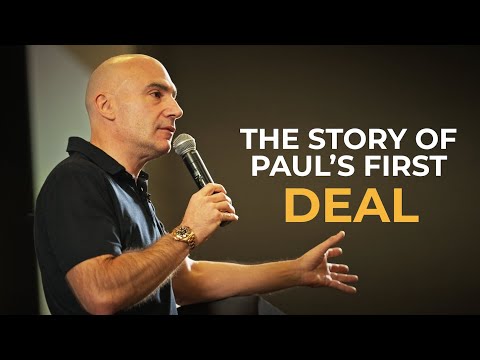
Negotiation vs. Auction: How a Family Heirloom Changed…
A highlight from Paul Giannamore's AZPPO keynote in which he recounts selling his family's rare Italian violin in the early 1990s and uses that experience to illustrate a core sell-side M&A lesson: choosing the right selling process—an auction versus a negotiated sale—can matter more than negotiation tactics themselves.
# Channel Presentation Observations: Sell-Side M&A Video
## Intended Audience
- **Business owners / prospective sellers**: The speaker frames the lesson around "when I think about the sale of a business," implying viewers are considering selling companies.
- **Possibly M&A professionals or students**: The speaker addresses an audience directly — *"you guys are just waking up so we're going to do a few thought experiments"* — suggesting a morning seminar, workshop, or classroom-style setting.
- **Readers of negotiation literature**: He references people who "read... Donald Trump's book or Chris Voss's book or any of these negotiation books," positioning his content as a counterpoint or supplement to popular negotiation frameworks.
## Claimed Scope / Expertise
- **Personal M&A advisory role**: *"as an M&A adviser my job is to do two things: I'm negotiating substance... but I'm also negotiating process."*
- **Long experience with auctions**: *"since then I've been to scores of auctions around the world... I've sold companies at auction, I've been to farm auctions... watch auctions, art auctions."*
- **Wall Street credibility claim**: *"on Wall Street most of these businesses are sold through without negotiating at all"* — asserting insider knowledge of how deals actually close.
- **Educational intent**: *"what I want to do is I want to walk you through a [side] process... where there's no negotiation"* and *"we're going to do some very very basic experiments and then I'm going to add to some complexity."*
## Self-Description Evidence (Explicit)
- The speaker describes himself as a **"process setter"** and **M&A adviser** whose leverage comes from designing the sale process, not just haggling over price.
- He claims roughly **30 years** of deal experience: *"my first foray into this was... going on 30 years ago."*
## Observable Presentation Patterns (Demonstrated)
- **Storytelling-first pedagogy**: Opens with a lengthy, humorous personal anecdote (the family violin, "a chameleon named Lester," the $50,000 canvas bag) before pivoting to the business lesson.
- **Conceptual framing**: Contrasts **direct negotiation vs. auction** as the two sale paths: *"it really comes down to one of two ways: direct negotiation like with the art collector, or auction through the auction house."*
- **Embedded negotiation terminology**: Labels tactics within the story itself — *"he made that offer, time bound, attempted to use a closing move on me... I appealed to higher authority"* — demonstrating the channel teaches negotiation concepts through narrative.
- **Interactive/teaching format**: Promises live "thought experiments" and increasing complexity, indicating instructional rather than pure commentary content.
## Notes on Limits
- No curated metadata was supplied; identity observations rest solely on the title and transcript.
- The speaker's motivations or beliefs beyond the stated educational purpose are not addressed.
# Delivery Observation: Negotiation vs. Auction
## Tone
- **Conversational and anecdotal** — the speaker opens with a personal family story rather than theory: *"my first foray into this was... my family was living on the west side of Chicago."*
- **Casual, informal register** with colloquial phrasing: *"sell this bad boy," "how the hell to do that," "my sister is a total bust."*
- **Humorous and self-deprecating** moments, especially when listing absurd trade offers: *"a chameleon named Lester, an RM80 dirt bike, a new VHS video recorder."*
## Vocabulary & Style
- Frequent **quantified specifics**: dollar figures and dates recur throughout — *"about $3,000 bucks," "$50,000 in cash," "65 Grand," "$105,000," "probably 1991."*
- **Business/M&A terminology** appears once the story pivots: *"cide process," "anchoring," "counter offers," "win-win negotiations," "process setter," "m&a adviser," "Leverage."*
- Uses **named references** to ground claims: *"Donald Trump's book or Chris voss's book."*
## Teaching Habits
- **Extended personal anecdote as scaffolding** — roughly the first two-thirds of the transcript is one story (selling a violin), explicitly framed as a lesson: *"it was the first experience I'd ever had with an auction."*
- **Labels negotiation tactics as he recounts them**, turning story beats into teaching points: *"when he made that offer time bound attempted to use a closing move on me... I appealed to higher authority."*
- **Advance signaling of structure** — he previews the session's plan: *"we're going to do a few thought experiments... I want to walk you through a cide process where there's no negotiation."*
- **Audience-aware asides**: *"you guys are just waking up."*
- **Build-then-complicate promise**: *"we're going to do some very very basic experiments and then I'm going to add to some complexity."*
## Recurring Phrases
- **"You know"** as a frequent filler/connector: *"you know what we could some money," "you know there's orchestras here," "you know you read these books."*
- Repetition for emphasis: *"very very basic experiments."*
- **"At the end of the day"** — appears once (*"because at the end of the day"*); insufficient repetition to call a stable pattern.
## Communication Patterns
- **Contrast framing** — the central rhetorical structure sets two options against each other: *"direct negotiation like with the art collector or auction through the auction house."*
- **Escalating-value storytelling** — each step in the anecdote raises the price ($0 offers → $3,000 → $50,000 → $65,000 → $105,000), building toward the lesson.
- **Summary transitions** from story to principle: *"when I think about the sale of a business it really comes down to one of two ways."*
- Ends with an **open, forward-looking setup** rather than a conclusion, indicating this is the start of a longer session.
## Uncertainty Notes
- Some transcript garbling limits observation: *"a cide process"* (likely a mis-transcription of a term such as "sell-side process"), and *"Crona"* / *"Strater"* appear phonetically rendered — no conclusions drawn from these.
- Judgments about personality or motivation are outside observable scope and not attempted.
# Observation Record: Negotiation vs. Auction — Paul's Violin Story & Sell-Side M&A
## Source
- **Video:** "Negotiation vs. Auction: How a Family Heirloom Changed Everything for Paul | Sell-Side M&A"
- **Speaker:** Identified in title as "Paul"; transcript is first-person narration. No other speaker metadata supplied.
## Narrative Claims (Paul, first-person account)
### The Heirloom
- ~30 years ago (context suggests ~1991), Paul's family on Chicago's **west side** discovered they owned a valuable **violin from Cremona, Italy**, made in the **same shop Stradivari worked in, in the 1700s**.
- The family had **no idea how to sell** a rare musical instrument or what it was worth.
### Attempt 1: Online Listing (Paul's sister)
- His sister listed it on "the precursor of Craigslist": *"violin made 1717, old, probably worth a lot, who wants to buy it."*
- Result: no serious cash offers — offers included **a chameleon named Lester, an RM80 dirt bike, and a VHS recorder**. Paul characterizes this attempt as "a total bust."
### Attempt 2: Local Music Shop (Gus)
- Gus, a family friend and shop owner, said: *"I have never seen anything like this but it's got to be worth about $3,000."*
- Gus offered to try to sell it; Paul told his father, *"I don't think Gus is our guy."*
- Paul notes $3,000 was significant then, since his house was likely worth under $100,000.
### Attempt 3: Direct Negotiation (via University of Chicago professor)
- A music conservatory professor connected Paul with a **collector**.
- The collector emerged with a **canvas bag of $50,000 cash** and made a **time-bound, accept-now closing offer**.
- Paul, lacking authority, **appealed to higher authority** ("I've got to talk to the family") and stepped out.
- The next day, after speaking with the professor, the collector raised the offer to **$65,000, described as "final."**
- Paul interpreted the $50K→$65K jump as evidence of a **negotiation process with unrealized value**.
### Attempt 4: Auction (New York auction house)
- A professor-recommended rare-instrument auction company estimated the violin would fetch **~$100,000 at auction**.
- Paul flew to New York (free travel via his father's airline job) with the violin in his backpack.
- **Result: sold at auction for $105,000** — "more than the house I lived in at the time," which Paul calls "literally hitting the lotto" for his family.
## Positions & Reasoning
### Core Lesson Drawn by Paul
- Selling a business comes down to **one of two methods**:
1. **Direct negotiation** (like the collector)
2. **Auction** (through an auction house)
- There is **"not really a clear-cut way of doing it"** — it takes **judgment** about both the **seller's profile** and the **buyers' profiles**.
### On Negotiation Literature vs. Wall Street Practice
- Books he names — **Donald Trump's** and **Chris Voss's** — focus on counter-offers, anchoring, influence methods, win-win negotiation.
- Paul's stated position: **"for the large part... on Wall Street most of these businesses are sold through without negotiating at all."**
### On the M&A Adviser's Role
- As an M&A adviser, Paul says his job has **two parts**:
1. Negotiating **substance** — purchase price and terms
2. Negotiating **process**
- His claim: **"the process is what effectively really gives you leverage in a sale process."**
## Forward-Looking Statement
- Paul announces intent to walk the audience through a **"cide process"** (likely "sell-side process," per video title) **with no negotiation**, using basic **thought experiments** that grow more complex, to show how this works in real life.
## Qualifications & Tensions to Preserve
- Paul explicitly frames the auction-vs-negotiation choice as **judgment-dependent**, not rule-based.
- The story contains an implicit tension: the collector's negotiation raised the price from $50K to $65K, yet the auction ($105K) still outperformed both — presented as anecdote, not a generalized proof that auctions dominate.
- Dates are approximate and stated from memory ("probably 1991," "going on 30 years ago").
# Speaker Attribution Record
## Video
**Title:** Negotiation vs. Auction: How a Family Heirloom Changed Everything for Paul | Sell-Side M&A
**Video ID:** `01a168c7-fe86-76d4-8ba4-4b59bd6d8ff1`
## Speakers
### Primary Speaker — Paul (Creator / Presenter)
- Identified by title ("**for Paul**") and self-reference as the storyteller.
- Roles evident in transcript:
- **Creator/presenter** delivering a talk to an audience ("you guys are just waking up").
- **M&A adviser** ("as an m&a adviser my job is to do two things") — stated self-identification.
- **Narrator** of a personal anecdote about selling a family violin.
### Mentioned Third Parties (non-speaking, within the story)
- **Paul's father** — initiated sale idea; worked for an airline.
- **Paul's sister** — attempted online sale on Craigslist precursor.
- **Gus** — music shop owner; offered informal appraisal (~$3,000).
- **University of Chicago music professor** — connected Paul to collector and auction house.
- **The collector** — made time-bound offers ($50,000, then $65,000).
- **Unnamed auction house** — appraised ~$100,000; sold violin for $105,000.
## Audience
- Implied live audience ("you guys are just waking up") — non-speaking participants.
## Referenced Sources / Claims
- **Donald Trump's book** (negotiation) — referenced generally.
- **Chris Voss's book** (negotiation) — referenced generally.
- Anecdotal claims (violin provenance, offers, prices) are **first-person, uncorroborated** by supplied metadata.
## Promotional Segments
- **None detected** in the transcript.
## Provenance & Availability Limits
- No curated metadata supplied beyond title and transcript.
- **Comment availability:** unknown/not stated.
- Quotes are paraphrases from transcript; names possibly transcribed phonetically (e.g., "**Strater**" likely Stradivari; "**Crona**" likely Cremona) — flagged as transcript uncertainty, not corrected.
and my first foray into this was I don't know Going on 30 years ago my family was living on the west side of Chicago we discovered that we had a very valuable
violin that had come over with us from Italy was made in Crona in the same shop that Strater worked in in the 1700s and we had no idea how much this thing was worth and so my father got the bright idea and said you know what we could some money so let's sell this bad boy now the problem was it's a rare musical instrument and none of us had any idea how the hell to do that so my little sister decided to head out on an expedition on the internet which was quite new at the time and she went onto the precursor of Craigslist and decided she was going to put it online vien Maiden 1717 Old as probably worth a lot who wants to buy it she got a lot of interesting offers a lot of interesting trades for sure um package deals a chameleon named Lester an RM80 dirt bike a new VHS video recorder but she didn't really come up with some great cash offers so my father's next idea was go see his friend who ran a music shop Named Gus we went in we saw Gus and Gus sweet old man looked at it and said I have never seen anything like this but it's got to be worth about3 ,000 bucks and that was a lot of money back then cuz the house I lived in I don't even think it was worth 100 Grand at the time so but he said you know I've never seen one of these before but I think I can probably sell it for you and I was like Dad I don't think Gus is our guy The Next Step was to go down to the University of Chicago I went to the Music Conservatory and I thought you know there's orchestras here there's got to be people that know what the hell they're doing when it comes to musical instruments I talked to a professor there and he said you know what it's a valuable instrument you got there and I know a collector I said okay so he set me up an appointment I went to this collector's home as I sat there The Collector looked at the instrument and said I am interested in this he went
into the back room he came out with a bag a canvas bag I distinctly remember it and it had $50,000 in cash in it I remember I was a young kid and this was
probably 1991 that was a lot of money so he looked at me and he said I will buy this instrument right now for $50,000 in cash but you've got to accept this deal right now now unfortunately I didn't have the authority to do that and when he made that offer time bound attempted to use a closing move on me I got a little bit nervous so I stepped out and I said you know what I've got to talk to the family about this I appealed to higher authority and said I'm not the decision maker I got to step off I got to talk to my parents went back to the professor and I said Professor I don't know what to do he offered me $50,000 now between the time I left his home and the following day when I saw the professor The Collector called and said you know what tell that kid I'll give him 65 Grand that's my final offer so now I'm thinking to myself okay I am in the process of negotiating with the collector um my sister is a total bust on her online sale process my father's still hanging out drinking coffee with Gus and so what should I do the professor said well you know I do know that there's instrument auctions take place often times in New York we have them in Chicago but there's a company that deals with these rare instruments maybe you should talk to them so I got their phone number placed a phone call um my father worked for an airline
so it was super easy for me to travel back then so I took a violin which at the time I knew to be worth at least $65,000 and put in my backpack and got on the plane
went out to New York I met with the auction house they looked at it and said this thing will sell at auction for a approximately $100,000 now that was amusing to my ears and so I learned about the auction process I eventually we engaged the auction house which sold the violin for $105,000 which was worth more than the house I lived in at the time so it was a literally hitting the lotto for my family um but it was a first it was the first experience I'd ever had with an auction right and since then I've been to scores of auctions around the world for everything from I've sold companies at auction I've been to farm auctions I've been to watch auctions art auctions now but when I think about the sale of a business it really comes down to one of two ways direct negotiation like with the art collector or auction through the auction house and there's not really a clear-cut way of doing it takes a lot of judgment to determine not only the profile of the seller but also that of the buyers and I think today what I want to try to do is I want to you guys are just waking up so we're going to do a few thought experiments but ultimately what I want to do is I want to walk you through a cide process and I want to walk you through a cide process where there's no negotiation because at the end of the day whenever you read you know you read these books you know Donald Trump's book or Chris voss's book or any of these negotiation books are always talking about things like counter offers and anchoring and methods of influence and win-win negotiations the for the large part you know on Wall Street most of these businesses are sold through without negotiating at all and as a process Setter so as an m&a adviser my job is to do two things I'm negotiating substance right I'm negotiating purchase price and terms but I'm also negotiating process and the process is what effectively really gives you Leverage and a sale process and we're going to do some very very basic experiments and then I'm going to add to some complexity here so that we can see how this works in real life