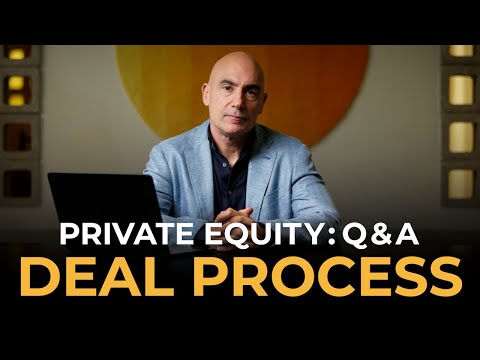
PE Questions Answered: Timelines, Inbounds, Diligence &…
A Private Equity Q&A Masterclass segment in which Paul Giannamore answers common questions from business owners approached by PE firms, covering how long PE deals take, how to handle inbound PE outreach, when to engage an advisor, due diligence workstreams (financial, legal, operational), why first-time industry buyers dig deeper, the question of debt loading, the rights PE firms typically get post-close, and whether a seller can back out after signing a Letter of Intent.
# Channel Presentation Observations
## Creator Self-Identification
- **Named individual presenter:** The creator identifies himself as **Paul Gammore** in the closing: *"My name is Paul Gammore. Thank you for joining me today."*
- **Advisory role claimed:** He presents himself as an advisor with active clients: *"this is a question I get every single day because our clients always have private equity firms reaching out to them directly"* and *"I'm going to answer this like I would answer any one of my clients."*
- **Named advisory firm:** He references **"PTOIC's my advisor"** when describing how clients respond to PE inbounds, implying affiliation with an advisory firm of that name.
## Claimed Scope of Content
- **Educational format on private equity transactions:** The video answers a series of seller-side questions about private equity: deal timelines, handling inbound PE outreach, due diligence, leverage concerns, deal rights, and walking away from letters of intent.
- **Reference to a broader educational product:** The creator mentions a **"private equity master class"** as ongoing programming: *"When I talk about this in the private equity master class, which you want to be at the driver's seat..."*
- **Series framing (title-level):** The title labels this a *"PE Q&A Masterclass Moment,"* suggesting it is an excerpt from a longer Q&A-format session.
## Intended Audience
- **Business owners / potential sellers:** Questions are framed from the seller's perspective, e.g., *"What should I do if a private equity firm reaches out to me?"* and *"Will private equity firms put my business in excessive debt?"*
- **Mixed client/non-client viewership explicitly addressed:** The creator differentiates advice by audience — *"for those of you out there who are not a client and don't have an adviser"* versus existing clients who are told to *"just forward the email."*
- **Decision-stage owners considering exit:** Advice centers on exit planning: *"you should determine what it is you want to do with your business, when you want to exit, how you're going to create value."*
## Observable Presentation Patterns
- **Advisory positioning:** Answers are delivered from the stance of a professional advisor ("like I would answer any one of my clients"), not a neutral educator.
- **Direct engagement funnel:** The creator closes with two contact paths: *"reach out to me directly on the contact form in the description below or join me on LinkedIn."*
- **Accessible explanatory tone:** Complex PE concepts are explained with everyday analogies, e.g., comparing choosing a PE partner to buying a vacuum: *"you find out what vacuum you want. You read reviews... and you go out and buy it."*
- **Reassurance-and-caveat pattern:** Several answers temper seller anxieties while noting caveats — e.g., on debt: *"I think that's often an unwarranted concern. Although it's not entirely unwarranted."*
# Delivery Observations: PE Q&A Masterclass Moment
## Format & Structure
- **Q&A format**: The speaker reads or restates viewer questions verbatim, then answers each one. Every segment opens with an interrogative: *"What's the timeline for a typical private equity investment?"*, *"What should I do if a private equity firm reaches out to me?"*, *"What kind of diligence can I expect from a private equity firm?"*, *"Will private equity firms put my business in excessive debt?"*, *"What rights do private equity firms typically demand in a deal?"*, *"What happens if I change my mind after signing a letter of intent?"*
- **Bookended with direct address**: Opens by answering immediately; closes with a sign-off thanking viewers and giving contact channels: *"Thank you for joining me today… feel free to reach out to me directly on the contact form in the description below or join me on LinkedIn."*
## Tone
- **Conversational, advisory register**: Uses "you know," "I mean," "look," "right?" repeatedly — e.g., *"I mean, look, um, some of you do."*
- **Direct, plain-spoken**: *"Significant."* — a one-word answer to the diligence question. *"Typically not."* — equally clipped on the debt question.
- **Balanced hedging**: Qualifies absolute answers: *"Although it's not entirely unwarranted. It should be considered, but I don't think it should be a concern."*
## Recurring Phrases & Teaching Habits
- **First-person advisory framing**: Repeatedly anchors advice in his client practice: *"this is a question I get every single day because our clients always have private equity firms reaching out"*, *"I'm going to answer this like I would answer any one of my clients."*
- **Enumerated options**: For the inbound question he lists numbered paths: *"That's one way to handle it. The other way to handle it is… Um, and number three…"*
- **Self-referencing his masterclass**: *"When I talk about this in the private equity master class, which you want to be at the driver's seat…"* — a cross-promotional teaching habit.
- **Repeated rhetorical constructions**: "Let's…" imperatives for diligence: *"Let's understand what revenue is. Let's understand what cash flow is."* Rapid-fire "How" questions: *"How is the business organized? How's it structured? How does it operate?"*
## Analogies & Metaphors
- **Everyday analogy**: The vacuum/pool-cover telemarketer comparison — *"you don't often answer the call from telemarketers… you find out what vacuum you want. You read reviews… and you go out and buy it."*
- **Colorful relationship metaphor**: *"You might have a long kind of mating dance with them before you consummate."*
- He explicitly flags the analogy's limits: *"Now, I know selling your business isn't the same thing as buying a vacuum, but you get the point."*
## Vocabulary
- Domain vocabulary delivered without simplification: *diligence, work streams, letter of intent, non-binding, control stake, postclosing, inbounds, strategics, LOI*.
- Informal business idioms: *"mating dance," "driver's seat," "tooling around," "fielding inbounds," "go out and hunt."*
## Communication Patterns
- **Direct address to viewer segments**: Distinguishes clients from non-clients: *"for those of you out there who are not a client and don't have an adviser…"*
- **First-person disclosure of judgment**: *"but I never really think about the complications of a intensive due diligence session swaying me from whether or not I would do do a deal."*
- **Emphatic warnings**: *"Make no mistake"* preceding the point about post-closing control.
- **Disfluency present but not dominant**: Occasional repetitions and false starts (*"how how are team members incentivized," "do do a deal"*) — consistent with an unscripted or lightly scripted delivery.
## Uncertainty Notes
- The video is a short excerpt ("Masterclass Moment"), so habits like the masterclass cross-reference and sign-off can only be observed once each here; their frequency across the full course is unverified.
- Intonation, pacing, and gestures are not observable from the transcript; tone observations rest solely on lexical and structural cues.
# Observation Document: PE Q&A Masterclass Moment
**Speaker:** Paul Gammore (self-identified at end of transcript)
## Q1: Timeline for a Typical PE Investment
- **Range:** "Multiple years to a few months" — depends on how the engagement begins.
- **Informal courtship:** If a seller engages with a PE firm on their own, there may be a **long "mating dance"** before a deal.
- **Formal process:** Once serious, particularly in a formal process, **3 to 5 months** is "pretty much what it takes to get a deal done."
## Q2: What to Do If a PE Firm Reaches Out
Gammore notes he receives this question "every single day" from clients.
- **For his clients (with an advisor):** Three options:
1. Reply and disclose the advisor: *"PTOIC's my advisor. Here's your contact information."*
2. Ignore it — "you're not compelled to answer anyone."
3. Forward the email to the advisor, who will contact the PE firm "in the appropriate time period."
- **For those without an advisor:**
- Meeting PE firms just to understand their world: "I don't see a problem in meeting with them."
- If actually considering a transaction: **get an advisor first**, don't meet with PE firms until a plan is in place.
- **Core position:** Be in the **driver's seat**, not passive. Decide what you want for the business, exit timing, value creation plan, and desired partner type — then "go out and hunt for the appropriate parties."
- **Analogy:** You don't buy a vacuum from a telemarketer; you research what you want and buy deliberately. He concedes: "selling your business isn't the same thing as buying a vacuum, but you get the point."
## Q3: Expected Diligence from a PE Firm
- **Overall:** "Significant."
- **New industry entrants** do **more diligence** than PE firms already operating in an industry, because new entrants must both verify the asset and **learn the industry**, fit, and acquisition opportunities.
- **Core diligence areas:**
- **Accounting/finance:** verify revenue, cash flow, seller claims; outside advisors brought in.
- **Legal:** lawsuits and their implications; title/ownership of the asset.
- **Operational:** organization, structure, org chart ("work chart"), team incentives, comp structures and harmonization.
- **PE vs. strategics:** PE diligence "tends to be a little bit more difficult... for a lot of sellers than strategics" (qualified with "I think").
- **His stance:** Intensive diligence alone wouldn't sway him from doing a deal with an acquirer.
## Q4: Will PE Firms Put My Business in Excessive Debt?
- **Typically not** — "often an unwarranted concern."
- **Qualification preserved:** "Although it's not entirely unwarranted. It should be considered, but I don't think it should be a concern."
## Q5: What Rights Do PE Firms Typically Demand?
- Depends on **minority vs. majority** deal structure.
- For most viewers: a **substantial or control stake**, giving the PE firm power to:
- Fire the seller
- Replace them as CEO
- Change the board
- **Qualification:** "they won't necessarily do that if you're performing," but they will have substantial post-closing control — "Make no mistake."
## Q6: Changing Mind After Signing an LOI
- Write a letter stating you've changed your mind and aren't moving forward.
- **Caveat:** unless the LOI was binding — which he says would shock him absent poor advice.
- For the most part, LOIs are **non-binding** and **either party can walk away**.
# Speaker Attribution & Provenance Record
## Video
**Title:** PE Questions Answered: Timelines, Inbounds, Diligence & Deal Rights | PE Q&A Masterclass Moment
**ID:** `01a168c7-d0e3-7aba-9aa9-fdcc5563f5d4`
## Speakers
### Paul Gammore — **Creator / Host**
- Self-identified at the end of the transcript: *"My name is Paul Gammore."*
- Sole speaker throughout; answers viewer/client questions in a Q&A format.
- Positions himself as an **adviser** speaking on behalf of clients: *"our clients always have private equity firms reaching out to them directly."*
### No other speakers
- No guests, narrators, or additional voices appear in the transcript.
## Referenced Sources & Claims
- **No external sources, studies, or third-party data are cited.** All claims are presented as the speaker's opinion and experience.
- References his own **private equity masterclass** as prior context: *"When I talk about this in the private equity master class…"*
## Promotional / Engagement Segments ⚠️
- **Closing call-to-action:** invites viewers to reach out via a **contact form in the video description** or **connect on LinkedIn**.
- Implicit promotion of the speaker's **advisory services** ("PTOIC's my advisor" example; repeated references to "our clients" and "forward the email to us").
## Third-Party Claims
- References **private equity firms** generically as counterparties (no specific firms named).
- Mentions use of **outside advisors** (legal, accounting/finance) in diligence — generic, no named parties.
## Metadata & Availability
- **No curated metadata supplied** beyond title and transcript.
- **Comment availability:** not indicated.
- **Timestamps:** not present in transcript.
## Uncertainty Notes
- Transcript audio-rendered text contains possible mis-transcriptions (e.g., "visor" likely "adviser"; "work chart" likely "org chart"; "PTOIC" possibly a firm name, unverified).
- Speaker's role stated as adviser/educator; affiliation with a specific firm is **not established** in the source.
What's the timeline for a typical private equity investment? Multiple years to a few months. I mean, if you're tooling around with a private equity firm uh on your own, you might
have a very long horizon. You might have a long kind of mating dance with them before you consummate. But typically, you know, when you get serious with a private equity firm, particularly in a formal process, anywhere between 3 and 5 months is pretty much what it takes to get a deal done. What should I do if a private equity firm reaches out to me? Now, this is a question I get every single day because our clients always have private equity
firms reaching out to them directly. And of course, I'm going to answer this like I would answer any one of my clients, which is like, hey, just forward the email. You know, you can reply to it. I if you want the private equity firm to
know that you've hired an adviser, you can reply to the email and say, PTOIC's my advisor. Here's your contact information. That's one way to handle it. The other way to handle it is you could ignore it, right? You're not compelled to answer anyone. Um, and number three, you can just forward the email to us and we'll be in contact with them in the appropriate time period. Um, that's how I would deal with clients. Um, for those of you out there who are
not a client and don't have an adviser and saying, "What should I do if a private equity firm reaches out to me?" Um, yeah, I mean, that's kind of your decision. You know, if you want to meet
with private equity and kind of understand their world and how they operate, I don't see a problem in meeting with them. If you're actually considering a transaction, I would probably advise you to get yourself a visor, don't meet with the private equity firms and wait until you get your plan put together. When I talk about this in the private equity master class, which you want to be at the driver's seat, you don't want to take a passive approach to this. So instead of fielding inbounds from private equity firms, you should determine what it is you want to do with your business, when you want to exit, how you're going to create value,
what sort of firm you want to partner with, and then go out and hunt for the appropriate parties. And I use the example, it's like you don't often answer the call from telemarketers selling all sorts of nonsense like a
vacuum or a pool cover or whatever and say, "Oh yeah, you know, I'm looking for a vacuum. I'll buy it." No, you find out what vacuum you want. You read reviews, you talk to people, and you go out and buy it. Now, I know selling your business isn't the same thing as buying a vacuum, but you get the point. What kind of diligence can I expect from a private equity firm? Significant. You know, private equity firms are, you
know, in every industry now. And there's a lot of them that are entering new industries every single day. And when a private equity firm that's entering a new industry tends to do a lot more diligence than private equity firms that
are currently operating in an industry because the new entrant not only needs to make sure that the asset it's buying is what the seller said it is but they also have to learn about the industry and how that particular asset fits in the industry and what sort of acquisition opportunities exist and so on and so forth. So but at its core you can expect diligence to be focused on accounting and finance. Let's understand what revenue is. Let's understand what cash flow is. And let's make certain that what the seller is telling us is true. So, we're going to bring in outside advisors to deal with that. There's legal due diligence, right? Making sure there's no lawsuits or understanding the implications of whatever existing lawsuits there are, making sure that you actually own title to the asset. There's operational due
diligence. How is the business organized? How's it structured? How does it operate? What's your work chart look like? How how are team members incentivized? What's comp structures? How is it harmonized? I mean, there
there is a ton of different work streams in due diligence for any transaction, private equity or otherwise. Private equity though tends to be a little bit more difficult, I think, for a lot of sellers than strategics. Um, but I never really think about the complications of a intensive due diligence session swaying me from whether or not I would do do a deal with an acquire, right? Will private equity firms put my business in excessive debt? Typically not. We already talked a little bit about debt, so I won't go back into
that, but I think that's often an unwarranted concern. Although it's not entirely unwarranted. It should be considered, but I don't think it should be a concern.
What rights do private equity firms typically demand in a deal? Well, again, this goes back to the prior question. Is it minority? Is it uh majority? Again, for the majority of you, it's going to be it's going to be a substantial or a control stake in the business, and they're going to have a lot of control. They're going to be able to fire you. They're going to be able to replace you as a CEO. They're going to be able to change the board around. Um, now, they
won't necessarily do that if you're performing, but they will have a lot of control over you postclosing. Make no mistake, what happens if I change my mind after signing a letter of intent? I mean,
look, um, some of you do. And when you change your mind after signing a letter of intent, you just write a letter that says, "I've changed my mind and I'm not interested in moving forward anymore."
Unless your letter of intent was binding. Um, and I would be shocked if it were, unless you really did not get any good advice and signed a binding letter of intent. For the most part, it
will be non-binding and either party can walk away. Thank you for joining me today as I discuss my clients most common questions regarding private equity. If you've got any questions, feel free to reach out to me directly on the contact form in the description below or join me on LinkedIn. My name is Paul Gammore. Thank you for joining me today and I'll see you on the next one.