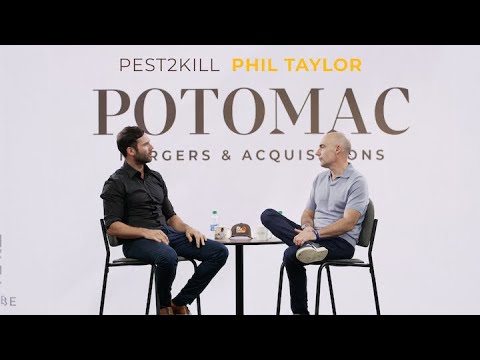
PEST2KILL Owner, Phil Taylor | Live from PestWorld 2023
Interview with Phil Taylor, owner of PEST2KILL, recorded live at PestWorld 2023 in Honolulu, Hawaii, on October 19, 2023. Part of Paul Giannamore's "Off the Record" live coverage of the pest control industry event, touching on the pest control business and related M&A context.
# Channel Presentation Observations — "PEST2KILL Owner, Phil Taylor | Live from PestWorld 2023"
## Format & Presentation
- **Interview-format podcast**, apparently recorded live on-site at **PestWorld 2023 in Hawaii**, with a host interviewing an industry guest.
- Evidence: title "Live from PestWorld 2023"; transcript opens "Carl, it's great to see you. Great to finally meet you."
- The channel (referred to as **"The Buzz"**) is a **podcast**, with content consumed both as episodes and while commuting.
- Evidence: guest describes discovering it: *"there's this podcast. Couple of American guys and yeah, they seem quite slick"*; also *"All these people I've heard… while I'm driving along in my car and putting a face to the voice."*
## Intended Audience
- **Pest control business owners and operators**, primarily US-based but with international reach (guest is from Sydney, Australia).
- Evidence: host and guest compare **US vs. Australian vs. Canadian markets** — subscription models, warranties, seasonality, pricing, and acquisitions.
- Audience is treated as **industry insiders familiar with named figures and companies** (Mike Rogers, Jim McCall/“the Mexican,” Rentokil, Anticimex, Sentricon, Termimesh).
- Evidence: *"You met Jim McCall in the pool. That was a bit of a pinch-me moment"*; host references *"Jim McKelvey's one example. He's got one office… 26 million USD in revenue."*
## Claimed / Demonstrated Scope
- **Educational resource for the pest control industry.**
- Evidence (guest's explicit characterization): *"The Buzz, you know, as a as a educational resource for me has been phenomenal."*
- Content themes demonstrated in this episode:
- **Business growth and recurring revenue** — host: *"It's one of the things that a lot…"* discussing subscription vs. one-time residential service.
- **Marketing and branding** — discussion of Mike Rogers' "billboards" (offices as branding) and pink/green branding.
- **Hiring and workforce culture** — guest describes recruitment strategy: *"you can't train personality."*
- **M&A / valuation** in pest control — host discusses lower Australian residential valuations due to lack of recurring revenue.
- **Live event coverage** — on-the-floor conversations at PestWorld.
## Audience Engagement Evidence
- The channel **receives listener email** and its hosts engage with listeners; the guest was invited on after writing in.
- Evidence: host: *"you sent me an email in about The Buzz… it was probably the most well-written email I've received from a listener."*
- **Community crossover between podcast and industry events** — guests recognize hosts and past interviewees in person.
- Evidence: *"Met some great people… You bump into Jim McDonald in the pool and chance to Matt Rogers and Seth."*
## Host Presentation Style
- **Conversational, lightly humorous interviewing** with rapid topic transitions across business operations.
- Evidence: host jokes *"I'm wondering if you could do the rest of the discussion with an American accent."*
- Host demonstrates **deep industry knowledge**, offering unsolicited market commentary (US Southeast vs. Northeast office strategies, Canadian market shifts).
- Evidence: *"In the Northeast, we don't see that at all… a lot of the pest control firms will use super centers."*
## Summary
The material demonstrates a channel presenting itself as a **US-centric, industry-educational podcast for pest control professionals**, with an interview format, live trade-show coverage, named-industry-figure familiarity, and a demonstrated listener-to-guest pipeline — claims of educational value come directly from the guest's on-air statement rather than channel self-description.
# Delivery Observation: Phil Taylor (Guest) — *Live from PestWorld 2023*
## Format & Setting
- **Conversational interview** between host (Carl) and guest Phil Taylor, recorded live at PestWorld 2023 in Hawaii.
- The host drives structure with direct questions ("What's the weather seasonality like in the Sydney market?", "What are your biggest challenges now today?"), while the guest responds in extended, story-driven answers.
## Guest Delivery (Phil Taylor)
### Tone & Register
- **Consistently warm, modest, and self-deprecating.** A stable pattern throughout:
> "I have a habit of choosing very unglamorous professions. So, I've gone from feet to rats and roaches."
- **Hedging qualifiers appear repeatedly**, softening claims:
- "I would say," "I think," "it seems," "possibly," "for now," "we're happy for now"
- E.g., "Uh we're about 50/50... Um we would love to grow that" and "we we we're going okay."
### Vocabulary & Phrasing Habits
- **Recurring vocabulary:**
- **"Recurring revenue"** — used at least five times (e.g., "that recurring revenue model just helps you build a a better business"), showing it as a core business concept he returns to.
- **"Opportunity"** — repeated framing of markets and staffing (e.g., "there's so much opportunity," "there's a huge amount of opportunity").
- **"Challenge"** — his default label for difficulties (seasonality, subscriptions, hiring), used many times rather than harsher terms like "problem."
- **Australian idioms and colloquialisms:**
> "then it's health for leather" *(likely "hell for leather")*, "old habits die hard," "bit of a pinch-me moment," "we we're kicking on," "clinging on during the winter."
- **Verbal stutter/repetition for emphasis:** frequently repeats initial words — "I I I've been over there," "it's it's it's a massively underrated industry," "we we we're going okay." This is a consistent delivery feature, not isolated.
### Storytelling Pattern
- **Answers history questions with mini-narratives** including specific dates and numbers:
> "I qualified as a podiatrist... in 2008," "that was me, him, and another guy at the point and that was in 2017 and yeah, 2023, we're at 18 employees."
- **Cites a memorable first-sale anecdote:**
> "The guy just says, 'Well, how much?' Pulled a number out of the air and and he said, 'Yeah.'"
### Named-Source Referencing
- **Repeatedly attributes business ideas to external sources** — The Buzz podcast, Mike Rogers ("Those are my billboards"), and industry contacts:
> "So, when he said it, I thought, 'Well, if it's good enough for him, uh maybe I'll give that a go.'"
This is a recurring pattern of framing himself as a learner/adaptor.
## Host Delivery (Carl)
- **Direct, short questions** that pivot topics sharply; uses light humor:
> "I'm wondering if you could do the rest of the discussion with an American accent."
- **Frequently supplies market context and statistics himself** (e.g., the Southeast vs. Northeast office-strategy comparison, Jim McKelvey's "$26 million USD out of one office"), shifting into a teaching/explaining register.
- Uses **affirmation interjections** throughout: "Yeah," "Okay," "Mhm."
## Stable Patterns vs. Isolated Moments
- **Stable:** modest hedging, "challenge/opportunity" vocabulary, recurring-revenue framing, storytelling with dates, self-deprecation.
- **Isolated/uncertain:** The "Mexican"/"Fat Pat" closing banter is a one-off jocular exchange; the accent joke ("I'll I'll I'll give it a go") is a single moment and doesn't reflect his baseline delivery.
## Uncertainty Notes
- Speaker attribution in the transcript is sometimes ambiguous (interview lines aren't labeled); a few quoted lines (e.g., "hell for leather") may contain transcription artifacts.
- The transcript contains no timestamps, so duration-based observations (pauses, pacing) cannot be made.
# Position Record: Phil Taylor (PEST2KILL, Sydney) — Live from PestWorld 2023
## Background & Path into Pest Control
- **Phil Taylor**: British-born, Sydney-based for ~15 years; qualified as a podiatrist in the UK (2008), an "allied health profession, not medical" — he notes "a habit of choosing very unglamorous professions... from feet to rats and roaches."
- Career path: podiatry job in Doha fell through → podiatry in Australia → brief stint welding-inspecting in mines → joined his football teammate **Julian** in pest control in **2017** ("it's not any stranger than any of the other professions... everyone could be a customer").
- Company grew from 3 people (2017) to **18 employees** (2023).
## The Buzz Podcast
- Taylor emailed the show after ~2 years of drafting; his wife — a marketing professional who joined the company ~2 years prior — discovered the podcast via social media.
- He credits The Buzz as a "phenomenal" educational resource.
## Australian vs. US Market — Residential Subscription Resistance
- **Taylor's core claim**: The US residential market is "very in tune with the subscription model"; Australia "really struggles" with residential recurring revenue.
- Residential customers are "very stuck on that annual service"; six-month warranties are "really ingrained" and "expected" culturally.
- Commercial recurring revenue "is fine."
- Plan: possibly introduce **tiered subscription packaging** ("gold, silver, bronze") within the next couple of years.
- He is "not a massive fan of warranties" because six-month warranties conflict with quarterly service models — a stated tension he accepts "for now."
- **Host's counterpoint**: The Canadian market is similar but shifting as US companies enter with monthly billing/quarterly service; change requires operators to collectively "say this is how this works."
- **Taylor's maxim**: "It's very difficult to make the market meet you, you've got to meet the market."
## Business Mix & Strategy
- Business is roughly **50/50 commercial/residential**; focus is on growing commercial (Taylor handles commercial sales).
- Rationale: recurring commercial revenue "helps you build a better business"; residential seasonality forces hard staffing choices.
- Contradiction he acknowledges: he'd "love" 80%+ commercial but finds it "hard to turn down that residential work because it's there" and it "built our business at the start... old habits die hard."
- Residential pricing: **A$295–395** one-time with a **six-month warranty** (competitors offer 12-month warranties, making it "difficult to compete" without one).
- Termite work: ~10–15% of revenue, growing; uses Sentricon-style monitoring ("a little bit greener") and barriers; termite monitoring brings recurring revenue.
## Seasonality (Sydney, subtropical)
- Peak season **October–end of April**; winters are mild and residential demand drops sharply.
- Countermeasure: switched from casual summer contracts to **permanent technicians**, using winter as a training ground — "it's really, really worked."
- New **Department of Education contract** (~200 schools in western Sydney) provides reliable winter recurring revenue.
- Off-season keeps staff busy via training, converting techs to sales, office upskilling.
## Branches Strategy — Inspired by Mike Rogers
- Citing Mike Rogers ("Those are my billboards" — re: his Charlotte offices), Taylor expanded from one office to **three** in Sydney's Eastern Suburbs, with local sponsorship, Chamber of Commerce involvement, and Google local search; plans "a couple more."
- **Host's context**: physical branch presence is a Southeastern US phenomenon; Northeast firms (e.g., Jim McKelvey, $26M from one office) use super-centers instead.
- **Taylor's qualification**: Sydney has similar local neighborhood identity; extra office space also helps with staffing; "for now it seems like a good idea."
## Growth & Demand
- Company has grown ~**60% year-on-year for the last 5 years**, boosted post-COVID (pest control was designated essential in Sydney after a March–April 2020 "biting our nails" slump).
- 2023 demand: "pretty high"; slight **price sensitivity** in residential, slight hospitality slowdown noted; still opening new accounts.
- Positioning: "smaller than the big guys, bigger than the small guys" — big-firm capability with small-firm responsiveness; wants steady growth.
## Staffing & Recruitment
- **Claim**: the best tactic is recruiting from **outside the industry** — "you can't train personality" — then offering career progression.
- Retention pitch in interviews: "I can't promise anything, but we're a growing company and there are opportunities here that I maybe don't know about yet."
- Methods: employee referrals, standard job ads, and a LinkedIn "day in the life" recruitment video (go-karting, team beers) that generated strong interest; applicant volume remains low.
- Technicians currently cover both commercial and residential (scheduling simplicity), though newer techs tend toward residential; Taylor is "not adverse" to splitting as food-manufacturing clients requiring documentation specialists increase.
- Taylor still does rodent work occasionally and is handing those reins to supervisors.
## Marketing — Wife's Role & "Bug Show"
- His wife, ex-destination-marketing professional (Brand USA, Visit California clients), joined ~2 years ago; "transformative" — managing SEO, Google Ads, websites, and creative strategy.
- Flagship program: the **Bug Show** — a termite tech/entomology enthusiast presents spiny leaf insects and burrowing cockroaches at schools/daycares (~once per fortnight, ~2,000 children reached), focused on "looking after the good bugs"; Taylor believes it's unprecedented in the industry.
## Acquisitions
- **Host's framing**: Australian residential valuations are lower due to lack of recurring revenue; acquirers like Rentokil/Anticimex buy one-off-Heavy residential books whose customers don't even track the provider.
- **Taylor**: acquisitions are "always mentioned" and a consideration for the next couple of years — chiefly to acquire **experienced staff**, especially qualified termite technicians who are typically subcontractors or owner-operators. Target profile: smaller firms of **2–4 employees** that fit operationally; "organic growth... can be stressful."
## Industry Perception
- Taylor embraces pest control being underestimated: "I love that we fly under the radar... it's such a good industry" — noting smirks about flying to Hawaii for "PestWorld."
## PestWorld 2023 Takeaways
- First PestWorld; highlights include meeting Jim McCall ("pinch-me moment"), Matt Rogers, and Seth; light closing banter about "the Mexican" and "Fat Pat." He plans to return in future years.
# Speaker Attribution Record: PEST2KILL Owner, Phil Taylor | Live from PestWorld 2023
## Speakers & Roles
- **Host / Interviewer** — Unnamed in transcript; refers to co-hosting "The Buzz" podcast with another American. Likely the show's creator/host (identity not explicitly stated in transcript or metadata).
- **Guest** — **Phil Taylor**, co-owner of **PEST2KILL** (Sydney, Australia). British-born podiatrist-turned-pest-control business owner; handles commercial sales. Explicitly identified in the video title.
## Mentioned Third Parties (Not Present as Speakers)
- **Julian** — Phil's business partner and PEST2KILL co-owner; met by the host.
- **Phil's wife** — PEST2KILL marketing professional (joined ~2 years ago); credited with finding "The Buzz" podcast.
- **Mike and Debbie Rogers** — referenced podcast guests (The Buzz); Mike quoted on offices as "billboards." Mike described as color blind re: pink/green branding.
- **Jim McCall** — met at PestWorld pool ("pinch-me moment").
- **Jim McCall/McKelvey** — host cites a New Jersey operator doing "26 million USD" from one office.
- **"The Mexican" / "Fat Pat"** — industry figures referenced at close; promotional/personal banter, not attributed facts.
- **Matt Rogers and Seth** — met in person at the event.
- Companies referenced: **Rentokil**, **Anticimex**, **Sentricon**, **Termimesh**, **Brand USA**, **Visit California** (former clients of Phil's wife).
## Provenance Notes
- **Setting**: Interview recorded live at **PestWorld 2023, Hawaii**.
- **Guest provenance claims** (self-reported): company size (18 employees), growth rates, revenue splits, pricing (A$295–395 residential), school contract with NSW Department of Education — all from Phil's own account, unverified.
- **Host claims**: US market subscription prevalence, Canadian market comparison, Southeast vs. Northeast office-building trends, Australian acquisition valuations — host assertions, no cited sources.
- **Podcast reference**: "The Buzz" is repeatedly discussed; host notes Phil's listener email. Host's remark that it was "the most well-written email" received is host opinion.
## Promotional Segments
- No explicit third-party promotional or sponsored segments identified in the transcript.
- Banter referencing industry personalities ("The Mexican," "Fat Pat") at the close is informal, not flagged as advertising.
## Availability Limits
- **No curated metadata supplied**; speaker identities, roles, dates, and comment availability beyond the transcript are **unavailable/unconfirmed**.
- Host's name not stated in the source material.
Carl, it's great to see you. Great to finally meet you. Great to be here. Thank you for having me. Your first Pass World. Indeed. Yeah. You came all the way from Sydney. Well, we found out a couple of years ago
it was going to be here in in Hawaii and a 9-hour flight for us from Sydney is kind of short. So, yeah, we thought we'd jump on that one and here we are. So, you're a Briton who lives in Australia. How'd this happen? Yeah, so I I I've been over there say 15 years now. Initially, I qualified as a podiatrist many years many years ago in 2008. Yeah, yeah. I have a habit of choosing very unglamorous professions. So, I've gone from feet to rats and roaches. Okay. I graduated from university in 2008. Got a filler role in a sports hospital in in Doha, funny enough. I was ready to go. Eventually, that job did actually fall through. I ended up a bit of a loose end. I was prepared to leave London. Where am I going to go? I knew Australia. I'd been traveling prior to uni. So, yeah, I I landed a job as a podiatrist in Australia and and and and moved over there. And that went well. I had a brief thing working in the mines in the mining industry. You're not joking about picking unglamorous Yeah, yeah, I know. It's a funny segue. So, I did some welding inspecting in the mines. That was good for the time being. Came back to Sydney and my now business partner, who I'd known for a few years, we played in the same football team or soccer, as you guys call it. He approached me and said, "Look, I'm busy. I've got a good thing here, but I can't take any leave. I'm all over the place. Would you consider joining me? All right, I'll see you then. Pest control, yeah. Okay, you know. It's not any stranger than any of the other professions. Exactly, exactly. Uh I just thought that everyone could be a customer.
Uh I thought there was some seemed like there might be so much opportunity there. Um and yeah, I joined him and and that was me, him, and another guy at the point and that was in 2017 and
yeah, 2023, we're at 18 employees and enjoying it. I uh appreciate you using the word soccer for our American audience. I'm wondering if you could do the rest of the discussion with an American accent. Try that. I'll I'll I'll give it a go. How's that? So, what year did you get involved in Pest Control? Uh 2017. So, 6 years. Okay, so it's really different. Yeah, yeah, yeah. Okay. Yeah. So, you decided to come out here, check out PestWorld. Yep. And how you and I met was relatively recently. You sent an email in about The Buzz and Yep. I did it of course mention on the air that it was probably the most well-written email I've received from a listener. I mean, it took me 2 years to write. I was drafting it, deleting it. So, I I hope I got it right, but Uh but um Yeah, I mean Did you have help with it? No, I didn't. I didn't. It was all my own wording. Uh but yeah, my wife could have would have attested to this that, you know, I was thinking about getting in touch for a little while. Yeah. Um you know, everything, you know, like I said in the in that email was was true. Um I do think The Buzz, you know, as a as a educational resource for me has been phenomenal. How did you stumble upon The Buzz in Australia? Yeah, so it was my wife again. Uh I came home from work one time and she said, "Yeah, you know, there's this podcast. Couple of American guys and yeah, they seem quite slick and started listening to it and uh yeah, you did call you quite sniff, I guess. Yeah. How did your wife find a bug podcast? Yeah. So, my wife actually works in Pest Control. Um she is a
phenomenal marketing professional. Um she was working in uh destination marketing. So, she Some of her clients would be Brand USA, Visit California, very familiar with the American industry
and travel industry. Um and we had uh We've got three children now, but it's after our second child. She couldn't be in the office full-time anymore. Came to join Pest Control and, you know, we've really benefited from having someone of her caliber I just don't think would be potentially interested in the role in the pest control industry. I probably wouldn't have been able to afford her. Right. Um and yeah, it's been transformative for our marketing. Uh she's very creative and and she stumbled upon the buzz as she does in social media and yeah. And from there. So, now that you've listened to it for a while, I mean, what are some of the big distinctions between the Australian market, the US market? Well, I think the main one that I have pulled out of it is the American market is very in tune with the subscription model in the residential market. We really struggle to get that recurring revenue in the residential market. Commercially, it's fine. Um but residentially, people are still very stuck on that annual service. Um it is a challenge and there's companies trying things and it may change, but I think it seems to be a cultural thing. Yeah. Um very difficult to change that. Um we would love it if we could have monthly or quarterly services residentially, but it just doesn't doesn't play out that way at the moment. tempted it? We tried a few things, but it Many companies are offering 6-month warranties and that seems to just be really ingrained in people. Um and I think we will go down that that route eventually, but look, I'm a commercial guy anyway, so I really like looking at
the commercial stuff. I think it may move to that subscription type model, but at the moment it's it is a challenge, yeah. Well, how much of your business now is
commercial versus residential? Uh we're about 50/50. Okay. Yeah. Um we would love to grow that, so we you know, I'm I I look after commercial sales and and we're definitely growing in that side of things. I mean, you guys are based in a major metro area, so commercial makes a lot of sense. Mhm. Um Is your focus more on growing the commercial side or the resi or your Um We are definitely focused on the commercial side of things. I think that recurring revenue model just helps you build a better business. Um It can just be really challenging, the seasonality with residential. You know, do you keep your staff on? Do you let them go? It can be really challenging. Um so we find if we get that solid base of commercial, it really gives you really gives you a stronger business. Yeah. Um so I've learned from you know, you guys again and the recurring and reoccurring revenue talks and um yeah. Yeah, I it's one of the things that a lot You and I were chatting about it yesterday, the Canadian market is very similar to Australia. Yeah. You know, and one of the issues is it's a lot of one-time resi revenue on the Yeah. on the domestic side. So I do though see the Canadian market has changed. Okay. And a lot of the direct or companies that have come from the United States have moved into Canada. That's the only way they do it. They do monthly billing, quarterly service. Yeah. Um so maybe at some point the you know, as we discussed, it's going to take the pest control operators to say, "This is how this works." Yeah, I think if we came together Yeah. and did I I always say, you know, you it's very difficult you you know, to
make the market meet you, you've got to meet the market and I've just found that that that expectation around the annual service is something that can be really hard to to tackle, but we're looking at it and we're looking at, you know,
bringing maybe tiered packaging with subscriptions, you know, gold, silver, bronze, whatever, something based on that. And I think it's something that we'll probably implement within the next couple of years. Um but certainly at the moment I would say our focus is on commercial and hospitality and that sort of things. What's the What's the weather seasonality like in the Sydney market? Yeah, so this is subtropical environment. There's a lot of greenery. Uh there's a lot of pest activity. Um we do have mild winters. And so it kind of shuts down residentially there. So you see a huge decline residentially. And then it all ramps up about this time of year, October, November, we're coming into we're spring summer now. Um and that's when we really see things start to start to move on. Um so yeah, it's it's managing that that winter drop-off. And I think if you don't have a strong commercial base, you will really struggle in Australia. What's termite like in I I know in Western Australia there's a lot of termite pressure. What's it like in Eastern Australia? Yeah, so Eastern Australia Queensland's a real hotspot, so just north of us in the tropical environment. So Brisbane, Gold Coast, and further north. Uh we certainly have a lot of activity in Sydney. Uh and I'd say termites represents probably 10 to 15% of our revenue. Mhm. Um again, a growing division we have there. Um So yeah, it's certainly a a very uh lucrative market as well with the on-selling and and treatments, system installs, barriers, etc. What sort of treatments are you doing in
Australia for termite? Yeah, so termite barriers and termite monitoring systems. So Sentricon. Termimesh type Uh Termimesh would be pre-construction stuff. Yeah, so Sentricon. There's a lot
of other brands. They're very similar to that. Uh and that's the the the one that we favor. Um a little bit greener. Um we do a lot of termite monitoring system installs. So, yeah. And that's again that that that does bring about that subscription, which is yeah, brings in that recurring revenue, which is great as well. You know, when we were chatting yesterday, you were talking about Mike and Debbie Rogers, their discussion on the buzz. Let's talk about that and what you picked up. Yeah. Again and uh met their son yesterday. Me and a lot of people here, a lot of faces. He's floating around. You know you met Jim McCall. Yeah, met Jim McCall in the pool. That was a bit of a pinch-me moment, so yeah. Uh yeah, it's been great. Um Uh the I I think Mike Rogers, what episode was that? First 10? I don't remember. It's It's the one where they were talking about the Maybe it was the first 10. Well, we did two with them. Okay, maybe. Yeah. Um well, in it one thing that stuck with me was Mike spoke about his offices in Charlotte. And Charlotte's I don't know, it's not I guess it's huge city, but he had I think eight or nine, maybe more. I don't know, it's a decent size. Yeah, it's a good size. And I remember him saying, you know, "Those are my billboards." Yes. Is that Is that okay? He used Southern Yeah. Um "Those are my billboards." And he had a very strong that green quote. Yeah, strong and branding. Pink and green. Yes. Yeah. Uh He's color blind, by the way. Oh, okay. Yes, so yeah, that's where that came from. Maybe that explains to you. Um Uh yeah, I took that and I thought at the time we only had one office in Eastern Suburbs of Sydney. We've now got three. So, we're not up to the eight, nine, 10, but I find that's been a great way of us differentiating ourselves from the opposition. Um we now have presence in local areas. We'll then do a bit of the Chamber of Commerce, sponsor a local school. Yeah. Google local search. And it really helps and I I I did use that as my inspiration for that. So, when he said it, I thought, "Well, if it's good enough for him, uh maybe I'll give that a go." So, we'll look at opening a couple more cuz it It been really good. Yeah. You know, that's a Southeastern US
phenomenon. We see that all across the Southeast. These guys will buy small buildings. And even if they just buy a building and rent it out to somebody else, Yeah. they've turned it into a big building.
Yeah. And you'll see, you know, you'll see companies that have 10 million in revenue in the Southeast and they'll literally have 15 or 20 buildings around. Um you know, from a cultural perspective, the Southerners like to do business with local companies in the neighborhood that they can see them. They got a problem, they can show up. Yeah. In the Northeast, we don't see that at all. Okay. You you look up in New Jersey, New York and those areas, a lot of the pest control firms will use super centers. Jim McKelvey's one example. He's got one office. On the day we sold that thing, he was doing 26 million USD in revenue out of one office. Okay. Yeah. So, it's a very different environment down there. Um we're just going with it for now. It's seen now. I just think it's it's a different angle. And I think similar to that you said in the Southeast of the States, um people in Sydney particularly do have that local association with the the part of the city. Um which is great. We have another We have more office space so we can have people working out there. They might be coming from somewhere else in the city. Mhm. Um so yeah, I I I think uh for now it seems like a seems like a good idea and uh yeah. What's the What's the consumer demand for pest services like now here in 2023 in Australia? I would say pretty high. It seems to be quite a thriving industry there. Um certainly post-COVID. Um I mean, our our company's grown with probably 60% year-on-year the last 5 years. So, there's certainly a lot of that has been a big growth post-COVID. Um so, I think the work is certainly there. Um and and Sydney's a great city. It's it's it's relatively easy to get around.
Mhm. Um and you've got a good variety there. So, there is the resi, there's the commercial termite. Um certainly a lot a lot of opportunity there. Yeah. Yeah. And Sydney didn't have the same restrictions during COVID as like
Melbourne did, right? For example. No, it it took a little while then we got listed as an essential service. Um so, we were able to carry on. We had a bit of a slump. I think it was March, April of 2020 when we were biting our nails and thinking is this thing going to survive? Um but after that, things started slowly coming back on and people realized, you know, we we need to get out there. Pest control needs to stay out there. Uh and yeah, we we really kicked on after COVID. For us, I mean, maybe that coincided with the buzz dying, I don't know. Um but that was a real Yeah, we really kicked on after COVID. And you're not seeing any slow demand now here in 2023. Not at the moment. No. Um possibly a little bit of more price sensitivity in the residential market. We have seen a little bit of a slowdown in hospitality potentially. Um For us personally, it's it's going okay and we're still finding that we're we're opening new accounts and and bringing in business. So, we're we're happy for now, yeah. And you know, from a seasonal perspective, everyone here for the most part is getting ready to kind of close shop, so to speak, for the winter. This is the slow period. For you, you're just gearing up now. gearing up. So, September we were onboarding new staff. Um that's really our time to ramp back up again. So, you know, when I get back, start working next week, we'll really be going for the season then and then it's health for leather. So. You know, I got to meet your partner Julian. What Yeah, what sort of aspirations do the two of you have for this business? Oof. Yeah. Um You know what? It's I guess it's changed along the way cuz when he brought me on, I didn't ever really envision us getting to this size. I remember one time saying, "You know what? It'd be so good if we just had five techs, wouldn't it?" And then you get to that mark and then, you know, the goal gets pushed on a little bit. Um
I often say to people that we're in this nice position in Sydney where we're smaller than the big guys, but we're bigger than the small guys. Uh and I think we can we can
service the clients of each of those quite well. I say that we I often say we've got the capability and resources of the big guys, but we've got the responsiveness and attentiveness of those small guys. Uh and we fit somewhere nicely in the middle and I think we're just going to keep growing at a steady rate, I hope, and uh and we'll see what the future holds, but yeah, we're we're enjoying it for now and yeah. Yeah. When your wife came on board, this was within the last year or two? Y- yeah, 2 years ago. 2 years ago. So, what are some of the things she straightened out for you guys? Quite a few things, thinking about it. Yeah. Yeah. Um Look, she coming from that corporate background as well, she just tidied things up in the office. So, there's that Tidied things, but marketing-wise, social media, knows how to manage people that look after websites, knows how to manage the SEO guy, knows how to look after the Google Ads, and then comes up with these creative marketing strategies that we find that kind of sets us apart a bit. So, we do, you know, we we run the bug show, for example. So, this is where one of our um termite technician goes in. He's also a bit of an entomologist. He goes into local schools and daycares and does a bug show. All about looking after the um the good the good bugs in the environment. Yeah. Uh I think we've we've we've seen about 2,000 children in that, so it's been really good. And it's a good way of making that connection with local educational facilities as well. How often do you do the bug show? Uh we've been doing it about once every 2 weeks. Oh. Yeah. Yeah. Okay. It's been uh it's been a great success.
What sort of bugs do you have on display? Uh he's got a few spiny leaf insects, he's got some burrowing cockroaches, things like that. So, yeah, that's
it's been a good hit. Parents, I think some people sometimes confuse, you know, you're a pest control company, why you quite makes sense. Yeah, it's been a nice way of us connecting with those educational facilities and the community as well. So, that's been a great great success and you know, it's really we've really not seen it done before in the industry as well. You know, one thing I'm particularly curious about with regard to Australia is, you know, you've heard us talk quite a bit about the fact that it's been very difficult to find employees. Yes. How How has it been for you guys there? It's always a challenge. And I think it's something that's always spoken about, whether I go to Pesticon in Australia, whether I'm here, it's always staff, staff, staff. How do we get good staff? How do we retain good staff? Um, we have often found that the best tactic is to recruit from outside the industry. Um, you know, the old adage, you can't train personality. So, we really look to build that that team that is going to have great culture, look after each other, and just be great to work with, you know? We always say, if you're going to work at a pest control company, we want ours to be the best one to work at. And we've managed to attract, maybe this is, you know, some of our marketing efforts around that, we've managed to attract maybe some candidates who wouldn't consider this. And and and and try them offer them, you know, some career progression, whether that's sales, whether that's office
support, whether that's termites, whether that's a lead technician role. I'm really trying to nurture them that way, to say, "Look, you know, you can be a tech forever if you want, that's great. I mean, we're always going to want techs."
Yeah. Yeah. But, it's also to say, "Look, if you do the hard yards as a tech, 1 2 years time, you might be a salesman or, you know, you might be in the office." And I and this is is of the things I still say in interviews, when people come in. I say, "Look, I can't promise anything, but we're a growing company and there are opportunities here that I maybe don't know about yet. Uh and if you're you know, if you work well with us, we will look after you." And I think that's really helped us retain great people, which is then kicked on in order to bring bring more people in. And And how have you guys recruited? I would imagine you recruit online, but you also Yeah. Do you go out and approach people? Uh we've Some of it's been word of mouth, referrals from other employees, which is always handy. Uh we did a video this year, recruitment video, which is kind of cool. It was on the uh we've got it on LinkedIn. Uh it was a day in the life of one of our pesties. Yeah. Uh you know, we we dressed it up a little bit. Uh you know, it was it was go-karting going for beers at the end of the day with the rest of the team, but that was really helpful. We got a lot hits on that and a lot of interest. So, that's been one way we've done it. We go on the regular job ads and things like that, but it it is tough, you know, it is tough and there's not a huge amount of applicants coming in. And you know, there's some unsuitable ones as well, but um yeah, for now, we we we've got a really good team. Um I've got some great supervisors that you know, really kick that that team culture going. Um yeah, it's uh it's certainly going to be a challenge, especially when you're growing. Um but for now, we think we we we're going okay. What are your What are your biggest challenges now today?
I would say managing the growth of a seasonal business, I think, and it's not trying to overdo it in the summer and then leaving yourself exposed.
Mhm. Um cuz we made a habit of bringing all our technicians on permanently and we think that that was a real change. Prior to that, I'd say prior to COVID, everyone came on, it was a casual contract. We'd ramp up in the summer. Yeah. These guys leave and then you're looking again. Um and we thought, "You know what we're going to do? We're going to take people on permanently and we're just going to cling on during the winter." and it's really, really worked. We use the winter as a bit of a training ground, uh improve everyone's skills, and then we come back out the other side, have to add maybe a couple more positions, and then we we go again. Um but I would say the challenge is is is managing that seasonality and then the and the workforce and the income. Yeah. It's certainly if we if we can manage that, then you know, we can do quite well. And it's always nice to come out the other side of winter and uh realize you've survived, and then and then go again. So, outside of training, what else are you doing to keep them busy in the off-season? Well, that's basically it. That's basically it. So, um we've converted a couple of guys into salesmen, uh which has helped. We start training people in the office, um giving people more responsibilities in that quiet time. Yeah. Um but yeah, it can be it can be tricky. It really does drop off. You know, we lose so much of that residential work. Um we've been fortunate enough we won a couple of contracts this year with the Department of Education. So, we're looking after some schools, and that really helps us this winter. Um there's about 200 schools
in the western part of Sydney, and that's been really good for us. Um and again, as we talked about that recurring revenue, it's just we we can really count on that. Mhm. Um that's helped us this winter, but yeah, it's certainly a challenge, and
you know, there's I think I think I think it will continue to be for a few years at least. On the residential side, so most of these are customer tracks you guys down as if they've got a pest problem. It's it's a one-time service. And that's usually what your your busy season would be what, 7-8 months of the year? Yeah, I would say our peak season October to end of April. Okay. Yeah. Yeah, and then those requests really drop off. Uh we stay in touch with our customers. We have a We have a good reputation as a company. We We don't lose many customers, and we'll try and get people in for those six-monthly services if we can. Um but again, that that's a huge challenge. You know, you're calling the list from last year. Yeah. Um you know, someone might put it off for another couple of months. who you are. Yeah, yeah, yeah. You know, we're already booked someone else, you know. We do the we remember your name. Was it Pest Control? Was it Pest This, Pest That? It gets a bit like that. Yeah, again, another challenge. Yeah, really difficult. Um but like I said, I think we will have to. Especially as we grow, we're going to have to try and move to some sort of subscription. Um otherwise, we will continue to find challenges around that. What's a typical residential pest control service cost? What's the price for something like Yeah, so with our business, so anywhere from probably 295 to 395. Something like
that. And um so probably a higher one-time cost than in the US. But you may be only getting that one-time cost. Yeah. Um so that's your typical pricing. Some
people will do it a little bit lower than that, but that's yeah, what we what we tend to find. And then you'll give a warranty on that for a period of time? there's a six-month warranty. Yeah. If we don't If we don't offer that, we can't Yeah, it's difficult to compete. The guy down the road's doing 12-month warranty, you know, for example, so it's a tough one. I'm not a massive fan of warranties in pest control. Going to be very difficult to encourage someone to do quarterly services if they've got a six-month warranty. Yeah. So yeah, um but that's just been something that is in the Australian pest control industry that is just expected. Yeah. Um so we'll deal with it for now and Yeah. How much runway is there for you guys on the commercial side there, do you think? I mean Sydney Sydney is a pretty massive market. There's a lot of opportunity there. Yeah, I mean Sydney, what are we good few million people there. Um thriving city. Um there is a lot of opportunity there. So why wouldn't you just focus then entirely on commercials? I think it's been very difficult because we built at the start it was very residential based. So when I joined Julian, I was the one that started to go out cold calling. Cafes, restaurants. I mostly remember the first first sale I got, you know. The guy just says, "Well, how much?" Pulled a number out of the air and and he said, "Yeah." And and we kind of went from there. So it certainly our focus is to gain more
of those commercial clients. We love the hospitality stuff. We do good work in that space. And we are trying to get the larger facilities and things like that. And there's a huge amount of opportunity. We just find it hard to turn down that
residential work because it's there. You know, I I I would love to us 80% commercial and and upwards, but it's difficult to to turn down that residential work that kind of built our business at the start. So I think old habits die hard maybe and I don't mind the residential work, but like, you know, it does create just another you're you're working for it the next year again, you know, you're working hard for it. And Yeah, you know, they take a bit of managing residentially. So you you put a lot more effort into that. But yes, certainly a lot of opportunity in the commercial space. And we are really over the next few years focusing on that. Do your technicians do both commercial and residential or do you have separate techs for that? they Generally, they will cover all bases. Yeah, and I know, you know, I saw guys here in the US people split them. We just found it difficult from a scheduling perspective mainly. And we have technicians who will favor for commercial work. But generally, the guys will will pick up all of it. Yeah, I mean, look, there are a lot of companies that pull that off. I think it's probably helpful over time as you scale to maybe separate that separate that out. I I I'm not adverse to it. Commercial, especially when you start to get into things like food manufacturing. Yeah, it takes a specific type of technician. You need someone who's going to be able to tick the boxes. Yep. Dot the I's and cross the T's as you say, but So I think as we take on more of those customers, those clients, certainly food manufacturing where you need that documentation in place, you do need a specialist. And I, you know, I know the ones that we're going to push into that area. So I think it probably would be something that we would do down the track, certainly.
We tend to use the newer guys on our residential stuff, tend to. Yep. Yeah. But some guys, you know, we we we give them the option. We say, "Hey, what do you prefer? If you want to do all commercial, talk to us. We could probably make it work."
Some guys love residential. I've never been a massive fan of it. Yeah. But I'm a commercial guy and but some people love doing it, so yeah. Do you know how to kill bugs bugs yourself? Not bad. Yeah, I'm not bad. Yeah, when I first It's been a while. Yeah. When I first started, I was out there, you know. We had one mobile phone that me and Jules were sharing and and and he was still the boss then, really, you know. We we're equal partners, but he was still running it, really. And I'd be out there kind of learning the ropes. Do a lot of rodent work. So that's my thing. I'm trying to hand those reins over to some of the the the supervisors. So I do a lot of rodent proofing, things like that. Not so much now, but sometimes I'll get called out. What did your family think? I mean, you were a bug doctor. I I can't claim to be a doctor. So the podiatry qualification in the UK slightly different. Okay. So we're more of an allied health profession. So like a physiotherapist. Okay. So yeah, we're not medical, we haven't been through med school. But yeah, still there was a few raised eyebrows even then. Yeah. Yeah. It was a a of a strange but it's gone so well and you you often get looks from people when you say pest control. I mean, I'm sure you yes. There's a couple of smirks from the guys when we said we're flying to Hawaii for PestWorld and you know. What do you mean PestWorld and you're going to learn about rats and yeah. Yeah, pretty much. Yeah, so I love that we fly under the radar. I love that people underestimate pest control. Yeah. Um because it's such a good industry, it's such a strong industry, there's so much opportunity.
And everyone has that little laugh, but you know. Yeah. We know what's going on. Uh to me, I'm always entertained when Yeah. you know, you see these guys that are worth a hundred million bucks. Somebody say, "Hey, what do you do?" "I'm a pest
control guy. I'm the exterminator." Yeah. And I'm happy that people think that for people to think that. So um Yeah, it's it's it's it's a massively underrated industry and uh yeah, I just I I really enjoy being in it, so. What are you going to do differently? So you're wrapping up for the season now. This year, are there any changes you're making in the business, any whether incremental or drastic? Um not so much. Um like I said, this school's contract has changed things a little bit. Um so there's some management that comes along with that. Um so that's a big one. Um but look, you know, we just want to grow at a comfortable rate. Manage that workforce. Um keep the guys happy and um you know, just come back into into winter next year comfortably. Um so yeah, no no major changes. I don't want to rock the boat too much and and usually we've got everything in place to get going for the season and then there's time to start, you know, knocking the balls out of the park then. At your growth rate, I know you're experiencing production issues where you've got all these customers, but you can't get the work done. So too many customers? Yeah, too many customers for for for the supply of your manpower, so to speak. No, look, usually because we're growing, we can find it the other way. Um so we're we're kind of always at that stage where we want to take more customers on because we've got another technician a guy and we're anticipating the growth. Yeah, exactly. Yeah, so we kind of plan it that way and um Yeah, look, we're we're always on the lookout for more customers. We're always out there. We're always out there trying to sell. Myself and Julian, we go out on the road and we network and we're always looking for those relationships and trying to find those those those clients. So, it's it's
a it's a battle and and yeah, it's it's a good bit of work, but we enjoy doing it and uh yeah. You know, I think about acquisitions in Australia and and I've been involved in
some over the years and I always kind of scratch my head because outside of the commercial realm, you know, when you see like a Rentokil or Anticimex buying a residential business because these businesses don't have recurring revenue. Like, for example, you know, Anticimex buys a pest control business in the middle of Australia that does a million per annum. 80% of that is one done. Yeah. So, now you suck it into Anticimex's system, the name changes, and those customers don't even know who serviced them last year. Yeah. And so, when you look at valuations in Australia, they're quite a bit lower than some other, you know, save for commercial. On the residential side, they're they're quite a bit lower due to the lack of that recurring revenue. Yeah. Cuz that's the fundamental problem, right? Like, if you acquire a recurring account, well, that guy's already on the hook. He's paying. It's just a new service provider. He doesn't even pay attention. Yeah. Um and I bring that up because I was curious if you guys ever thought about acquisitions. I mean, I'd be lying if I said we haven't thought about it. Yeah, it's it's it's all it's always mentioned. Um we know that the big guys are very active in Australia. Um and and like you're saying, buying up some businesses that maybe the deal doesn't quite make sense if you know, when you compare to the US. Um it's something we think about and I think, you know, if you if you build a business that you can sell, even if you're not going to sell it, it's still going to be a strong business, right? So, look, we're we're happy for now. We've
got no plans to move on. But I'm I'm I'm talking about you from an acquisition perspective of going out and acquiring. Oh. Oh, yes. Possibly. Yeah. And And so, why would you do that? I
guess I'm just curious as to, you know, what sort of capabilities, I guess, would you be buying and what for what reasons would you guys go out and do that? So, it's it's something we've talked about. And I think one of the reasons is staff. And experienced staff. Okay. So, yeah, we've done well recruiting people into into the industry, but you don't want to have a you know, a rookie work workforce. And it's very difficult to find well-qualified termite technicians. Okay. Uh they're usually subcontracting or running their own business. Yeah, so uh I think it's something we would consider in the next couple of years, and we have talked about it. And, you know, there's possibly a couple of companies in Sydney that I would, you know, look at. Um It's got to be the right one, something that would fit in with us operationally. Mhm. Um So, yeah, certainly something that we would consider, and I think as the years go on, trying to grow organically might is is is it can be stressful. It's tough work. Yeah. Um so, yeah, I I think we'd we'd definitely be looking around. Just maybe those businesses that are a little bit smaller, you know, two to four employees, something like that would be of interest. Um so, they run well, and yeah. Great. I guess, in closing here, I'm curious about what else you learned here at your first Pest World. What's that? What's that again? What What else What else you learned here at your first Pest World? Oh. Okay. Well, I learned that the Mexican is even more aggressive and terrifying in person. Yeah. I know. I think you want to be just talking. I was thinking about him when you said you can't change personality. Yeah. Yeah. Did he Did he come to mind? Yeah, yeah, yeah. So, yeah.
And and and Fat Pat if he's around. He's a lot slimmer in person, so he is in great shape for Hawaii. Did the Mexican tell you why we call him Fat Pat? It's a state of mind. I I Yes. You can't lose that. Oh, there's the Mexican there. Oh, there he is. Mexican. That's something I Yeah, yeah, yeah. No, it's been it's been great. It's been a great It's been a great week. Met some great people like I said. You bump into Jim McDonald in the pool and chance to Matt Rogers and Seth that I met last night in person. All these people I've heard Yeah. you know, while I'm driving along in my car and putting a face to the voice now and it's Yeah, no, it's been it's been really good. I think we'll be I think we'll be at this whatever year now. So Yeah, great. Listen, it's been awesome to meet you. It's been fun to run into you today. Yeah, thanks for having me. Cheers.