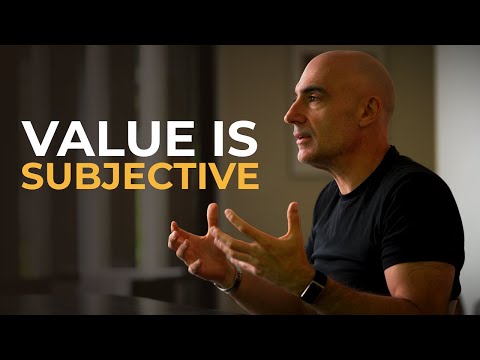
Understanding the True Range of Your Business’s Value |…
A Valuation MasterClass Moment in which Paul Giannamore explains why a business's value should be understood as a range rather than a single number. Topics include the difference between strategic value and investment value, how market conditions and sale timing affect the value range, and how to prepare years in advance to position at the top of the range when planning an exit. Timestamps cover: introduction to valuation ranges, strategic vs investment value, market conditions impact, timing your sale, and positioning for maximum value.
# Video Identity Observations: "Understanding the True Range of Your Business's Value | Valuation MasterClass Moment"
## Creator Self-Description (Explicit Claims)
- **Paul Gammore (transcript spelling varies: "Gammore" / "Jammore")** introduces himself directly:
> "Hi, I'm Paul Gammore. I'm an investment banker and I negotiate for a living."
- He references an affiliated firm, **"PTOIC"** (as heard in transcript):
> "What I hear most often from our clients here at PTOIC is the extreme value in working with us years in advance of a sale."
- He frames the video as part of a **"master class series"**:
> "And feel free to share this master class series with somebody who you think might benefit from it."
- The title itself labels the content a **"Valuation MasterClass Moment"**, indicating a series format on business valuation.
## Intended Audience
- **Business owners considering a sale**, on either short or long timelines:
> "If you've got a sale on the horizon, whether it be 6 months from now or 5 years from now, we'd love to have a chat with you."
- **Prospective clients** for his firm's advisory services — the video ends with a direct call to action:
> "Please use the contact form below in the description to reach out to us today."
- Implied secondary audience: viewers who might **share the content** with others who could benefit.
## Claimed Scope of Content
- Business **valuation**, framed conceptually rather than technically:
> "Today, we're going to talk about valuation and why it's not just about the numbers. Valuation is storytelling."
- Services the firm claims to provide:
- "help establish a fair market value in a range of investment values for the client"
- "provide them a roadmap of everything they could possibly do in order to increase value and decrease risk in anticipation of a future sale"
## Observable Presentation Patterns (Demonstrated, Not Claimed)
- **Educational, narrative-driven teaching style**: uses a single extended case study (Halo's acquisition of starbelly.com for $240 million during the dot-com bubble) to illustrate that valuation is subjective:
> "A business doesn't have one value. It is not objective. It's subjective."
- **Conversational, informal tone** with rhetorical repetition and humor:
> "What's your business worth? To whom? ... To your cousin Eddie who's got no money and no capacity to pay, it's worth something entirely different."
- **Hybrid content/lead-generation format**: the bulk of the video is instruction; the closing segment pivots to a promotional pitch and contact call-to-action.
- **Episodic series conventions**: standard outro signaling continuity:
> "Thank you for joining me today and I'll see you on the next one."
## Notes on Evidence Limits
- No curated metadata was supplied; all observations derive from the title and transcript alone.
- The firm name appears only as spoken ("PTOIC" per transcript), which may be a transcription of a differently spelled name — no invention of the official spelling is made here.
# Delivery Observation: "Understanding the True Range of Your Business's Value"
## Speaker & Format
- Self-introduced expert framing: **"Hi, I'm Paul Gammore. I'm an investment banker and I negotiate for a living."** — credentials established in the first sentence.
- The video opens as a **mini-lecture** and closes as a **promotional pitch** for the firm ("PTOIC"), followed by a sign-off: *"Again, I'm Paul Jammore. Thank you for joining me today and I'll see you on the next one."*
## Tone & Register
- **Conversational, informal teaching tone** — uses casual asides and rhetorical questions:
- *"To whom? What's your business worth? To whom?"*
- *"I mean, what sort of would pay $240 million for a website..."*
- Uses **humorous hypothetical characters** to make abstract points concrete: *"your cousin Eddie who's got no money and no capacity to pay."*
## Vocabulary & Framing Devices
- **Central metaphor repeated as a thesis:** valuation as storytelling.
- *"Valuation is storytelling."*
- *"It's a story buyers tell themselves about risk, about cash flow, and about the future."*
- Later echoed: *"that was ultimately a story, a narrative that the buyer told itself."*
- **Second repeated metaphor:** value as beauty.
- *"beauty really is in the eye of the beholder when we talk about valuation"*
- Restated near the end: *"just like beauty, value really is in the eye of the beholder."*
## Teaching Habits
- **Anchors concepts in a detailed case study** (Halo's acquisition of starbelly.com), including specific figures: $240 million, $800K revenue, $5 million loss, "300 times revenue."
- **Pre-emptively flags the example's extremity:** *"I know it's an absurd example, but it proves the point here."*
- **Simplifies jargon into plain descriptions:** *"a company that does branded trinkets, right? You know, mugs and pens with IBM or AT&T on it."*
- **Dramatizes dialogue within the case study**, quoting the bankers directly: *"Hey, there's this new technology... it's out in the ether and it's going to destroy your business."*
- Uses the **punchline-summary structure** — after each example, restates the lesson: *"So, that's an example of how valuation actually is subjective."*
## Communication Patterns
- **Repetition for emphasis**: key phrases ("to whom," "story," "eye of the beholder") recur deliberately.
- **Direct address to the viewer** at the close: *"If you've got a sale on the horizon... we'd love to have a chat with you."* plus a call to action and request to share the series.
- Emphasis through intensifiers: *"very, very wrong,"* *"extreme value,"* *"absurd example."*
## Uncertainty Notes
- Based on a single ~4-minute transcript; patterns like the case-study habit and closing pitch appear once here and may reflect this video's format rather than a stable series-wide pattern (though the phrase "master class series" and "the next one" suggest a recurring format).
- Timestamps are coarse; exact timing of delivery features cannot be pinpointed.
- The transcript contains apparent transcription artifacts (e.g., "what sort of would pay," "scared the living out of"), so quoted wording may not match spoken audio exactly.
# Observation Record: "Understanding the True Range of Your Business's Value | Valuation MasterClass Moment"
## Speaker
- **Paul Gammore** (self-identified in transcript; also rendered "Paul Jammore" at the close — transcription inconsistency, same speaker), an **investment banker** who states he "negotiates for a living."
## Central Claims
### 1. Valuation is subjective, not objective
- Gammore asserts **valuation is storytelling** — "a story buyers tell themselves about risk, about cash flow, and about the future."
- A business does not have **one value**; it depends on the buyer:
- To the owner: one value.
- To "cousin Eddie who's got no money and no capacity to pay": something entirely different.
- To a publicly traded industry behemoth that could acquire the company and capitalize on its technology: something different again.
- His standard response to "What's my business worth?" is: **"To whom?"**
- He summarizes: "beauty really is in the eye of the beholder when we talk about valuation."
### 2. Case study: Halo's acquisition of Starbelly.com
- Gammore describes it as an **"absurd example"** that "proves the point":
- Halo paid **$240 million** for a website with, per Gammore, **no real technology**, generating **$800K in revenue**, and **losing $5 million a year**.
- Context: at the height of the **dot-com bubble** (he says "dot bubble").
- **Stated reason for the price:** 29-year-old founders **Brad Keywell and Eric Lefkowsky** (transcript: "Lefowski") hired investment bankers who "scared the living [daylights]" out of Halo's management by claiming the web would destroy their business unless they paid up.
- **Outcome claimed:** Halo's management "bought that line," paid $240 million, and the business "ended up in bankruptcy."
- **Counterfactual claim:** "There was no one else on the planet who was going to pay that" — no one else would pay **300 times revenue** for the website.
- **Qualified aside:** Eric and Brad "of course thought they could take that business public for a billion dollars. Maybe." — Gammore flags this as speculative ("Maybe"), even under dot-com bubble conditions.
- **Underlying narrative:** Halo was an "old-world promotional products company" (branded mugs, pens for IBM/AT&T) selling via account representatives; Starbelly pitched branded online apparel/cup stores for employees. Halo's management "listened to this nonsense," told themselves a story about risk, and "their story happened to be very, very wrong."
### 3. Promotional segment (PSC/PTOIC)
- Gammore reports the most common client feedback: the value of working with his firm **years in advance of a sale**:
- Establishing a **fair market value** and a **range of investment values**.
- Providing a **roadmap** to increase value and decrease risk before a future sale.
- Call to action: contact via the form below; share the master class series.
## Reasoning Pattern
- Framework: value ≠ single objective number → value = buyer-specific narrative about risk/cash flow/future → illustrated via an extreme case (Starbelly/Halo) → concludes value is "in the eye of the beholder."
## Preserved Qualifications & Tensions
- The dot-com-bubble context is offered as a **mitigating consideration** ("notwithstanding...") yet the $240M price is still framed as unjustifiable by any other buyer.
- "Maybe" — Gammore explicitly declines to endorse the founders' $1B IPO expectation.
- Case-study framing is admitted as "absurd," i.e., an extreme illustration, not a typical transaction.
- Promotional claims about client outcomes are attributed to what Gammore says he "hears most often from our clients" — self-reported, not independently evidenced in the transcript.
# Speaker Attribution & Provenance Record
## Video Identification
- **Title:** Understanding the True Range of Your Business's Value | Valuation MasterClass Moment
- **Video ID:** `01a168c7-9a79-77e7-b84c-91b20e6580d0`
## Speakers & Roles
| Speaker | Role | Evidence |
|---|---|---|
| Paul Gammore (spoken as "Paul Gammore"; closing says "Paul Jammore") | **Creator / host** | Self-introduction: *"Hi, I'm Paul Gammore. I'm an investment banker and I negotiate for a living."* Solo speaker throughout. |
> **Note:** The transcript contains a spelling inconsistency in the speaker's surname ("Gammore" at open, "Jammore" at close). No metadata is supplied to resolve it.
- **No guests, narrators, or other speakers** appear in the transcript.
## Referenced Third Parties & Claims
- **Halo / Starbelly.com acquisition** — cited as illustrative example:
- Purchase price of **$240 million** for a website with **"$800K in revenue and losing $5 million a year"** (per speaker's account).
- **Brad Keywell and Eric Lefkofsky** (transcript: "Lefowski") described as founders, age ~29 at the time, who "hired investment bankers."
- Outcome claimed: Halo "ended up in bankruptcy."
- All third-party transaction details are **speaker-narrated claims**, with no cited documents or external sources in the transcript.
## Promotional Segments ⚠️
- **End-of-video promotion** for the speaker's firm (**"PTOIC"** — as transcribed):
- Offers valuation services, "roadmap" for increasing value before a sale.
- **Call to action:** contact form in video description; share the "master class series."
- Flagged as a promotional segment, distinct from the instructional content.
## Availability & Metadata Limits
- **No curated metadata supplied** (no channel, publish date, or comment information).
- **Comment availability:** unknown / not stated.
- Timestamps are absent from the transcript; no time-coded attribution possible.
Hi, I'm Paul Gammore. I'm an investment banker and I negotiate for a living. Today, we're going to talk about valuation and why it's not just about the numbers. Valuation is storytelling.
It's a story buyers tell themselves about risk, about cash flow, and about the future. Whenever a business owner asks me, "What's my business worth?" My response is always the same. To whom? What's your business worth? To whom? To you? It might be worth one thing. To your cousin Eddie who's got no money and no capacity to pay, it's worth something entirely different. Now, of course, the publicly traded behemoth in your industry, it
might be worth something entirely different. A business that can acquire your company and capitalize on the technology that you've built over the years. So a business doesn't have one
value. It is not objective. It's subjective. And beauty really is in the eye of the beholder when we talk about valuation. The discussion we had about Halo's acquisition of starbelly.com. I know it's an absurd example, but it proves the point here. I mean, what sort of would pay $240 million for a website that had no real technology generating $800K in revenue and losing $5 million a year. Now, I know it was at the height of the dot bubble. But notwithstanding,
there was one reason why Halo paid $240 million for Starbelly. It was because 29-year-old Brad Keywell and Eric Lefowski hired investment bankers. And
those investment bankers scared the living out of Halo's management team. They came in and said, "Hey, there's this new technology. It's the web.com. It's out in the ether and it's going to destroy your business. So unless you guys pay up, we're going to take over." And unfortunately for Halo and its shareholders, management bought that line and ended up paying $240 million for that business. And it ended up in bankruptcy. There was no one else on the planet who was going to pay that. You know, Eric
and Brad of course thought they could take that business public for a billion dollars. Maybe. I mean, again, it was the height of the dot bubble, but there was no one else that was going to pay
300 times revenue for a website. So, that's an example of how valuation actually is subjective. And that was ultimately a story, a narrative that the buyer told itself about risk and about cash flow. They looked at Starbelly and said, "Well, wait a second. We've got this oldworld promotional products company." So, it's a company that does branded trinkets, right? You know, mugs and pens with IBM or AT&T on it. They were selling them through account representatives at the corporate level. Starbelly came in and said, "Hey, we'll take this and we'll give IBM or AT&T its own branded apparel store so employees
can log in and get themselves an IBM cup." Halo's management team listened to this nonsense and then told themselves a story, a story about risk. And their
story happened to be very, very wrong, unfortunately. So that demonstrates the subjective nature of value. So, just like beauty, value really is in the eye of the beholder. What I hear most often from our clients here at PTOIC is the extreme value in working with us years in advance of a sale. Not only do we help establish a fair market value in a range of investment values for the client, but we provide them a roadmap of everything they could possibly do in order to increase value and decrease risk in anticipation of a future sale. If you've got a sale on the horizon, whether it be 6 months from now or 5 years from now, we'd love to have a chat with you. Please use the contact form below in the description to reach out to us today. And feel free to share this master class series with somebody who you think might benefit from it. Again, I'm Paul Jammore. Thank you for joining me today and I'll see you on the next one.