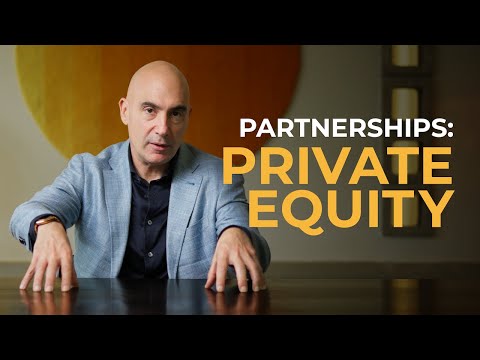
Why Partner with Private Equity? Scenarios & Strategic…
A clip from a private equity masterclass Q&A in which Paul Giannamore explains why business owners partner with private equity firms. Topics include common motivations (valuation, liquidity, growth capital, strategic expertise), how equity roll structures work, partial exits versus 100% change-of-control transactions, structuring platform and add-on acquisitions, and key considerations when evaluating PE partners.
# Channel Identity Observations — "Why Partner With Private Equity?"
## Intended Audience
- **Business owners considering a sale or PE partnership** — the entire framing is from the seller's perspective:
> "why would a business owner actually want to partner with private equity?"
- Specifically owners of **mid-market businesses** — example valuations cited are $50M–$75M enterprises, plus a smaller "$10 million or $20 million waste management firm" scenario.
- Sub-segments addressed explicitly:
- Owners near retirement wanting a **full exit** ("somebody who's 60 years old and says… I want to sell my business")
- Mid-career owners wanting **partial liquidity while retaining control** ("I'm 45 years old… I'd like to be the majority shareholder")
## Claimed Scope
- Positioned as part of an **educational M&A series**: "M&A Masterclass Moment" (title) and stated in-transcript:
> "later in this series, I'm going to talk extensively about how business owners can think about the differences between private equity firms, how to do your own due diligence on PE firms"
- Covers **sell-side M&A advisory scenarios**: auction processes, strategic vs. PE buyers, equity rollovers, platform vs. add-on acquisitions, minority vs. majority sales.
## Self-Description Evidence
- Creator identifies himself by name: **"I'm Paul Gammore."**
- Claims **active deal practice**, not just commentary:
> "that's what I see in my day-to-day work life" and "We do dozens of those every year."
- Provides **direct client services solicitation**:
> "if private equity's reached out to you, feel free to reach out to me. You can contact me on the contact form below in the description as well as you can always reach me on LinkedIn."
## Demonstrated Presentation Patterns (Observable)
- **First-person deal anecdotes as teaching tools** — e.g., a detailed $75M sale where the seller rolled $15M into NewCo and took $60M cash.
- **Jargon defined inline for a lay audience** — "rolling… means rolling some equity into new co"; "when I say platform, I mean it's a portfolio company."
- **Persona-based scenario structure** — walks through distinct seller archetypes ("the typical seller," "the next typical after that") rather than abstract theory.
- **Conversational, direct-to-camera style** with informal delivery ("um," "so on and so forth") suggesting a low-production personal brand format rather than polished corporate content.
## Claims vs. Demonstration Distinction
- **Creator claims:** active deal flow ("dozens… every year"), an ongoing educational series, advisory availability.
- **Demonstrated:** fluency in sell-side M&A mechanics, comfort with valuation specifics, audience-first pedagogy, and a lead-generation close — but the volume of deals claimed is not independently verifiable from this material.
# Delivery Observation: "Why Partner With Private Equity?"
## Speaker & Format
- Single presenter, **Paul Gammore**, speaking directly to camera in an educational "Masterclass Moment" format.
- Conversational first-person framing anchored in his own practice: *""Let's think about this from my day-to-day work life."*
## Tone
- **Conversational and advisory**, not lecture-like: casual fillers ("um," "you know," "so on and so forth") appear throughout, giving a spoken, unscripted feel.
- **Pragmatic and deal-focused** — heavy emphasis on concrete numbers and outcomes rather than theory.
## Teaching Habits & Structure
- **Scenario-based teaching**: builds the lesson around seller personas rather than abstractions.
- Scenario 1: the reluctant 60-year-old seller who exits via a PE platform deal.
- Scenario 2: the 45-year-old owner wanting liquidity while keeping control.
- Scenario 3: 100% change-of-control deals ("plain vanilla" platform add-ons).
- **Defines jargon inline** as it arises:
- > "And when you say rolling, that means rolling some equity into new coco [NewCo]."
- > "when I say financial sponsor, I use that interchangeably with private equity."
- **Concrete numeric examples** are a signature move:
- > "Last year, I ran a process on a business um that ultimately sold for $75 million."
- > "they wanted to put $60 million down in cash and have the owner roll $15 million."
- **First-person credibility framing**: repeatedly anchors claims in his own deal flow — *"The one that I come across most often," "That's the typical seller that I would come across on a day-to-day basis," "We do dozens of those every year."*
## Vocabulary & Recurring Phrases
- Domain terms used repeatedly: **"platform" / "platform acquisition," "roll equity," "new co," "strategics," "run a process" / "full process," "portfolio company," "add-on acquisitions," "change of control," "chips off the table."**
- Framing device of ranking frequency: *"the one that I come across most often"* → *"the next typical after that."*
- Vivid colloquialisms to humanize sellers: *"I have all of my chips in this basket," "my CFO is a glorified accountant."*
## Rhetorical & Engagement Patterns
- **Direct quotation of imagined client speech** to illustrate personas:
- > "It might be somebody who's 60 years old and says, 'Hey, Paul, I want to sell my business.'"
- > "Well, I'm 45 years old. I've got a business that's worth 50 million bucks."
- **Series of rapid rhetorical questions** to model the seller's decision process: *"do I want to sell 70% of the business, 80%...? How much do I want to pull out?"*
- **Forward-referencing / episodic hooking**: *"And later in this series, I'm going to talk extensively about..."*
- **Closing call-to-action with self-identification**: *"if private equity's reached out to you, feel free to reach out to me... I'm Paul Gammore. Thanks for joining me today. I'll see you on the next one."*
## Stable Patterns vs. Isolated Moments
- **Stable, repeated**: numeric example-building, inline definitions, persona construction via quoted client dialogue, first-person deal experience framing.
- **Isolated**: the $75M case study appears once; the "3x return" figure and "45 plus million" projection are single-use and framed as idealized ("in a perfect world") — not a general claim.
## Uncertainty Notes
- The transcript contains apparent transcription artifacts ("new coco," "weight man waste management," "NCO") that likely reflect transcription of "NewCo" rather than the speaker's vocabulary — noted as uncertainty about exact spoken words.
- Tone and delivery pacing beyond word choice (e.g., gestures, emphasis) are not observable from the transcript alone.
# Video Position Record: "Why Partner With Private Equity?"
**Speaker:** Paul Gammore (self-identified at end of transcript), M&A advisor; all positions below are his, drawn from his day-to-day deal work.
## Central Question
Why would a business owner actually want to partner with private equity? Gammore answers through seller archetypes and a worked example.
## Seller Scenario 1: The Reluctant Exiter
- **Most common case he encounters:** an owner (e.g., ~60 years old) with *no interest* in a PE partnership who simply wants the best exit price.
- **Process:** a full auction including both PE firms and strategics; PE firms sometimes emerge leading on **price and terms**.
- **Key mechanism — "rolling equity":** PE buys a majority (e.g., 85%) while the owner retains a stake in the new company ("NewCo").
### Worked Example ($75M sale, last year)
- Strategics and most PE firms valued the business in the **$50–60M** range.
- One PE firm wanted it as a **platform acquisition** at **$75M**, structured as **$60M cash at close + $15M rolled into NewCo**.
- The PE firm **required** the seller roll equity despite the owner's reluctance and disinterest in running the company going forward.
- **Seller's stated logic:** the cash alone matched others' all-in bids, so the rolled $15M equity was "for free."
- **Outcome:** management team runs the business; PE hired an **operating partner** to replace the selling shareholder; add-on acquisitions continue.
- **Forward projection (Gammore's):** PE targets at least a **3x return**, so in a "perfect world" the seller's 15% could yield "$45 plus million" at exit in 3–6 years — explicitly framed as ideal, not guaranteed.
## Seller Scenario 2: The Growth-Oriented Majority Owner
- **Profile he describes:** ~45 years old, business worth ~$50M, wealth concentrated in the business, believes it can reach $100M.
- **Motivations stated:** partial liquidity ("take some chips off the table" — $5–20M), **retain majority control**, stay CEO, gain a partner for:
- Acquisitions (no prior experience)
- Marketing revamp
- Hiring a real CFO (current one described as "a glorified accountant")
- **Process:** formal process run as usual; strategics included to gauge valuation and options; ends with a small set of interested PE firms.
- **Decision variables for seller:** sell 70%, 80%, or 90%; how much to roll into NewCo; ongoing participation.
- **Gammore's caution:** this seller type must be **deliberate** and do **due diligence on the PE firm**, because firms "are all very different yet they sound the same — even to me."
## Scenario 3: 100% Change of Control / Platform Add-Ons
- PE deals also occur as **100% change-of-control** sales, common in industries like lawn care, fire protection, and waste management.
- **Platform definition he gives:** a portfolio company of a PE fund (e.g., PE firm ABC's fund owns waste management company XYZ), which then makes its own acquisitions.
- **Target option:** sell 100%, or sell only ~80% and convert part of the price into equity of the platform company, becoming its partner.
- He calls these "pretty plain vanilla deals," done "dozens" per year.
## Terminology Notes
- **Financial sponsor** used interchangeably with **private equity**.
- **Platform acquisition** = the PE firm's foundational portfolio company in an industry/geography.
## Forward References & CTA
- Later in the series: how owners can differentiate PE firms, conduct their own PE due diligence, and make decisions.
- He invites contact via the description's contact form or LinkedIn ("I'm Paul Gammore").
## Preserved Qualifications
- The 3x/$45M+ outcome is conditional ("ideally," "in a perfect world").
- The $75M example owner "wasn't wild" about rolling and had no interest in running the business — the roll was a PE requirement, not a preference.
- Speaker hedges his own expertise on distinguishing PE firms ("they sound the same even to me").
# Speaker & Provenance Observation Record
## Video Identification
- **Title:** Why Partner with Private Equity? Scenarios & Strategic Considerations | M&A Masterclass Moment
- **Video ID:** `01a168c7-e905-79da-aee4-19990eae670d`
- **Curated metadata:** None supplied beyond the title; roles inferred from transcript only.
## Speaker Inventory
| Speaker | Role | Evidence |
|---|---|---|
| **Paul Gammore** | **Creator / Host** | Self-identifies at close: > "I'm Paul Gammore. Thanks for joining me today." Speaks throughout in first person about his deal work. |
- **No guests, narrators, or other speakers** appear; the transcript is a single-voice monologue.
## Role Notes
- Speaker addresses the audience directly as an **M&A advisor / intermediary** ("my day-to-day work life," "we run a full process," "we would run a formal process like we always do").
- References a future continuation of a series: he will later discuss **differences between private equity firms and how to do due diligence on PE firms**.
## Cited Sources & Third-Party Claims
- **No external sources, publications, or third-party data** are cited. All content is the speaker's first-person professional anecdotes and general market commentary.
- **Anonymized case study:** the speaker recounts an unnamed business he represented that "sold for $75 million" last year, with $60M cash at close and $15M rolled equity into "NewCo." No party names, dates, or documents provided.
## Promotional Segments ⚠️
- **Closing call-to-action:** speaker solicits viewer contact:
> "if private equity's reached out to you, feel free to reach out to me. You can contact me on the contact form below in the description as well as you can always reach me on LinkedIn."
- Flagged as **self-promotion / lead generation** for the speaker's advisory services.
## Availability & Uncertainty
- **Comment availability:** Not indicated in the supplied material.
- **Timestamps:** None present in transcript.
- Terms are defined within the talk (e.g., "rolling" = rolling equity into NewCo; "financial sponsor" used interchangeably with private equity; "platform" = portfolio company).
So, why would a business owner actually want to partner with private equity? Let's think about this from my day-to-day work life. The one that I come across most often is the business owner who actually has no interest in
partnering with private equity. He or she just wants to exit the business. It might be somebody who's 60 years old and says, "Hey, Paul, I want to sell my business. I want to get the absolute best price I can for it. We run a full process, meaning we go out to private equity firms. We go out to strategic acquirers. We run a process and we get to the end and lo and behold, the private equity
firms are leading in terms of terms and price. Now, that owner has to look back and say, "Well, man, I never thought about partnering with a private equity firm, but this priv private equity firm
said my business would be a great platform acquisition, and the price is right, the terms are right. I'm not wild about rolling. And when you say rolling, that means rolling some equity into new coco. That means, for example, the private equity firm buying 85% of the business and the owner retaining 15%. But sometimes what happens is, I'll give you an example. Last year, I ran a process on a business um that ultimately sold for $75 million. And the majority of the strategics in the private equity firms from a valuation perspective were in the 50s
and 60s. We had one private equity firm that wanted that company as a platform and was willing to pay 75 million bucks for it. Um but they wanted to put $60
million down in cash and have the owner roll $15 million uh into NCO. So the owner would walk away with $60 million and own a percentage or 15 million in equity of the new company. And while the owner wasn't wild about that, was not interested in running that company going forward, the private equity firm made it a requirement that the seller roll equity and be a partner. And the seller looked at it and said, "Well, wait a minute. Even with the cash that I get at the closing, I am just as good as the all-in purchase price from everyone else that was at the table. So, I got $15 million in rolled equity for free. I'm going to do that deal. Now, that particular owner sold that business last
year, took a step step back. His management team is running that business and the private equity firm is now continuing to do add-on acquisitions. They've hired an operating partner. So, they've gone out into the industry.
They've replaced that selling shareholder. They put a new individual in charge of that business. Now they're doing add-on acquisitions. He got a 60 million bucks and now he owns 15% of new co. And when that private equity firm exits 3, four, 5, 6 years down the line, he'll get ideally a return on that investment. Of course, that private equity firm is focused on at least a 3x
return on that money. So in a perfect world, he walks away with 45 plus million. That's the typical seller that I would
come across on a day-to-day basis. I would say the next typical after that would be the seller who says, "Well, I'm 45 years old. I've got a business that's worth 50 million bucks. I um I don't have any money outside of that, right? Like I have all of my chips in this basket. The business is growing well. I think I can take it to 100 million. Um, but it would be nice to have some additional investment capital. I certainly would like to take some quote unquote chips off the table. I'd like some liquidity. I'd like to be able to pull 5, 10, 15, $20 million out of this business now in order to buy the vacation home, take the vacation, do the types of things that I want to do while still maintaining control of this
business. I want to be the majority shareholder. I want to be able to call the shots. But I would like to have a partner that can help me do acquisitions because I've never done acquisitions before. that can help me revamp my marketing program, that can help me hire
a CFO. I don't, you know, my CFO is a glorified accountant at this point. I really could get a new CFO, but I'm not quite sure how to do that or the best way to go about it. So, in that particular case, we would run a formal process like we always do. Um, we would bring in strategics always because the strategics help us get an understanding of valuation um and option. Um, but we would end up with a small handful of private equity firms that would have expressed interest in that business. And the seller could now start to think through, do I want to sell 70% of the business, 80% of the business, 90% of the business? You know, how much do I want to pull out? How much will I want to roll into new co? What sort of participation will I have going forward? Most of the time they want to continue to be CEO. Um, and so they might find themselves in a situation where they're a platform acquisition for a private equity firm looking to get into that industry in a particular geography. They can roll equity, remain on a CEO, the private equity firm backs them, allows them to do acquisitions, so on and so forth. Private equity deals also come in the flavors of 100% change of control. And that's often when you know you might have a lawn care business or a fire protection company or a waste management firm that is owned by a private equity firm. It is a platform of a private equity firm. And when I talk about platform, I mean it's a portfolio company. You got private equity firm ABC has a fund. That fund invested in the weight man waste management industry and owns waste management company XYZ. Now waste management company XYZ the portfolio company is now going out making acquisitions right and typically the targets of that XYZ waste management firm would have the ability to either sell 100% do 100% change of control deal with Waste Management XYZ or at times would also be able to roll equity. So, they might sell their business. Maybe they've got a $10 million or $20 million waste management firm. They might be able to sell that $20 million firm and sell only 80% of it and now convert some of that purchase price into equity of XYZ. So, now they're a partner of the platform portfolio company. Um, and they've taken some size sizable capital off the table of 70 80 90%. That's a pretty plain vanilla deal. We do dozens of those every year. We see those all the time. Um I think from a participation perspective when you start to think about private equity, the guys that actually have to be deliberate about this process is the second individual. The individual who wants to continue to grow the business, wants to take on a financial sponsor. And when I say financial sponsor, I use that interchangeably with private equity. Wants to take on a private equity firm and partner with that private equity firm. um grow the business and exit at some point in the future. That's when the seller needs to do a lot of due diligence on the private equity firm because they're all very different yet they sound the same even to me. And later in this series, I'm going to talk extensively about how business owners can think about the differences between private equity firms, how to do your own due diligence on PE firms, and how to make a decision. So, if private equity's reached out to you, feel free to reach out to me. You can contact me on the contact form below in the description as well as you can always reach me on LinkedIn. I'm Paul Gammore. Thanks for joining me today. I'll see you on the next one.